Socialism Vs. Capitalism

Place for books, articles, and websites with content that connect or detail Anabaptist theology
Post Reply
Ken
Posts: 21863
Joined: Thu Jun 13, 2019 12:02 am
Location: Washington State
Affiliation: former MCUSA

Re: Socialism Vs. Capitalism

Post by Ken »

Robert wrote: ↑Tue Aug 09, 2022 5:51 pm
Ken wrote: ↑Tue Aug 09, 2022 4:27 pm Quoting from the very first page of the article

Socialism: “an economic system characterized by
social ownership of the means of production.” In
other words, the resources are owned and managed
by and for the benefit of a group (family, business,
local community, country.
This does not state how it works. This is just a general idea. Please explain briefly how this would work. My eye is really bad today and I can not read long posts well. This is why I am asking for a brief description of the workings of it, not the idea of it.
Ken wrote: ↑Tue Aug 09, 2022 4:27 pm As noted in the article, the US is really a mixed economy.
Just because something is government run, does not mean it is socialistic. If it is run, but still gives the individual choices, it is not what I would call socialism. This is why I am asking how you see it working.
Government-owned is what makes a sector of the economy socialist not government-run.

Traffic on the highways is government-run. The state troopers are out there to enforce traffic laws and they run the show. But the cars and trucks aren't government owned.

By contrast the public schools are both government owned and government run. Therefore that section of the economy meets the definition of socialist. Private for-profit schools would be the capitalist counterpart. Religious non-profit schools that do not have a profit motive are sort of in the middle.
1 x
A fool can throw out more questions than a wise man can answer. -RZehr
Josh

Re: Socialism Vs. Capitalism

Post by Josh »

They are not in the middle but rather are a third, rather unexplored category.

In a just world, nearly everything would be provided by nonprofits instead of large, faceless corporations. Think of the difference between a community credit union and a giant megabank.
0 x
Ernie

Re: Socialism Vs. Capitalism

Post by Ernie »

Ken wrote: ↑Tue Aug 09, 2022 6:06 pm Government-owned is what makes a sector of the economy socialist not government-run.

Traffic on the highways is government-run. The state troopers are out there to enforce traffic laws and they run the show. But the cars and trucks aren't government owned.

By contrast the public schools are both government owned and government run. Therefore that section of the economy meets the definition of socialist. Private for-profit schools would be the capitalist counterpart. Religious non-profit schools that do not have a profit motive are sort of in the middle.
This is helpful IMO.
0 x
Ken
Posts: 21863
Joined: Thu Jun 13, 2019 12:02 am
Location: Washington State
Affiliation: former MCUSA

Re: Socialism Vs. Capitalism

Post by Ken »

Josh wrote: ↑Tue Aug 09, 2022 6:11 pm They are not in the middle but rather are a third, rather unexplored category.

In a just world, nearly everything would be provided by nonprofits instead of large, faceless corporations. Think of the difference between a community credit union and a giant megabank.
I guess it is how you define things. I see them in the middle.

A private university like say Harvard isn't government owned and run. It isn't a capitalist money-making enterprise established for the purpose of return on investment by shareholders unlike say University of Phoenix. But Harvard does still compete in the free market for students and research dollars and everything else that a university does. So it is subject to market forces that a subsidized state university might not be but isn't trying to make a profit for shareholders or "capital" By contrast, a small Mennonite school is obviously different and not really in the marketplace at all but more of closed private endeavor.

I'm not sure that non-profits are an unexplored category. There is plenty written about them. They just don't fit neatly into the capitalist vs socialist continuum.

I think there is a role for all three in our economy. There are plenty of sectors of the economy that require public investment or very close public regulation in order to operate efficiently and fairly for the benefit of the entire public. Fire fighting, for example. There was no public fire department in ancient Rome. Marcus Crassus, one of the richest Romans in history would show up at buildings on fire in Rome with his platoons of slave firefighters and use extortion to buy up the burning building at "fire sale" prices and only then would he proceed to put the fire out. That is how he built his wealth.

On the other hand, large enterprises like airlines or automobile manufacturers are probably best left to the corporations. State-run airlines or auto companies generally don't do well and they are probably too large to run through some sort of community co-op.

But I agree that organizations that are smaller and closer to the public like a community credit union are generally better. They are also much more likely to take into account local issues and concerns than a faceless megabank from out of state.
0 x
A fool can throw out more questions than a wise man can answer. -RZehr
Josh

Re: Socialism Vs. Capitalism

Post by Josh »

Ken wrote: ↑Tue Aug 09, 2022 8:35 pm
Josh wrote: ↑Tue Aug 09, 2022 6:11 pm They are not in the middle but rather are a third, rather unexplored category.

In a just world, nearly everything would be provided by nonprofits instead of large, faceless corporations. Think of the difference between a community credit union and a giant megabank.
I guess it is how you define things. I see them in the middle.

A private university like say Harvard isn't government owned and run. It isn't a capitalist money-making enterprise established for the purpose of return on investment by shareholders unlike say University of Phoenix. But Harvard does still compete in the free market for students and research dollars and everything else that a university does. So it is subject to market forces that a subsidized state university might not be but isn't trying to make a profit for shareholders or "capital" By contrast, a small Mennonite school is obviously different and not really in the marketplace at all but more of closed private endeavor.
No serious person thinks that universities aren't giant money making enterprises. It's just a question of whom it makes money for. Harvard provides large amounts of power and influence to the elite. Likewise, state universities tend to have athletics departments with coaches getting million-dollar salaries.

In contrast, a small Mennonite school is not a "closed private endeavour" but rather seeks to serve the community around it, often educating children of people besides just its own sponsoring church's members' children.
I think there is a role for all three in our economy. There are plenty of sectors of the economy that require public investment or very close public regulation in order to operate efficiently and fairly for the benefit of the entire public. Fire fighting, for example. There was no public fire department in ancient Rome. Marcus Crassus, one of the richest Romans in history would show up at buildings on fire in Rome with his platoons of slave firefighters and use extortion to buy up the burning building at "fire sale" prices and only then would he proceed to put the fire out. That is how he built his wealth.
Where I live (and most of America is this way), we are served by volunteer fire departments. The fact Rome had nobody volunteering speaks to the poor character of the Roman people, not the necessity of having government-run fire departments.

There is no need to have government fire departments to put out fires. Volunteer fire departments can do just fine, and in fact it is a sign of health in the community when they are thriving.
On the other hand, large enterprises like airlines or automobile manufacturers are probably best left to the corporations. State-run airlines or auto companies generally don't do well and they are probably too large to run through some sort of community co-op.
I'm not sure I'd agree. The big automobile manufacturers forced through a lot of changes into society that weren't desirable and got so big, they lobbied the government to drive passenger rail out of business so that people would be forced to buy cars or ride buses. I don't think that's good at all.
But I agree that organizations that are smaller and closer to the public like a community credit union are generally better. They are also much more likely to take into account local issues and concerns than a faceless megabank from out of state.
There is really no reason to have gigantic megacorps at all. We end up with "too big to fail" institutions that rob the people blind and pillage the national wealth.

0 x
Ken
Posts: 21863
Joined: Thu Jun 13, 2019 12:02 am
Location: Washington State
Affiliation: former MCUSA

Re: Socialism Vs. Capitalism

Post by Ken »

Josh wrote: ↑Tue Aug 09, 2022 10:54 pmWhere I live (and most of America is this way), we are served by volunteer fire departments. The fact Rome had nobody volunteering speaks to the poor character of the Roman people, not the necessity of having government-run fire departments.

There is no need to have government fire departments to put out fires. Volunteer fire departments can do just fine, and in fact it is a sign of health in the community when they are thriving.
I'm not sure how things work where you live but around here and everywhere else I have lived the volunteer fire departments are public taxpayer funded organizations supported by local tax levies and fire districts. The only thing "volunteer" about them is the fire fighters. The buildings, fire trucks and other equipment is funded by tax dollars as is the training, just like any other government agency. And many of the larger ones have salaried chiefs, dispatchers, etc. In other words, they are taxpayer supported government run organizations that just use volunteer labor for the actual fire fighting.
Josh wrote: ↑Tue Aug 09, 2022 10:54 pmI'm not sure I'd agree. The big automobile manufacturers forced through a lot of changes into society that weren't desirable and got so big, they lobbied the government to drive passenger rail out of business so that people would be forced to buy cars or ride buses. I don't think that's good at all.

There is really no reason to have gigantic megacorps at all. We end up with "too big to fail" institutions that rob the people blind and pillage the national wealth.
I'm not sure how you do that short of very active government control over the economy of the sort that people here would label "socialist"
0 x
A fool can throw out more questions than a wise man can answer. -RZehr
User avatar
Robert
Site Janitor
Posts: 12078
Joined: Wed Oct 19, 2016 4:16 pm
Affiliation: Anabaptist

Re: Socialism Vs. Capitalism

Post by Robert »

Ken wrote: ↑Tue Aug 09, 2022 6:06 pm
Government-owned is what makes a sector of the economy socialist not government-run.

Traffic on the highways is government-run. The state troopers are out there to enforce traffic laws and they run the show. But the cars and trucks aren't government owned.

By contrast the public schools are both government owned and government run. Therefore that section of the economy meets the definition of socialist. Private for-profit schools would be the capitalist counterpart. Religious non-profit schools that do not have a profit motive are sort of in the middle.
This helps me understand your perspective, but I see it differently. Government controlled production is what makes a society or economy socialist. I do not see infrastructure owned and managed by government as socialist, if that government is a representative of the citizenry. Government only structures may lean that way, but military and governing structures would not.

There are private roads and highways, so public roads are an option. This is not socialism, just as you shared about schools. States, federal, county and private roads are all options.

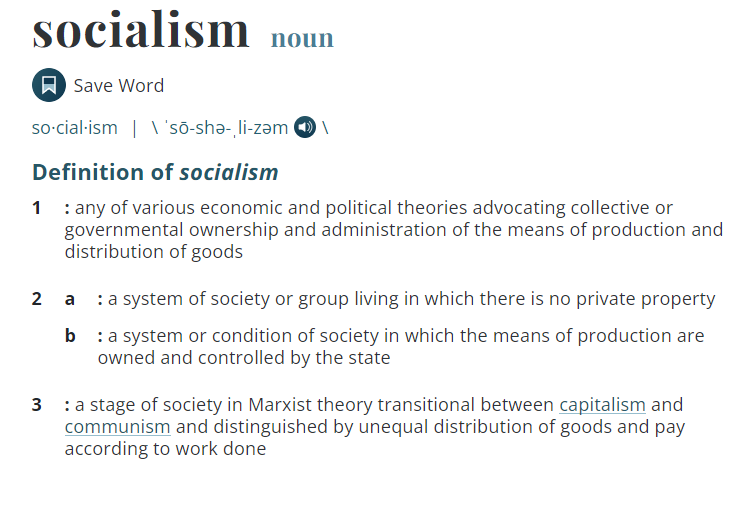
Image

Is says where there is no public property. Government options are not socialism if there are other options.
0 x
Try hard not to offend. Try harder not to be offended.
I think I am funnier than I really am.
Josh

Re: Socialism Vs. Capitalism

Post by Josh »

Ken wrote: ↑Tue Aug 09, 2022 11:32 pm
Josh wrote: ↑Tue Aug 09, 2022 10:54 pmWhere I live (and most of America is this way), we are served by volunteer fire departments. The fact Rome had nobody volunteering speaks to the poor character of the Roman people, not the necessity of having government-run fire departments.

There is no need to have government fire departments to put out fires. Volunteer fire departments can do just fine, and in fact it is a sign of health in the community when they are thriving.
I'm not sure how things work where you live but around here and everywhere else I have lived the volunteer fire departments are public taxpayer funded organizations supported by local tax levies and fire districts. The only thing "volunteer" about them is the fire fighters. The buildings, fire trucks and other equipment is funded by tax dollars as is the training, just like any other government agency. And many of the larger ones have salaried chiefs, dispatchers, etc. In other words, they are taxpayer supported government run organizations that just use volunteer labor for the actual fire fighting.
Josh wrote: ↑Tue Aug 09, 2022 10:54 pmI'm not sure I'd agree. The big automobile manufacturers forced through a lot of changes into society that weren't desirable and got so big, they lobbied the government to drive passenger rail out of business so that people would be forced to buy cars or ride buses. I don't think that's good at all.

There is really no reason to have gigantic megacorps at all. We end up with "too big to fail" institutions that rob the people blind and pillage the national wealth.
I'm not sure how you do that short of very active government control over the economy of the sort that people here would label "socialist"
Pretty simple actually: the government stops permitting large corporate structures which shield owners and stockholders from liability, and stops letting big corps lobby and control legislation.

Likewise. The government stops subsidising automakers, like the recent IRA bill does to an absurd degree.
0 x
Ken
Posts: 21863
Joined: Thu Jun 13, 2019 12:02 am
Location: Washington State
Affiliation: former MCUSA

Re: Socialism Vs. Capitalism

Post by Ken »

Josh wrote: ↑Wed Aug 10, 2022 7:40 am
Ken wrote: ↑Tue Aug 09, 2022 11:32 pm
Josh wrote: ↑Tue Aug 09, 2022 10:54 pmWhere I live (and most of America is this way), we are served by volunteer fire departments. The fact Rome had nobody volunteering speaks to the poor character of the Roman people, not the necessity of having government-run fire departments.

There is no need to have government fire departments to put out fires. Volunteer fire departments can do just fine, and in fact it is a sign of health in the community when they are thriving.
I'm not sure how things work where you live but around here and everywhere else I have lived the volunteer fire departments are public taxpayer funded organizations supported by local tax levies and fire districts. The only thing "volunteer" about them is the fire fighters. The buildings, fire trucks and other equipment is funded by tax dollars as is the training, just like any other government agency. And many of the larger ones have salaried chiefs, dispatchers, etc. In other words, they are taxpayer supported government run organizations that just use volunteer labor for the actual fire fighting.
Josh wrote: ↑Tue Aug 09, 2022 10:54 pmI'm not sure I'd agree. The big automobile manufacturers forced through a lot of changes into society that weren't desirable and got so big, they lobbied the government to drive passenger rail out of business so that people would be forced to buy cars or ride buses. I don't think that's good at all.

There is really no reason to have gigantic megacorps at all. We end up with "too big to fail" institutions that rob the people blind and pillage the national wealth.
I'm not sure how you do that short of very active government control over the economy of the sort that people here would label "socialist"
Pretty simple actually: the government stops permitting large corporate structures which shield owners and stockholders from liability, and stops letting big corps lobby and control legislation.

Likewise. The government stops subsidising automakers, like the recent IRA bill does to an absurd degree.
People would find a way around it quickly. If you cap the size of corporations then you just end up with 10 different Fords with the same owners working together. One Ford corporation does the engines. One does the electronics, one does the frames, one does the transmissions, etc. You add a layer of inefficiency to no apparent end.
0 x
A fool can throw out more questions than a wise man can answer. -RZehr
Ken
Posts: 21863
Joined: Thu Jun 13, 2019 12:02 am
Location: Washington State
Affiliation: former MCUSA

Re: Socialism Vs. Capitalism

Post by Ken »

Robert wrote: ↑Wed Aug 10, 2022 5:00 amIs says where there is no public property. Government options are not socialism if there are other options.
Sure, it is all how you decide to define things. If your definition of socialism is a society with no private property then the only society on the planet that might be socialist would be North Korea and I'm not even sure about that.

And by extension nothing happening in the US or any other country short of North Korea could ever be called socialist or socialism because we will always have private property of some sort.

I'm not sure that is a very useful definition.
0 x
A fool can throw out more questions than a wise man can answer. -RZehr
Post Reply