Jazman wrote: ↑Sat Oct 11, 2025 8:26 pm It sounds like he did more than just "speak out about" it... Why is he taking a dispute between himself and his church to a national media outlet?
He's a public figure with a public brand (a coffee shop and roastery). I don't see anywhere the Bible says that we have to be silent when spiritual abuser occurs.
Excommunication should not be happening because someone expresses a political view that someone in church leadership disagrees with. If it does, that's spiritual abuse... and I think it's always the right thing to speak up and expose spiritual abuse when it happens.
Suppose your description of the situation was accurate. How should a Bible-believing Christian go about doing that, in light of New Testament teaching?
Should he appeal to Caesar against the church?
0 x
1. Are we discussing the topic? Good.
2. Are we going around and around in a fight? Let's stop doing that.
3. Is there some serious wrongdoing or relational injury? Let's address that, probably not in public and certainly not for show.
Jazman wrote: ↑Sat Oct 11, 2025 8:26 pm It sounds like he did more than just "speak out about" it... Why is he taking a dispute between himself and his church to a national media outlet?
He's a public figure with a public brand (a coffee shop and roastery). I don't see anywhere the Bible says that we have to be silent when spiritual abuser occurs.
Excommunication should not be happening because someone expresses a political view that someone in church leadership disagrees with. If it does, that's spiritual abuse... and I think it's always the right thing to speak up and expose spiritual abuse when it happens.
Suppose your description of the situation was accurate. How should a Bible-believing Christian go about doing that, in light of New Testament teaching?
Should he appeal to Caesar against the church?
What does the government have to do with this discussion?
Bootstrap wrote: ↑Sat Oct 11, 2025 2:13 pm
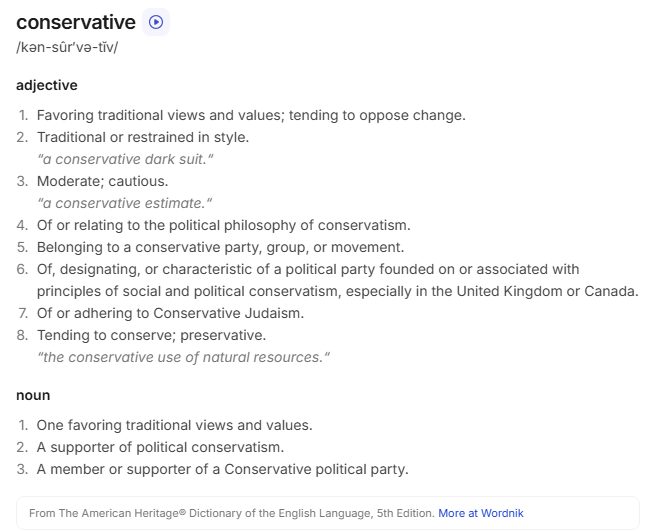
Do you think any of the dictionary senses in your definition are the same thing as faithful discipleship to the Bible as Christians?
"Favoring traditional views and values; tending to oppose change"
Ephesians 4:14-15 ESV so that we may no longer be children, tossed to and fro by the waves and carried about by every wind of doctrine, by human cunning, by craftiness in deceitful schemes. (15) Rather, speaking the truth in love, we are to grow up in every way into him who is the head, into Christ,
Lots about God not changing too.
0 x
Try hard not to offend. Try harder not to be offended.
I think I am funnier than I really am.
Bootstrap wrote: ↑Fri Oct 10, 2025 1:13 pm
Yeah, I don’t mean it literally. But evangelism was mostly about getting people to pray the sinner's prayer, and supporting the Republican party was one of the major themes at the time of Reagan and after. I bought into it, too - I ran for precinct delegate as a Republican back in that time. Political involvement was seen as a major sign of living out the Christian life.
Boot, my exposure to evnagelicalism is that supporting the Republican party is not really centered at all - although opposing abortion, supporting laws against abortion or gay marriage, etc., often are.
It is coincidence that the Republican party sometimes supports these causes. If the Democrats wanted to support life and support pro-life causes, they'd find a lot more evangelicals very interested in supporting them.
Since the 1980s, “white evangelical Protestant” has become a standard political category in political surveys because of consistent Republican alignment (75–80% since 2004).
But many who identify as evangelical in polls don’t attend church or hold orthodox beliefs. So “evangelical” is often mostly as a cultural or political identity. That's very different than it was in the time before Reagan.
What I always heard was WASP - White Anglo-Saxon Protestant. (Nothing about 'Evangelical'.)
Favoring traditional views and values; tending to oppose change"
Ephesians 4:14-15 ESV so that we may no longer be children, tossed to and fro by the waves and carried about by every wind of doctrine, by human cunning, by craftiness in deceitful schemes. (15) Rather, speaking the truth in love, we are to grow up in every way into him who is the head, into Christ,
Lots about God not changing too.
And I'm with you on this, especially where it means putting our trust in the Bible. I do think "traditions of men" need to be tested against the Bible. And I think it's clearer to say "Bible believing" than "conservative", which gets mixed up with so many other issues and identities.
1 x
1. Are we discussing the topic? Good.
2. Are we going around and around in a fight? Let's stop doing that.
3. Is there some serious wrongdoing or relational injury? Let's address that, probably not in public and certainly not for show.
Here's an overview of the political and Old Testament background of some of the key words found in the New Testament gospel message. Produced with help from GPT. Most of this, I think, is not controversial, it's easy to see how these words are used in the Septuagint translation of the Old Testament (LXX) and in classical Greek literature.
I think it's important to remember that this is political language used by Greek and Roman emperors, but also language used in the Old Testament. And religion and politics are not cleanly separated in either. In ancient Israel, politics and religion were inseparable. The king was anointed by God, and his rule was supposed to reflect God’s covenant. National assemblies (qāhāl YHWH) were both religious (standing before God) and political (deciding laws, leaders, wars). Priests, prophets, and kings each had roles that blended civic and religious authority.
Politics and religion were also intertwined in Greek city-states. The city (polis) was both a political and a religious community. The ekklesia (citizens’ assembly) deliberated on laws and wars but always with reference to the gods. Religious festivals, sacrifices, and oaths were woven into civic life. Civic titles like Savior (sōtēr) or Lord (kyrios) could apply both to gods and to political leaders.
Key NT Words with Political Significance
1. Titles of Jesus (Identity & Kingship)
- Anointed One, Messiah, Christ – Χριστός (*Christos*)
LXX: translates Hebrew *Mashiach* (anointed king). Political: royal office, rival to Caesar.
- Lord – Κύριος (*Kyrios*)
LXX: rendering of YHWH. Civic: also a title for rulers and the emperor.
- Savior – Σωτήρ (*Sōtēr*)
LXX: God as deliverer. Civic: emperors hailed as “Savior.”
- Son of God – υἱὸς τοῦ θεοῦ (*huios tou theou*)
LXX: Israel/Davidic king as "son." Civic: Caesar called *divi filius* (“son of the divine”).
3. Community/Assembly
- Assembly, Church – ἐκκλησία (*ekklēsia*)
LXX: Israel’s *qāhāl* (assembly before God). Attic: citizens’ lawmaking assembly.
- Synagogue – συναγωγή (*synagōgē*)
LXX: *ʿēdāh* (congregation). NT: narrowed to Jewish local assembly/building.
4. Kingdom & Power
- Kingdom, Reign – βασιλεία (*basileia*)
LXX: God’s kingship. Civic: monarchy/royal rule. NT: God’s reign breaking in.
- Power, Authority – ἐξουσία (*exousia*)
LXX: divine authority. Civic: legal/civic authority, magistrates.
- Ruler, Governor, Prince – ἄρχων (*archōn*), ἡγεμών (*hēgemōn*)
LXX/civic: rulers of cities/provinces. Used in NT for both earthly and spiritual powers.
5. Eschatology (Future & Coming)
- Coming, Royal Visit – παρουσία (*parousia*)
LXX: presence/arrival. Civic: formal imperial visit. NT: Christ’s return.
- King – βασιλεύς (*basileus*)
LXX: Israel’s kings, God as king. Civic: monarchs/emperors. NT: Jesus as true King.
Takeaway:
The NT writers chose vocabulary already loaded with political resonance.
From the LXX, these words link Jesus to Israel’s covenant and God’s kingship.
From Attic and civic Greek, they carry the weight of assemblies, rulers, decrees, and kingdoms.
Together, they proclaim: Jesus is King, His people are the true assembly, and His reign challenges all rival claims.
0 x
1. Are we discussing the topic? Good.
2. Are we going around and around in a fight? Let's stop doing that.
3. Is there some serious wrongdoing or relational injury? Let's address that, probably not in public and certainly not for show.
JohnH wrote: ↑Sat Oct 11, 2025 8:56 pmHe's a public figure with a public brand (a coffee shop and roastery). I don't see anywhere the Bible says that we have to be silent when spiritual abuser occurs.
Excommunication should not be happening because someone expresses a political view that someone in church leadership disagrees with. If it does, that's spiritual abuse... and I think it's always the right thing to speak up and expose spiritual abuse when it happens.
Suppose your description of the situation was accurate. How should a Bible-believing Christian go about doing that, in light of New Testament teaching?
Should he appeal to Caesar against the church?
What does the government have to do with this discussion?
I think the toxic media soup in The Blaze is closely linked to Caesar, and speaks Caesar's language on behalf of Caesar.
The New Testament sets the standard for Christian speech. Every logos (word) and every rhēma (utterance) is accountable before God (Matt 12:36). That includes political opinions — they don’t get a free pass. Christian speech must be gracious (Col 4:6), truthful yet gentle (Eph 4:15), free from slander (Col 3:8), and aimed at building up (Eph 4:29). For Christians, the same standards apply to political discourse as to every other kind of speech: Jesus is Lord over our words, too.
I think that's something churches should teach. It is counter-cultural, we live in a country where churches are told we need to be more political, mixing religion with secular politics. Our politics should be the politics of Jesus.
0 x
1. Are we discussing the topic? Good.
2. Are we going around and around in a fight? Let's stop doing that.
3. Is there some serious wrongdoing or relational injury? Let's address that, probably not in public and certainly not for show.
JohnH wrote: ↑Sun Oct 12, 2025 4:46 pmYou’ve spoken publicly on this forum before how you rejected church discipline and an excommunication from a group that tried to do that to you.
Why is it wrong when someone else does it?
I'll answer this in the other thread.
0 x
1. Are we discussing the topic? Good.
2. Are we going around and around in a fight? Let's stop doing that.
3. Is there some serious wrongdoing or relational injury? Let's address that, probably not in public and certainly not for show.