Safetyism

Place for books, articles, and websites with content that connect or detail Anabaptist theology
R7ehr
Posts: 2030
Joined: Sat Sep 14, 2024 9:51 pm
Affiliation: C. Mennonite

Safetyism

Post by R7ehr »

This is an excerpt from the August 2025 issue of The Sword and Trumpet, article in the Newsline's section written by Hans Mast.

I think this well lays out my problem with the unrelenting drive towards safety in America. Because it only considers safety achieved without counting the cost of that achievement. Appropriate risk is beneficial.
Safetyism’s Cost: When Good Intentions Backfire

What if our efforts to stay safe are actualy kiling thousands more people every year than they save? We’ve always been told to “err on the side of safety,” but could that very instinct be causing far greater harm than the dangers we fear most?

Daniel Kahneman argues in Thinking, Fast and Slow that people are inherently poor at understanding relative statistical risk due to the way our minds rely on quick, intuitive judgments rather than careful analysis. That has caused us to engage in some safety efforts that are counterproductive.

Consider car seat laws. Research shows mandating car seats for older children did save about 57 lives in 2017. But that same year, these mandates discouraged an estimated 8,000 births because many vehicles can’t accommodate three car seats, deterring families from having a third child. Since 1980, this unintended result may have led to 145,000 fewer children born.

Research shows that COVID-era school closures, aiming to keep children "safe" caused substantially more harm than good. Children endured unprecedented learning loss, mental health crises, and billions in projected future economic losses, despite being the demographic least at risk from the virus.

Safetyism's impulse also influenced our response to nuclear energy, driving policies dominated by rare but dramatic fears of nuclear disasters like Chernobyl (1986) and Fukushima (2011). Yet researchers show that shifting away from nuclear power toward coal, oil, and gas has resulted in vastly greater harm. Per kilowatt-hour, nuclear energy causes far fewer deaths than even the safest fossil fuels. On the other hand, the least safe, coal, kils around 350 times more people than nuclear, primarily through routine polution rather than headline-making accidents.

Germany's nuclear phase-out following Fukushima led directly to increased fossil fuel usage, adding roughly 1,100 premature deaths each year. Japan’s post-Fukushima nuclear shutdown similarly caused thousands of excess deaths due to heightened air polution and costly winter heating. Globally, nuclear power had already prevented about 1.8 million deaths between 1971 and 2009 by displacing fossil fuels. Fear-driven anti-nuclear policies, aimed at preventing extremely rare reactor incidents, have likely resulted in tens of thousands of additional deaths already—and milions more could die prematurely by 2050 if these policies persist.

Here are a few more examples:
• Opioid Crackdown: Cracking down on prescription painkillers made addicts switch to deadlier drugs like heroin and fentanyl, increasing overdoses.
• Iraq War: Fearing imaginary weapons led to a war that caused chaos, violence, and strengthened terrorism.
• Afghanistan War: Aimed at preventing terrorism, the lengthy war destabilized Afghanistan and ended with the Taliban back in power.
• Wildfire Suppression: Preventing smal fires for decades built up fuel, leading to massive wildfires.
• Floodwalls in New Orleans: Floodwalls gave false security, amplifying destruction during Hurricane Katrina.
• 1976 Swine Flu Vaccine: Rushed vaccinations against a pandemic that never came caused severe ilnesses and deaths instead.
• Antibiotic Overuse: Overprescribing antibiotics created resistant superbugs, causing untreatable infections.
• Excessive Cleanliness: Over-sanitizing childhood environments increased alergies and asthma due to underdeveloped immune systems.
• Overprotective Parenting: Constant supervision prevented children from developing resilience, leading to increased anxiety.
• Footbal Helmets: Hard helmets designed for protection allowed players to tackle dangerously, causing more severe brain injuries.
• Avoiding Flying after 9/11: Fearful travelers drove instead of flying, unintentionaly causing more deaths from road accidents.
• 2008 Financial Bailouts: Banks took bigger risks believing the government would save them, laying groundwork for future financial crises.

Each case above is based upon clear evidence or a lot of careful study, they are not merely theoretical.

Safety measures can backfire in five main ways.
First, risk compensation means people become careless, believing safety features protect them.
Second, moral hazard arises when protections make individuals or organizations behave recklessly because they aren't facing the full consequences.
Third, unintended consequences happen in complex systems—like ecosystems or societies—when solving one problem creates another.
Fourth, overprotection can weaken resilience, making people or systems vulnerable when eventualy exposed to risk.
Lastly, decisions based on fear often lead to overreaction, trading one danger for an even worse one due to panic-driven decision-making. Understanding these patterns can help us implement safety measures more thoughtfuly and effectively.

Safety is undeniably valuable. But maximal safety, pursued without thoughtfuly weighing ripple effects and trade-offs, frequently backfires. History repeatedly demonstrates that fear-based policies often underestimate human behavior and overestimate their own wisdom, creating greater harm than the risks they sought to avoid.
Last edited by ohio jones on Thu Jul 31, 2025 11:47 pm, edited 1 time in total.
Reason: formatting
1 x
Ken
Posts: 21863
Joined: Thu Jun 13, 2019 12:02 am
Location: Washington State
Affiliation: former MCUSA

Re: Safetyism

Post by Ken »

He makes some good points but does get some things wrong.

For example, COVID school closures weren't about protecting children who everyone knew were at low risk from COVID. They were about reducing the rate of spread of the disease to more vulnerable people because kids are perfect disease vectors. Millions of at risk people older worked in schools, drove school buses, etc. And many children live in multi-generational households with vulnerable elderly people at home. In-person schools can't operate without putting millions of vulnerable adults at risk. You can't have functional schools if only the children show up but none of the adults. But yes, they should have opened schools back up as soon as vaccines because available.

We have the technology to make soft and much safer football helmets. The reason we don't is the sporting goods manufacturers really don't want to change how they operate. Which is a scandal about which a lot has been written.

And the only reason we had a opioid crisis in the first place was corporate greed. That is a very very sordid tale that has nothing to do with risk. And the reason we cracked down on prescription abuse was not safety. But to stop the drug companies from ruining millions of lives and creating addicts for profit. Some addicts turned to fentanyl. But doctors and the medical profession worked enormously hard to wean people off prescription drugs. So that really wasn't a safety issue. There are some radical folks out there promoting safe use of drugs to homeless drug user types. But they are on the fringe.

With respect to antibiotics. By far the biggest user and abuser of antibiotics is the livestock and poultry industry. Yes, people overuse them too but that is why they are prescription drugs. Not because they are unsafe. It is virtually impossible to OD on antibiotics. Acetaminophen which is available over the counter is far more dangerous

All the stuff about nuclear power is dead on though. The biggest problem with nuclear is that the nuclear industry (at least in the US) is not safety but that it seems incapable of operating without enormous cost overruns. While wind and solar keep plummeting in price.

One thing he doesn't mention is the whole current moral panic about trans people. There are hundreds of things that pose far greater threats to children than the notion that they might be trans. Or want to use pronouns or nicknames that make some adults uncomfortable. But we've wrapped ourselves completely around the axle on that one to an absurd degree.

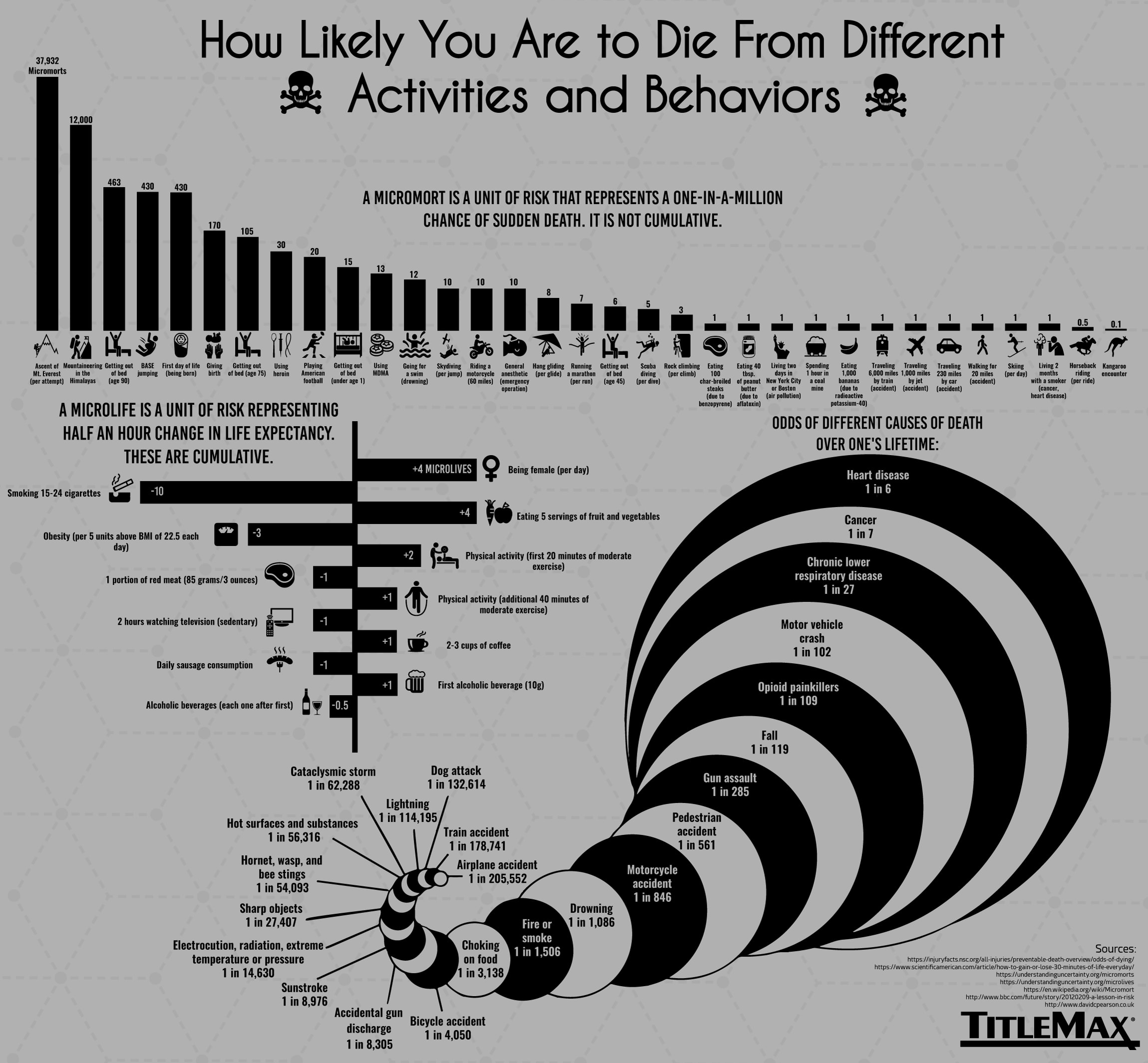
But yes, Americans are absolutely horrible at risk assessment. Here is a good chart on that subject

Image
0 x
A fool can throw out more questions than a wise man can answer. -RZehr
R7ehr
Posts: 2030
Joined: Sat Sep 14, 2024 9:51 pm
Affiliation: C. Mennonite

Re: Safetyism

Post by R7ehr »

Ken wrote: Fri Aug 01, 2025 12:03 am One thing he doesn't mention is the whole current moral panic about trans people. There are hundreds of things that pose far greater threats to children than the notion that they might be trans. Or want to use pronouns or nicknames that make some adults uncomfortable. But we've wrapped ourselves completely around the axle on that one to an absurd degree.
Oh but he did mention it. Directly after the part I posted, he then goes on to say:
Transgender Surgery’s Mental Health
Outcomes

The transgender movement’s main goal
seems to be in making “gender-affirming
care” easily accessible and destigmatized, even
to young children. That process generally
involves chemical and/or surgical castration/
sterilization and an attempt to rebuild a rough
facsimile of the anatomy of the opposite sex.
The ralying cry of the movement is that if
someone is “born in the wrong body” that
doesn’t conform to their gender, it harms their
mental health to the point of danger of suicide
if they are “forced” to not transition. The
mental health of those who believe they are
transgender has become the chief justification
for the rest of the skeptical world to support
their transition or else be responsible for their
suicide.

A remarkable study intended to support
transgender surgeries has inadvertently given
lie to that entire dogma. Published by advo-
cates of “gender-affirming” interventions, the
research found that patients who underwent
gender reassignment surgery experienced
worse mental health outcomes (higher rates
of depression, anxiety, and suicidal thoughts)
compared to those who did not undergo
surgery.

The study’s authors appeared not to recog-
nize the significance of their findings. Instead,
they explained away these negative outcomes
by suggesting patients simply needed more
post-operative emotional support and blamed
societal stigma. Yet their own data quietly
revealed what Christians and conservatives
have long argued: attempting to change one's
biological sex through hormones and surg-
eries is not only impossible but actualy quite
harmful.

Other robust studies align with these find-
ings. A landmark Swedish study showed
alarmingly high suicide rates persisted long
after surgical transition. A large Finnish study
similarly found no evidence that medical
transitions reduce suicide risks. Despite these
uncomfortable truths, most American
academic researchers continue to interpret
negative data through a politicaly correct lens,
emphasizing affirmation and social accep-
tance rather than accepting the obvious truth
that transgenderism is simply another mental
disorder that surgery is il-equipped to fix.
0 x
Ken
Posts: 21863
Joined: Thu Jun 13, 2019 12:02 am
Location: Washington State
Affiliation: former MCUSA

Re: Safetyism

Post by Ken »

R7ehr wrote: Fri Aug 01, 2025 12:34 am
Ken wrote: Fri Aug 01, 2025 12:03 am One thing he doesn't mention is the whole current moral panic about trans people. There are hundreds of things that pose far greater threats to children than the notion that they might be trans. Or want to use pronouns or nicknames that make some adults uncomfortable. But we've wrapped ourselves completely around the axle on that one to an absurd degree.
Oh but he did mention it. Directly after the part I posted, he then goes on to say:
Transgender Surgery’s Mental Health
Outcomes
Well, his argument here is an example of the "safetyism" that he, himself, is criticizing.

Trans surgeries are probably not even in the list of top 10,000 things that injure or kill children. Complications or deaths are exceedingly rare. By his own numbers, children riding without carseats are at vastly more risk. As are children who drink sugary soft drinks. The trans panic is about moral disapproval, not safety.

Like he said:
History repeatedly demonstrates that fear-based policies often underestimate human behavior and overestimate their own wisdom, creating greater harm than the risks they sought to avoid.
0 x
A fool can throw out more questions than a wise man can answer. -RZehr
JohnL
Posts: 2616
Joined: Tue Oct 29, 2024 1:40 pm
Location: The Bionic Hillbilly
Affiliation: Free Will Baptist

Re: Safetyism

Post by JohnL »

R7ehr wrote: Thu Jul 31, 2025 10:37 pm This is an excerpt from the August 2025 issue of The Sword and Trumpet, article in the Newsline's section written by Hans Mast.

I think this well lays out my problem with the unrelenting drive towards safety in America. Because it only considers safety achieved without counting the cost of that achievement. Appropriate risk is beneficial.
I agree. There also seems to be a major motive in making a profit. Sell fear and then sell the remedies to those fears.
Fear of not enough money to live in a fancy assisted living community is the latest one I’m seeing. Buy more insurance so you can be taken care of in your old age!
Trust in God and a sense of adventure are missing compared to former years.
0 x
Free Will Baptist <-> Anabaptist
”Try hard not to offend. Try harder not to be offended.” Robert Martz
PeterG
Posts: 58
Joined: Fri Feb 07, 2025 4:12 pm
Affiliation: Mennonite

Re: Safetyism

Post by PeterG »

Many of the examples given in the article demonstrate poor assessment of risks relative to each other, not overvaluing safety.
2 x
Ernie
Posts: 2670
Joined: Sun Sep 15, 2024 3:21 pm
Affiliation: Anabaptist Umbrella

Re: Safetyism

Post by Ernie »

R7ehr wrote: Thu Jul 31, 2025 10:37 pm Appropriate risk is beneficial.
I agree.
PeterG wrote: Fri Aug 01, 2025 7:13 am Many of the examples given in the article demonstrate poor assessment of risks relative to each other, not overvaluing safety.
I also agree with this.


We will never agree on what appropriate risk is... But looking at the extremes on either side and the long-term outcomes of both is very, very important.
Last edited by ohio jones on Fri Aug 01, 2025 8:16 am, edited 1 time in total.
Reason: coding
0 x
"The old woodcutter spoke again,
'You people are obsessed with judging. Don’t go so far. We only have a fragment. Life comes in fragments...
It is impossible to talk with you. You always draw conclusions.
' "
JohnH
Posts: 7146
Joined: Sat Sep 14, 2024 5:00 pm
Affiliation: Mennonite Church

Re: Safetyism

Post by JohnH »

Ken wrote: Fri Aug 01, 2025 1:47 am Trans surgeries are probably not even in the list of top 10,000 things that injure or kill children. Complications or deaths are exceedingly rare. By his own numbers, children riding without carseats are at vastly more risk. As are children who drink sugary soft drinks. The trans panic is about moral disapproval, not safety.
Back when cars were not common (like "transgender" children were 50 years ago), one could have said "Complications or deaths are exceedingly rare". Deaths from children not having car seats were nonexistent in 1850 and very rare in 1900. So, let's make an analogy from above:
Someone in 1890 could have wrote:Car seats are probably not even in the list of top 10,000 things that injure or kill children. Complications or deaths are exceedingly rare. By his own numbers, children riding bicycles are at vastly more risk. The anti-car panic is about moral disapproval, not safety.
0 x
ohio jones
Posts: 1848
Joined: Sat Sep 14, 2024 6:03 pm
Affiliation: Rosedale Network

Re: Safetyism

Post by ohio jones »

Ken wrote: Fri Aug 01, 2025 12:03 am And the only reason we had a opioid crisis in the first place was corporate greed. That is a very very sordid tale that has nothing to do with risk. And the reason we cracked down on prescription abuse was not safety. But to stop the drug companies from ruining millions of lives and creating addicts for profit. Some addicts turned to fentanyl. But doctors and the medical profession worked enormously hard to wean people off prescription drugs. So that really wasn't a safety issue.
Apparently that is just a regional thing.
Ken wrote: Tue Sep 21, 2021 3:52 pm When we moved from TX to WA my wife was absolutely shocked by how much more prescription opioids were prescribed in WA. Doctors are much more reticent to prescribe opioids in TX because the medical board frowns upon it and you can have your license reviewed and investigated if you prescribe too many opioids. It is the opposite in WA. You can be investigated if you don’t adequately treat patient pain.
0 x
temporal1
Posts: 4112
Joined: Sat Sep 14, 2024 7:57 pm
Affiliation: Christian

Re: Safetyism

Post by temporal1 »

Very few think of how many babies-children have died horrifying deaths from
1) being strapped into car seats
2) being strapped into car seats in rear seats

It’s hard to “forget” an unrestrained baby or child in one’s car. i remember clearly. as a child, and as a parent.

Years ago, i had an idea for an alert system for cars (many have had ideas).

i was serious, i knew technology existed. Why not?

i learned, NASA has a patent for a similar idea. They sit on it.
All these years. Nothing.

for a period, my daughter worked for a patent office for a large state university.
i learned, universities and other wealthy organizations, buy up patents to sit on. for their own interests.
universities have contracts to “own” rights to patents to anything developed in their grasp, i’m sure businesses do this, too.

some reasons to sit on patents, like car seat alarms, are diabolical.
this one hit me hard. i think of it with every reported child car seat death. every year.
i have never thought the same about NASA since.

this is not Henry Ford’s world.

- - - - - - -

conversely, some inventors have refused patents, wanting the public to have free access to their ideas.
0 x
i’m perfectly comfortable with an older, wiser, more docile Trump.

”Try hard not to offend. Try harder not to be offended.” Robert Martz
Post Reply