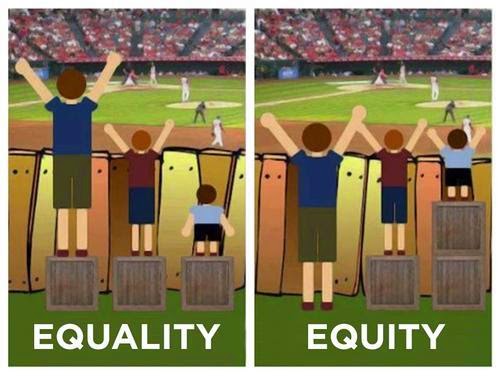
Since we are talking about CRT, I should point out that Derrick Bell, who is often considered the founder of CRT, agrees with you, which is why he proposes solutions like magnet schools, which offer advantages to both whites and blacks. That's what he means when he says whites will always act in their own interest and anyone seeking equity for blacks need to take that into account. As the summary states:
I don't think that's zero-sum. I don't think that's tearing people down. I don't think that's Marxist revolution. And I think that's generally true for the CRT sources I have been reading.He suggests the interest of blacks in quality education might now be better served by concentration on improving the quality of existing schools, whether desegregated or all-black.
A lot of commentators seem to be targeting Ibram X Kendi, who favors some extreme things like defunding the police. I listened to this interview with Ezra Klein, and Kendi also speaks out against zero-sum thinking:
In general, I think we would be having a very different conversation if we were discussing what the CRT people themselves are saying. I have real issues with some things Ibram X Kendi says, but what he says is not what right-wing commentators claim he says.EZRA KLEIN: How do you build that idea that there is no need for zero-sum thinking in this and that it is a legacy of racism that the only answer to the legacy of racism is a new hierarchy where white people are on the bottom as opposed to a more positive sum country for all?
IBRAM X. KENDI: Well first, I can say that there’s been people across different racial groups who’ve come to me and said what allowed them to really reflect on their own racist ideas was reading me do the same, that instead of writing a book in which I lecture to other people about how racist they were, I wrote a book admitting and being vulnerable about the times in which I thought there was something wrong with Black poor people or Black women or Black people or even white people. And I used myself and really my growth and I decided to be vulnerable to do so. And people have responded really well. I didn’t know how people would respond.
I’ve also used the stories of history, particularly with white Americans. Because one thing white Americans are not taught, because we don’t teach about race and racism with any specificity or comprehensiveness in schools and even colleges, is about white American history. White Americans don’t know that some studies show that the majority of white Americans were against secession in the South. White Americans don’t know that there were roughly 5 million poor non-slaveholding whites in 1860. White Americans don’t know that white people rioted for food during the Civil War and were fleeing the Confederate army in droves. White people don’t know that white people had to go to court to get some of the Jim Crow voting laws in the South lifted because it was making it harder for white people to vote.
There’s so many aspects of white American history that people have not learned. And just as Jonathan Metzl wrote in his book, we’re not talking about the epidemic of white men dying by suicide via handguns specifically in states where they’ve rolled back gun control policies. These are not things we’re talking about. And I think the more white people learn about white American history and the ways in which certainly white people have benefited and been privileged as a result of the effects of racism, but also the ways in which they have not been, I think would allow people to really complicate themselves and their history in this country.
 - so that they can better understand what it is like to be in that other person't position. In the context of ethnic inequality, I would recommend the book "Black Like Me".)
  I think the key here is voluntarily.