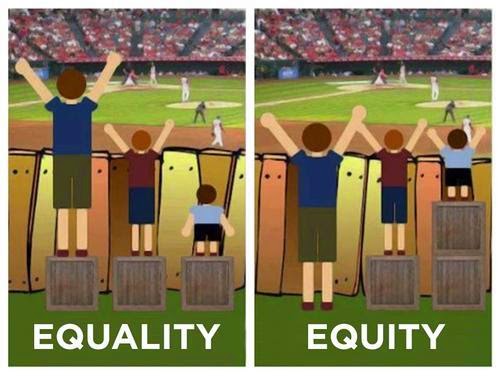
We don't need to be afraid of CRT

General Christian Theology
Bootstrap

Re: We don't need to be afraid of CRT

Post by Bootstrap »

Neto wrote: ↑Thu Jul 22, 2021 8:58 am Two, any notion that someone needs to be pushed down in order to give the less-privileged an equal opportunity is (in my opinion) utter nonsense.
Since we are talking about CRT, I should point out that Derrick Bell, who is often considered the founder of CRT, agrees with you, which is why he proposes solutions like magnet schools, which offer advantages to both whites and blacks. That's what he means when he says whites will always act in their own interest and anyone seeking equity for blacks need to take that into account. As the summary states:
He suggests the interest of blacks in quality education might now be better served by concentration on improving the quality of existing schools, whether desegregated or all-black.
I don't think that's zero-sum. I don't think that's tearing people down. I don't think that's Marxist revolution. And I think that's generally true for the CRT sources I have been reading.

A lot of commentators seem to be targeting Ibram X Kendi, who favors some extreme things like defunding the police. I listened to this interview with Ezra Klein, and Kendi also speaks out against zero-sum thinking:
EZRA KLEIN: How do you build that idea that there is no need for zero-sum thinking in this and that it is a legacy of racism that the only answer to the legacy of racism is a new hierarchy where white people are on the bottom as opposed to a more positive sum country for all?

IBRAM X. KENDI: Well first, I can say that there’s been people across different racial groups who’ve come to me and said what allowed them to really reflect on their own racist ideas was reading me do the same, that instead of writing a book in which I lecture to other people about how racist they were, I wrote a book admitting and being vulnerable about the times in which I thought there was something wrong with Black poor people or Black women or Black people or even white people. And I used myself and really my growth and I decided to be vulnerable to do so. And people have responded really well. I didn’t know how people would respond.

I’ve also used the stories of history, particularly with white Americans. Because one thing white Americans are not taught, because we don’t teach about race and racism with any specificity or comprehensiveness in schools and even colleges, is about white American history. White Americans don’t know that some studies show that the majority of white Americans were against secession in the South. White Americans don’t know that there were roughly 5 million poor non-slaveholding whites in 1860. White Americans don’t know that white people rioted for food during the Civil War and were fleeing the Confederate army in droves. White people don’t know that white people had to go to court to get some of the Jim Crow voting laws in the South lifted because it was making it harder for white people to vote.

There’s so many aspects of white American history that people have not learned. And just as Jonathan Metzl wrote in his book, we’re not talking about the epidemic of white men dying by suicide via handguns specifically in states where they’ve rolled back gun control policies. These are not things we’re talking about. And I think the more white people learn about white American history and the ways in which certainly white people have benefited and been privileged as a result of the effects of racism, but also the ways in which they have not been, I think would allow people to really complicate themselves and their history in this country.
In general, I think we would be having a very different conversation if we were discussing what the CRT people themselves are saying. I have real issues with some things Ibram X Kendi says, but what he says is not what right-wing commentators claim he says.
0 x
joshuabgood

Re: We don't need to be afraid of CRT

Post by joshuabgood »

As for Christians joining with secular movements and earthly governments to deal with sin issues - that's something I don't find Jesus and the Apostles teaching or engaging in. In fact the NT scriptures clearly warn against being yoked together with unbelievers. That's at the heart of my concern about Christians embracing CRT and other secular ideologies to try and accomplish something the finished work of Jesus sufficiently provides for. You seem to be promoting this idea in your paper. This may surprise you, but I find that idea equally as galling as Christian nationalism, which is truly galling to me.
I am not advocating for Christians to join the organization BLM or the CP. Not at all. Let me explain it this way.

One approach, the one I often hear from conservative Christian's across the USA is that CRT is a threat to the church and it is evil, racist and Marxist/Commujist ideology. And the church should repudiate it as did SBC. I am suggesting that CRT actually, like Marxism, brings some important thinking to the conversation. And when we reject those theories with a religious fervor or concern it doesn't do away with the real problems noted by the theories and it doesn't sit well with those that see the validity of the issues being raised. The truth is black people are not more wicked, lazy, or sinful than anybody else, neither are they more righteous. They are people. There are real social, historical, and political reasons, systems, as to why black people have less economic and social power, why there are more of them in prison, etc, in this country. These reasons go way beyond black people are lazier and more wicked sinners or more promiscuous than whites. CRT gives a framework for understanding this outside of a "blaming the victim" approach. That can, and should in my view, be validated. It is a lie that black people are worse than white people and that explains the inequity. That lie severely impacts white people and also black people with regard to how they see themselves.

All that said, violence and coercion, though tempting, are not the solutions. I think Christian's should acknowledge the issues some of these theories raise. We can say to the commie, we value brotherhood, we appreciate your concern regarding the poor and inequality. You are right. However violent revolution wont work to fix it, but let us tell you about a kingdom that is led by a man where these problems are acknowledged and worked on. And that King is advancing his kingdom across our society. To the CRT folks we can say, you are right. Black people have been historically oppressed and yet today as a result they have less social and economic opportunity and have less political power. And they are discriminated against in many ways yet today. Violence wont work to make the rights wrong, but there are tools and a kingdom where we can fight to end these wrongs and work for racial reconciliation and restitution. In my view that approach would be much more effective and Christlike rather than issuing formal denunciations and papers condemning evil theories. That is what I am advocating for.

Now, why Christian Nationalism is especially galling. First that narionalism is an actual idol in the USA church. There are no hymns of praise sung to CRT. CRT flags and idols are not at the front of every church in America. CRT is not spoken of in glowing myths about its founders being Christian and it being a special theory blest by God. There wasn't CRT emblazoned on church bulletins and programs on July 4th Sunday like there was on even at least one CA church. The mixture of nationalism with Christianity deserves a more rigorous critique because it is a heresy within the church itself, and because it is an actual idol in the church. Look how the conservative Chrsitians responsed when a few athletes wouldn't stand and worship the flag at a football game. The true devotion came out clearly. Skipping church to watch the superbowl? No problem. Not standing for the flag at the actual game...big problem. My daughter's Christian Abeka teacher literally said, after singing a patriotic hymn, "now that we are done singing praises to our country, let's sing praises to our God." (At that point we dispensed with Abeka Bible curriculum). As Chrisitans I believe we should be more discerning and prophetic for our own issues. The world we expect to not model Jesus, the church however names his name is rightdully held to a higher standard methinks.
0 x
Neto

Re: We don't need to be afraid of CRT

Post by Neto »

Bootstrap wrote: ↑Thu Jul 22, 2021 1:34 pm
Neto wrote: ↑Thu Jul 22, 2021 8:58 am Two, any notion that someone needs to be pushed down in order to give the less-privileged an equal opportunity is (in my opinion) utter nonsense.
Since we are talking about CRT, I should point out that Derrick Bell, who is often considered the founder of CRT, agrees with you, which is why he proposes solutions like magnet schools, which offer advantages to both whites and blacks. That's what he means when he says whites will always act in their own interest and anyone seeking equity for blacks need to take that into account.
Does he really say that "...'whites' will ALWAYS act in their own interest"?!? Talk about "racially" charged rhetoric! This is simply not true. Do YOU (Boot) always act in your own interest? I should say not.

I agree that we should do all we can to help others succeed, even if they are of a different ethnicity, or "color". But yes, it should be voluntary, and there are lot of people who devote their lives to helping people of other groups. (I could point out that that's what we did for the better part of our adult life so far, at the risk of sounding like bragging. And the Banawa are sort of brown, so I guess they are "people of color". And it isn't just Christians who do this, either. I have been deeply impressed with some very un-christian people I've worked alongside of in our relationship with the Indians. They worked tirelessly, at personal risk of life, and didn't even have that spiritual strength or motivation for service. These people have my respect, even though they were also against what we were doing in the spiritual sense of our ministry.)

I don't think anyone wants to be put in a "color box", but I'll repeat this story from 1979 SIL training for Wycliffe Bible Translators service. A group of us were lingering around the supper table in the cafeteria, and a Black girl from California was a part of the group. Someone asked her how she'd prefer to be called, 'Black", or "African American". (This was a time when there was a sort of change in this regard.) She gave her name. She wanted to be known as a person, an individual, with her own emotions, thoughts, & convictions. I think that most people want to be known personally, not as a single member of some social construct.
0 x
temporal1

Re: We don't need to be afraid of CRT

Post by temporal1 »

Soloist wrote: ↑Thu Jul 22, 2021 12:49 pm
Neto wrote: ↑Thu Jul 22, 2021 8:58 am An article about CRT showed up on BBC this morning.
https://www.bbc.com/news/world-us-canada-57908808

I've seen this explanation before, but the author referenced the idea of a difference between equality and equity, using the illustration of a short person needing more boxes to see over a fence than a tall person. The idea is that some should have more help in order to access the same level of opportunity. In its application to past policies that sought to give special (additional) assistance to the "under-privileged", some persons at whom this was aimed have said this is demeaning, reducing the importance of their achievements. They wanted an equal playing-field, so that no one could say to them "You didn't build that, it was given to you w/o equal merit." An objection to this feeling might be raised on the basis of the pride involved, but as I've said before, not all pride is wrong. I think that in-so-far as one is being proud in comparison to another person, it is wrong, but not when one is measuring one's current position against one's past position. (Paul writes something from which I derive this, but I don't recall the reference right now.)

But I have two areas of severe restraint when it comes to CRT.
One, it is politics. I think that within the church, yes, we should give additional assistance to some people, in order to help them have equal opportunity. (Think of the additional assistance we offer to people with physical handicaps, like wheel-chair access, etc. In this sense we are "raising them up, giving them a level of assistance we do not offer to those w/o these limitations.) But I strongly believe in the separation of the Christian from the state. That political activism - attempting to force the government to live in peace - that is where I was when I first moved from patriotism to pacifism (largely due to Hippie philosophy as interjected into 'Mennonite pacifism' of the MCC variety in the 70's). So I do not enter into any effort to force the government or any other secular entity to offer the extra assistance. I believe that this is something that can, and should, be done on the personal level, acting as Christians. Incidentally, that is what Jesus did.
Two, any notion that someone needs to be pushed down in order to give the less-privileged an equal opportunity is (in my opinion) utter nonsense. In the context of the example I referenced above, that would be like crippling everyone who can walk, in order to "lift up" those whose physical disabilities have put them in wheel chairs. Or. like cutting the legs off of the tall person so that he or she is now the same height as the short person.
(I do think that some people would benefit from voluntarily submitting themselves to this type of limitation on a temporary basis - the wheel chair, not the cutting off of one's legs ;) - so that they can better understand what it is like to be in that other person't position. In the context of ethnic inequality, I would recommend the book "Black Like Me".)
:arrow: I think the key here is voluntarily.
John the Baptist lowered himself so that Jesus would be elevated. Jesus lowered Himself so that we could be saved.
Its one thing if we chose to give up ice cream and send our money to the needy instead, its another thing to have someone deny us ice cream to help the poor.

Also, if they object to the boxes, society seems to like boxes.
Most of these equality things I've seen are not based on equal playing field but in many aspects it seems like the short person analogy fits. Not enough women in STEM? give them free money.

The funny thing is, this doesn't always apply with that logic.
Not enough men in nursing? given women more scholarships. I have yet to see a scholarship for male nursing. I'm sure they exist, but this problem seems ignored outside of some men beating their drums. Even among Conservative Mennonites... it confuses me to no end how we can offer nurse training for free to ladies and refuse to offer it to men even though women end up married, not working outside of the home and do not use the degree for more then a few years on average. The male on the other hand often is the primary breadwinner.


Image

Thomas Sowell speaks to equal opportunity versus equal outcomes. :shock:
(The box meme.)
i believe the box meme is great! - For individual free will love and giving to one another. Jesus’ message.
It fails when “giving” is by force of the sword (gov taxation). This is corruption of Jesus’ message. :-|


TS sometimes speaks about Christianity. i’ve not heard him say he is Christian. i have no idea.
He is an economist, and dedicated academic fact-finder.

i believe this is the “box meme” Neto refers to above:

Image

When free individuals/groups do this sort of thing, yes! It’s great.
It’s out of the domain of gov to impose “generous hearts” by force of the sword. It just doesn’t work well. It’s not of Christ.
Last edited by temporal1 on Thu Jul 22, 2021 3:00 pm, edited 2 times in total.
0 x
Neto

Re: We don't need to be afraid of CRT

Post by Neto »

Szdfan wrote: ↑Thu Jul 22, 2021 1:16 pm
Neto wrote: ↑Thu Jul 22, 2021 8:58 am Two, any notion that someone needs to be pushed down in order to give the less-privileged an equal opportunity is (in my opinion) utter nonsense. In the context of the example I referenced above, that would be like crippling everyone who can walk, in order to "lift up" those whose physical disabilities have put them in wheel chairs. Or. like cutting the legs off of the tall person so that he or she is now the same height as the short person
I have a couple of issues and questions with this.

I completely agree with you that there is unlimited good. However, material resources are not unlimited and the attempt to make the unequal distribution of resources more equal is not like crippling everyone in order “lift up” others. This past week, two billionaires flew to the edge of space. Are Richard Branson and Jeff Bezos unimaginably wealthy because of inherent attributes like the ability to walk? Why should Amazon warehouse workers labor under inhospitable working conditions in order to maximize profits so that their boss can spend millions to fly into space? Is restricting Jeff Bezos’s ability to make billions of dollars so that his employees can have a greater share of Amazon’s profits or have better working conditions “pushing” him down?

The wealthy aren’t wealthy because they are more deserving of their wealth than the rest of us or that they have inherent abilities and attributes that the rest of us don’t. There’s a bunch of complicated and intersecting reasons why the rich are rich and the poor are poor. Some of it has to do with personal choice and some of it has to do with systematic structures beyond any one person’s control.

Right now, there’s a lot of anger in my corner of the world that the meat-packing monopolies are manipulating the market in order to maximize profits for their shareholders. Many of the ranchers in my area are struggling to make it because of the artificially low cost of beef. Breaking up the monopolies so that ranchers can get a more fair price for their cattle isn’t like physically crippling the shareholders of JBS.

Also, as I read your comments, I kept thinking about Mary’s declaration in the Magnificat:
He has performed mighty deeds with his arm;
he has scattered those who are proud in their inmost thoughts.

He has brought down rulers from their thrones
but has lifted up the humble.

He has filled the hungry with good things
but has sent the rich away empty.
What do you think Mary is talking about? What are the characteristics of God that she’s describing here?
These are good thoughts, and deserve careful consideration. My first thoughts, however, come back to the separation from this world system. I am not in any position to convince or force these super wealthy people to give up even a small part of what they have in order to help someone else. All I have at my disposal is what I have myself, which is not a whole lot.

Looking at what Mary said, first, she's talking about God's actions, not that of herself or of a justice movement. But, as I started off with here, it requires careful thought.
0 x
Ken
Posts: 21863
Joined: Thu Jun 13, 2019 12:02 am
Location: Washington State
Affiliation: former MCUSA

Re: We don't need to be afraid of CRT

Post by Ken »

Neto wrote: ↑Thu Jul 22, 2021 2:37 pm
Bootstrap wrote: ↑Thu Jul 22, 2021 1:34 pm
Neto wrote: ↑Thu Jul 22, 2021 8:58 am Two, any notion that someone needs to be pushed down in order to give the less-privileged an equal opportunity is (in my opinion) utter nonsense.
Since we are talking about CRT, I should point out that Derrick Bell, who is often considered the founder of CRT, agrees with you, which is why he proposes solutions like magnet schools, which offer advantages to both whites and blacks. That's what he means when he says whites will always act in their own interest and anyone seeking equity for blacks need to take that into account.
Does he really say that "...'whites' will ALWAYS act in their own interest"?!? Talk about "racially" charged rhetoric! This is simply not true. Do YOU (Boot) always act in your own interest? I should say not.

I agree that we should do all we can to help others succeed, even if they are of a different ethnicity, or "color". But yes, it should be voluntary, and there are lot of people who devote their lives to helping people of other groups. (I could point out that that's what we did for the better part of our adult life so far, at the risk of sounding like bragging. And the Banawa are sort of brown, so I guess they are "people of color". And it isn't just Christians who do this, either. I have been deeply impressed with some very un-christian people I've worked alongside of in our relationship with the Indians. They worked tirelessly, at personal risk of life, and didn't even have that spiritual strength or motivation for service. These people have my respect, even though they were also against what we were doing in the spiritual sense of our ministry.)

I don't think anyone wants to be put in a "color box", but I'll repeat this story from 1979 SIL training for Wycliffe Bible Translators service. A group of us were lingering around the supper table in the cafeteria, and a Black girl from California was a part of the group. Someone asked her how she'd prefer to be called, 'Black", or "African American". (This was a time when there was a sort of change in this regard.) She gave her name. She wanted to be known as a person, an individual, with her own emotions, thoughts, & convictions. I think that most people want to be known personally, not as a single member of some social construct.
There are always unique individuals within every population. I haven't read Derrick Bell. But I doubt he was talking about every single white person in every single circumstance. Rather, I suspect he was taking about the white population on average or writ-large. And what he is saying is largely true in that context. If you want to address widespread discrimination. You need to design programs in which the white population sees it as in their own interest to participate. Rather than programs in which they perceive it to be a sacrifice. So, for issues like school desegregation, he promotes programs like magnet schools which serve to attract white folks back into highly diverse inner-city schools. Rather than bussing mandates that require that they do so against their will and perceived self-interest.
0 x
A fool can throw out more questions than a wise man can answer. -RZehr
temporal1

Re: We don't need to be afraid of CRT

Post by temporal1 »

Neto:
:arrow: I don't think anyone wants to be put in a "color box",
but I'll repeat this story from 1979 SIL training for Wycliffe Bible Translators service. A group of us were lingering around the supper table in the cafeteria, and a Black girl from California was a part of the group. Someone asked her how she'd prefer to be called, 'Black", or "African American". (This was a time when there was a sort of change in this regard.)

:arrow: She gave her name. She wanted to be known as a person, an individual, with her own emotions, thoughts, & convictions.

:arrow: I think that most people want to be known personally, not as a single member of some social construct.

Yes. Jesus offers Himself in just this way.
Secular gov messes with things attempting to be “smarter than God.” It’s not gonna happen. A constant struggle. One human law begets endless additional laws, all in attempt to be smarter than God.

There is a pattern.

Our country is now “secular law happy,” thousands of new law passed each calendar year. God have mercy.
It’s as-if we-all never heard of The Better Way. :-| So sad.
Last edited by temporal1 on Thu Jul 22, 2021 3:03 pm, edited 1 time in total.
0 x
Bootstrap

Re: We don't need to be afraid of CRT

Post by Bootstrap »

Neto wrote: ↑Thu Jul 22, 2021 2:37 pm
Bootstrap wrote: ↑Thu Jul 22, 2021 1:34 pmSince we are talking about CRT, I should point out that Derrick Bell, who is often considered the founder of CRT, agrees with you, which is why he proposes solutions like magnet schools, which offer advantages to both whites and blacks. That's what he means when he says whites will always act in their own interest and anyone seeking equity for blacks need to take that into account.
Does he really say that "...'whites' will ALWAYS act in their own interest"?!? Talk about "racially" charged rhetoric! This is simply not true. Do YOU (Boot) always act in your own interest? I should say not.
Bell was saying that whites, on the whole, will not accept policies if they think they are not in their interest. I don't think he used the word "always", that was my bad. Again, it's probably better to read the article first and respond to what he actually says.

Why do you think schools refused to integrate even when the Supreme Court said they had to? That's the question Bell was asking. His conclusion is that public policy is just not going to be adopted if the white majority thinks it is against their interests, and that you need to avoid triggering defiance in whites if you want to actually make a difference.. Here's what he actually said:
III. INTEREST-CONVERGENCE REMEDIES UNDER BROWN

Further progress to fulfill the mandate of Brown is possible to the extent that the divergence of racial interests can be avoided or minimized. Whites in policymaking positions, including those who sit on federal courts, can take no comfort in the conditions of dozens of inner-city school systems where the great majority of nonwhite children attend classes as segregated and ineffective as those so roundly condemned by Chief Justice Warren in the Brown opinion. Nor do poorer whites gain from their opposition to the improvement of educational opportunities for blacks: as noted earlier, the needs of the two groups differ little. Hence, over time, all will reap the benefits from a concerted effort towards achieving racial equality. The question still remains as to the surest way to reach the goal of educational effectiveness for both blacks and whites. I believe that the most widely used programs mandated by the courts - "antidefiance, racial balance" plans - may in some cases be inferior to plans focusing on "educational components," including the creation and development of "model" all- black schools. A short history of the use of the antidefiance strategy would be helpful at this point.
0 x
Bootstrap

Re: We don't need to be afraid of CRT

Post by Bootstrap »

Neto wrote: ↑Thu Jul 22, 2021 2:37 pmI don't think anyone wants to be put in a "color box", but I'll repeat this story from 1979 SIL training for Wycliffe Bible Translators service. A group of us were lingering around the supper table in the cafeteria, and a Black girl from California was a part of the group. Someone asked her how she'd prefer to be called, 'Black", or "African American". (This was a time when there was a sort of change in this regard.) She gave her name. She wanted to be known as a person, an individual, with her own emotions, thoughts, & convictions. I think that most people want to be known personally, not as a single member of some social construct.
Absolutely.

But they also want to be able to share their experiences and understandings based on who they are and what they have experienced. Nobody wants to be just a generic person, some things are really personal to each of us, and that varies by culture. In that SIL training, you were also taught to be sensitive to local culture and language and ready to listen. I don't think that contradicts what you said above.

And the people I am listening to say that the deaths of George Floyd, Breonna Taylor, Tony McDade, Ahmaud Arbery, Stephon Clark, Philando Castile, Alton Sterling, Tamir Rice, Sandra Bland, Trayvon Martin, Michael Brown, Eric Garner, and others have really hit them hard. So has the message that black people who care about this should just shut up, a message they are hearing loudly from some ends of the political spectrum and even parts of the church. The black people I know generally believe that racial profiling is alive and well in the United States. Tim Scott, a Republican, has shared abuot this quite openly (see, e.g. https://www.politico.com/news/2020/06/2 ... ice-336650). Racial profiling and videos of unwarranted violence against black people are the real source of outrage, CRT is just a framework some scholars use to try to explain it.

In the church, I think we should be interested in listening to our black brothers and sisters as they share their feelings and experiences about these things. I don't think we should tell people it's wrong to speak openly about these things. In Acts, just saying that there is no difference between Jews and Greeks was not enough. When believers of Greek heritage said their widows were being neglected, the church decided to act.
Last edited by Bootstrap on Thu Jul 22, 2021 3:18 pm, edited 1 time in total.
0 x
temporal1

Re: We don't need to be afraid of CRT

Post by temporal1 »

.. Why do you think schools refused to integrate even when the Supreme Court said they had to? ..

All human laws BEGIN with the best intentions. i lived thru these times. i was a young teen, and wondering. i lived in a culturally and racially mixed area, i was sometimes baffled at some things i learned about.

Decades later, i wonder, “What if?” ..
What if Jesus was followed, just straight-up, as He invites? What if? ..

What if no pastors leading their flocks to government (by force of the sword) answers??

Today, that period, the 1960’s, are treated as sacrosanct, as if there was no other way.
But, you know what? That’s NOT the message of Jesus. Not by a long shot.

Jesus is Truth at all times, superceding all situations.
So, that period, those human laws, cannot be sacrosanct. Those things do not align for Christians.

The only have-to for Jesus IS Jesus. Full stop.

Feel free to call me all the names you like. :)
Jesus tells me it’s not a problem.
Last edited by temporal1 on Thu Jul 22, 2021 3:27 pm, edited 2 times in total.
0 x
Post Reply