"Housing First" doesn't mean what you think it means.
A Housing First model means it is your policy to place people into housing BEFORE you address the underlying pathologies that made them homeless in the first place such as addiction, mental illness, or complete lack of employable skills. It has been a disaster in most places where it has been tried because you end up putting dysfunctional predators into ordinary housing where poor families and poor elderly live with predictable consequences.
San Francisco might have a Housing First policy on paper, but that doesn't mean they are actually building any low income housing in the city or allowing the private sector to do the same. They are NOT. And a Housing First Model doesn't mean one single new home ever gets built. The wait list for section 8 housing in San Francisco is something like 18 YEARS. And anyone in the private sector who wants to build housing faces similar obstacles. San Francisco has maybe 1/4 the population density of smaller European cities like Barcelona. Here is an article on how San Francisco makes it insanely difficult to build housing: https://sfstandard.com/housing-developm ... d-housing/
The legal problem facing San Francisco and other cities is that the Federal Courts have said that you cannot make public camping on the streets and public parks illegal unless you provide alternative places for them to sleep. And because most cities do not actually have adequate shelter or camping space they are stuck having to tolerate public camping.
But the solution isn't to build brand new housing for vagrants that meets every single esthetic, design, construction, parking, accessibility, and energy efficiency code we have in place for new construction because in big cities that ends up costing half a million dollars per unit. Nor is the solution to ding around with one-off hand-built "tiny home" communities of the sort they are now building in Portland and Seattle. We can look overseas to actually get better ideas.
Let's look at Turkey which has absorbed nearly 4 MILLION refugees from Syria over the decade. Compared to that, San Francisco's 8,000 homeless isn't even rounding error. How does Turkey do it? Not with tents and blue tarps on the streets and in the parks. And not by slowly building more section 8 housing. No, they put up temporary refugee housing on an industrial scale. With walls and lots of police security as well as schools, social service agencies, and so forth:

There is no reason other than political will and bureaucracy for why US cities cannot do the same exact thing. It is mostly a lack of imagination and the political will to go against a myriad of vested interests. Put in industrial scale temporary shelters of this sort, surround them by social service agencies in FEMA type trailers, let churches and other social service organizations come in and put in food trucks for meals if they want to feed the homeless, put in tight security including surveillance cameras to keep out drug dealing and other crime, and so forth. You could get this sort of thing put up in weeks.
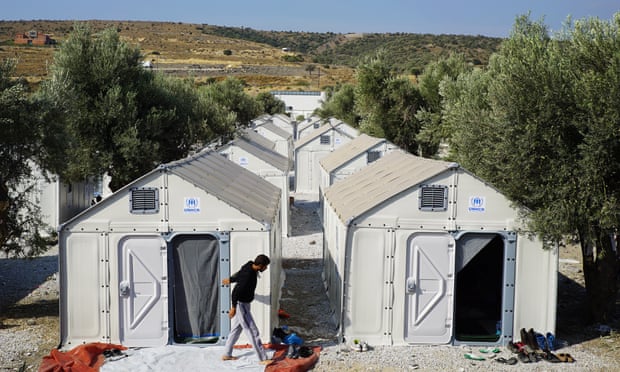
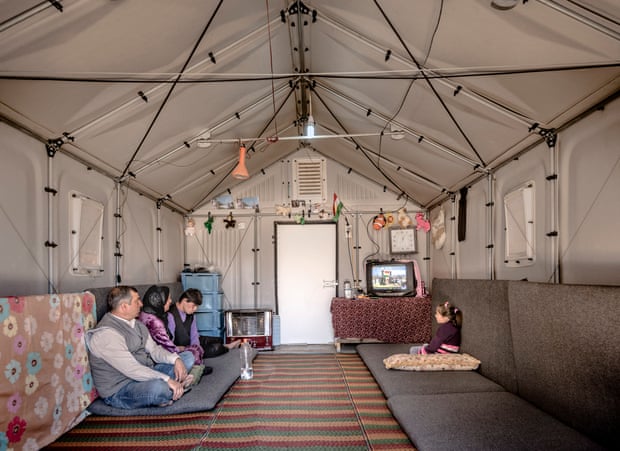
Even refugees in places like Somalia and Sudan often have better shelter than homeless on the streets of the richest nation that has ever existed. IKEA makes flat-pack refugee housing that costs about $1250 per unit and can be assembled with minimal tools in 4 hours. Put in a few thousand of these in remote industrial areas of cities like Portland and San Francisco and you have basically solved the problem of "where can the homeless go" which then enables you to sweep the streets and parks daily and nightly of tents and garbage and all the rest.
And for those criminals who refuse to follow the rules, you put in some designated camping areas in parking lots on the edge of town where they can camp and put some squad cars there to keep an eye on things. Then you can legally toss them out of every other part of the city where you don't want them to camp.
These are the $1250 flat-pack easy to assemble IKEA refugee shelters. They are designed for electricity and security (locking doors). 8,000 of these would cost San Francisco $10 million which is a drop in the bucket compared to what they are wasting now on the problem. And would be a VAST improvement in every way over nylon camping tents on the sidewalks and in the parks.