Who speaks for the black community?

Things that are not part of politics happening presently and how we approach or address it as Anabaptists.
RZehr

Re: Who speaks for the black community?

Post by RZehr »

Bootstrap wrote: “There is a lot of joy in being black,” Lacy said of the people she interviewed. “This is a really important point. Most of the media coverage of black people is negative. Scholars have spent a lot of time documenting the racial discrimination blacks experience. We do need to know about how and why discrimination persists. But there is very little attention to all the good things about being black.”
Bootstrap wrote:
“We’re left with the impression that black people wake up every morning thinking, ‘Ugh, I’ve got to be black today, and it’s going to be awful.’ None of the people I interviewed held that view,” Lacy added. “They take a lot of pride in being black and worry that their kids might not embrace being black with the same enthusiasm.”
For black people I know, living out the Gospel in black churches, being black is not an illness to be diagnosed and cured. But some of the things I read seem to treat it that way.

This is not what we are ever told. The “left” is always telling everyone about the ills, and if the “right” every would say something close to this, they are bigots.
Bootstrap wrote: To me, really listening to our black brethren also means being willing to appreciate pig pickings, Gospel music, and joyful hugs that we do not have in our local Mennonite church.

Again, the “left” “cancels” people on the “right” for making stereotypes. Yet apparently the left is the arbiter of which stereotypes are okay.
0 x
Wade

Re: Who speaks for the black community?

Post by Wade »

Bootstrap wrote:
Wade wrote:
Ms. Izzie wrote:So am I understanding correctly that for some of you living out Kingdom principles is solely done individually, one soul at a time, and for others it is done individually but also in a way where Gods' Kingdom on earth engages the earthly kingdom through_____________? I'm not sure what all is on that blank yet. For now, listening to the black community is on it. What else might belong on it?

(Sometimes it's easier to tell what a person is not promoting than what they are promoting.)
It isn't so rigid with one soul at a time as much as listening to the story of each person.

For example if I make a generalization about the black community because of allowing someone to speak for them then it is really likely I am going to offend at least a few people. I'd rather not put people in a box, which could very easily result in racism. People are people. And each person has a different story. When I try to share the love of Christ with someone I try to listen to them individually, rather than look at their skin colour and assume they have been oppressed, assume they have grown up privileged, or whatever it might be. Sometimes those things can relate but each person processes those differently with their own perspectives and experiences. I want to know their heart and what ministering needs to take place for them to find Christ and see His kingdom - and coming up with systems based on race just doesn't work because it is racist in itself and shuts out the opportunity to connect with people that opens a door into deeper conversations that effect eternity.
I'm going to respond only to the part involving how we listen to black people.

I agree with what you say here, Wade, but I also think there's a place for polls and other reliable sources of information if we want to know whether the experiences of one person are similar to the experiences of many black people.

I don't think we should establish systems based on race, but I do think we should be bothered by systems that discriminate based on race. And I think black Americans are best positioned to tell us when they experience this. We should be careful not to shout them down when they speak out about their own experiences.
Boot, the problem is people often intentional and unintentionally use polls to drowned out the voices of each person.

Your polls are as much value to me as the early Coronavirus epidemiological projection numbers that were easy to see would be wrong as I said from the start with inconsistent techniques of how they derived their numbers not assuming any asymptomatic people.

Showing poll numbers tells me almost nothing. A real poll to me would tell me what questions were even asked! And what questions were not asked. And how they were asked. And how many different choices the people had to answer to. - How many people answered what was close but not exactly how they feel? Why they choose those answers - because many people can agree on one thing but choose that answer for different reasons. And who all took the survey? What were their ages? Where do they all live? What was the answers in comparison to those that grew up in a home with one set of married parents? What was going on politically while this survey was taken that could have influenced their choices? How many that answered are Christian? Protestant? Catholic? Muslim? Did they take the survey on Monday and felt upset to start another work week or Friday and felt care free coming into the weekend? And etc. and etc.

Your polls do absolutely nothing for me as I meet and engage with people that have black coloured skin and want to know who they are.
0 x
User avatar
Robert
Site Janitor
Posts: 12078
Joined: Wed Oct 19, 2016 4:16 pm
Affiliation: Anabaptist

Re: Who speaks for the black community?

Post by Robert »

Bootstrap wrote: For black people I know, living out the Gospel in black churches, being black is not an illness to be diagnosed and cured. But some of the things I read seem to treat it that way.

To me, really listening to our black brethren also means being willing to appreciate pig pickings, Gospel music, and joyful hugs that we do not have in our local Mennonite church.
This just seems really racist and exclusionary. It is about as bad as what DrWojo wrote.

Why must there be a white and black? Why not just people?
0 x
Try hard not to offend. Try harder not to be offended.
I think I am funnier than I really am.
Bootstrap

Re: Who speaks for the black community?

Post by Bootstrap »

RZehr wrote:
Bootstrap wrote:For black people I know, living out the Gospel in black churches, being black is not an illness to be diagnosed and cured. But some of the things I read seem to treat it that way.

This is not what we are ever told. The “left” is always telling everyone about the ills, and if the “right” every would say something close to this, they are bigots.
I think I have read things across the political spectrum that focus on the ills. I'd like to avoid the whole "left" versus "right" framing, I don't think it helps to act like everything is always about the war between the "left" and the "right".
RZehr wrote:
Bootstrap wrote: To me, really listening to our black brethren also means being willing to appreciate pig pickings, Gospel music, and joyful hugs that we do not have in our local Mennonite church.
Again, the “left” “cancels” people on the “right” for making stereotypes. Yet apparently the left is the arbiter of which stereotypes are okay.
These are memories, not stereotypes. Here in North Carolina, at least, these are things I experienced quite a bit in church services in prisons, black churches I visited with friends who went to them, black funerals, and black family gatherings. You live in Oregon, is it different there? Have you been to black church services?
0 x
GaryK

Re: Who speaks for the black community?

Post by GaryK »

Robert wrote:
Bootstrap wrote: For black people I know, living out the Gospel in black churches, being black is not an illness to be diagnosed and cured. But some of the things I read seem to treat it that way.

To me, really listening to our black brethren also means being willing to appreciate pig pickings, Gospel music, and joyful hugs that we do not have in our local Mennonite church.
This just seems really racist and exclusionary. It is about as bad as what DrWojo wrote.

Why must there be a white and black? Why not just people?
Along with your question, why is it acceptable to talk about pig pickings, Gospel music, and joyful hugs, but not fried chicken when referring to black culture?
0 x
Bootstrap

Re: Who speaks for the black community?

Post by Bootstrap »

Wade wrote:Showing poll numbers tells me almost nothing. A real poll to me would tell me what questions were even asked! And what questions were not asked. And how they were asked.
!!! SNIP !!!

You can find that information by following the links to the polls and reading up. I have been careful to use reliable polling sources. If you start with the polls in the OP, for instance, you can click through to the source for each number.

And when reliable polls tell you that 91% of blacks believe that police do not treat black people and white people equally. 88% of blacks believe that race was a major factor in George Floyd's death. 87% believe that police are more likely to use excessive force if the suspect is black, I think that means that the concerns you hear in protests today are widespread concerns among black Americans.
Bootstrap wrote:Do You Know How Divided White And Black Americans Are On Racism?

For instance, 91% of blacks believe that police do not treat black people and white people equally. 88% of blacks believe that race was a major factor in George Floyd's death. 87% believe that police are more likely to use excessive force if the suspect is black. That's why they are speaking out. 77% of black Americans support the George Floyd protests. When you get numbers like that, I think it is fair to say these beliefs are representative of the black community.

Sure, that means that there are black people who do not feel this way. But they are a distinct minority. Candace Owens does not get most of her support from the black community.
And in the absence of polls, we wind up with a bunch of white people telling each other what black people do think or should think.
Wade wrote:Your polls do absolutely nothing for me as I meet and engage with people that have black coloured skin and want to know who they are.
Sure. You don't want to insist that an individual shares every widespread belief. Polls aren't there to enforce stereotypes on individuals. But they do tell us which beliefs are widespread. And in the current protests, the tell us that the concerns of the protesters are widely shared.

When you talk to individuals, it might be interesting to see what they think about these questions, if you are interested.
0 x
Bootstrap

Re: Who speaks for the black community?

Post by Bootstrap »

Robert wrote:
Bootstrap wrote:For black people I know, living out the Gospel in black churches, being black is not an illness to be diagnosed and cured. But some of the things I read seem to treat it that way.

To me, really listening to our black brethren also means being willing to appreciate pig pickings, Gospel music, and joyful hugs that we do not have in our local Mennonite church.
This just seems really racist and exclusionary. It is about as bad as what DrWojo wrote.

Why must there be a white and black? Why not just people?
Why must there be Mennonites? Why not just people? Why were there still identifiable Jews and Greeks after the church became one?

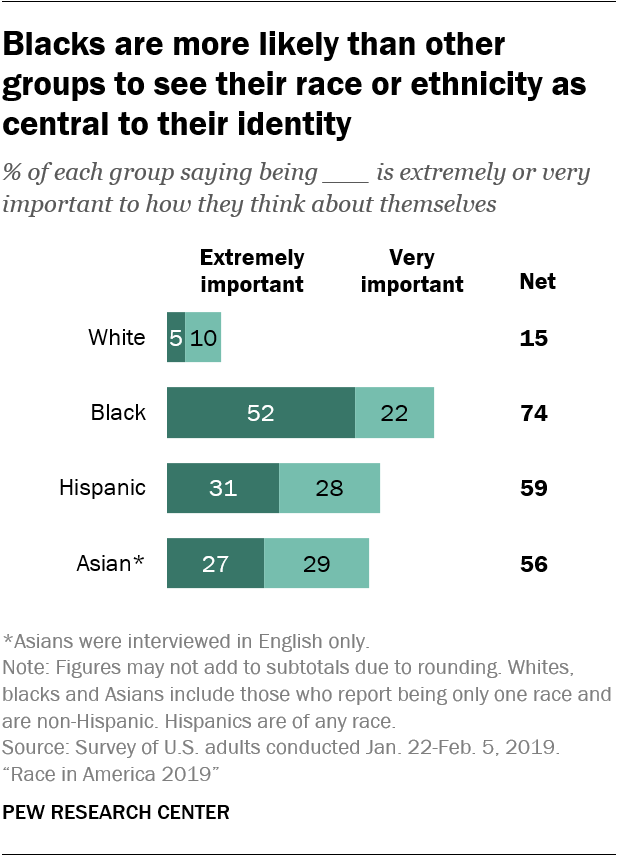
74% of black people say race is important to their identlty. They have a right to that identity. And they have a right to be treated fairly by police and the criminal justice system.

Image
0 x
GaryK

Re: Who speaks for the black community?

Post by GaryK »

Bootstrap wrote: Why were there still identifiable Jews and Greeks after the church became one?
Why did Paul work so hard at removing the distinctions?
Ephesians 2:11-22 NKJV 11 Therefore remember that you, once Gentiles in the flesh--who are called Uncircumcision by what is called the Circumcision made in the flesh by hands-- 12 that at that time you were without Christ, being aliens from the commonwealth of Israel and strangers from the covenants of promise, having no hope and without God in the world. 13 But now in Christ Jesus you who once were far off have been brought near by the blood of Christ. 14 For He Himself is our peace, who has made both one, and has broken down the middle wall of separation, 15 having abolished in His flesh the enmity, that is, the law of commandments contained in ordinances, so as to create in Himself one new man from the two, thus making peace, 16 and that He might reconcile them both to God in one body through the cross, thereby putting to death the enmity. 17 And He came and preached peace to you who were afar off and to those who were near. 18 For through Him we both have access by one Spirit to the Father. 19 Now, therefore, you are no longer strangers and foreigners, but fellow citizens with the saints and members of the household of God, 20 having been built on the foundation of the apostles and prophets, Jesus Christ Himself being the chief cornerstone, 21 in whom the whole building, being joined together, grows into a holy temple in the Lord, 22 in whom you also are being built together for a dwelling place of God in the Spirit.
0 x
Bootstrap

Re: Who speaks for the black community?

Post by Bootstrap »

GaryK wrote:
Bootstrap wrote: Why were there still identifiable Jews and Greeks after the church became one?
Why did Paul work so hard at removing the distinctions?
We do want spiritual unity with black churches and black members of our own churches. How is your church working toward that? That would be worth discussing in another thread.

Paul did not try to erase Jews or insist they could not have Jewish practices. He said they had to embrace Gentiles. When Paul said "there is no longer male nor female", he still talked about differences between husbands and wives. We do not have to abolish Gospel choirs out of a desire for equality. Let's not work to erase black culture or silence black voices. That's not building equality.
0 x
silentreader

Re: Who speaks for the black community?

Post by silentreader »

Bootstrap wrote:
Robert wrote:
Bootstrap wrote:For black people I know, living out the Gospel in black churches, being black is not an illness to be diagnosed and cured. But some of the things I read seem to treat it that way.

To me, really listening to our black brethren also means being willing to appreciate pig pickings, Gospel music, and joyful hugs that we do not have in our local Mennonite church.
This just seems really racist and exclusionary. It is about as bad as what DrWojo wrote.

Why must there be a white and black? Why not just people?
Why must there be Mennonites? Why not just people? Why were there still identifiable Jews and Greeks after the church became one?

74% of black people say race is important to their identlty. They have a right to that identity. And they have a right to be treated fairly by police and the criminal justice system.

Image
I don't know, that sounds very much like Mennonites and ethnicity, especially like NMBs accuse MBs of being, doesn't it?
0 x
Post Reply