Who speaks for the black community?

Things that are not part of politics happening presently and how we approach or address it as Anabaptists.
Bootstrap

Re: Who speaks for the black community?

Post by Bootstrap »

Josh wrote:Men are far more likely to get targeted by the police and end up in prison, but we don’t see much focus on that.
But for males, this is much more proportional to the percent of crimes they are responsible for. Blacks are responsible for more crimes, as a percent of the population, but that only accounts for some of this. And as a whole, males occupy most of the leadership positions in this country. Blacks are not.

Police and the criminal justice system are significant problems for neighborhoods who actually need them the most. I think Bill Stuntz describes this well in The Collapse of American Criminal Justice.
Discretion and discrimination travel together. Ten percent of black adults use illegal drugs; 9 percent of white adults and 8 percent of Latinos nos do so. Blacks are nine times more likely than whites and nearly three times more likely than Latinos to serve prison sentences for drug crimes.10 The racial composition of the dealer population might explain some of that gap but not most of it, much less all."

And the same system that discriminates against black drug defendants also discriminates against black victims of criminal violence. Clearance rates for violent felonies-the the rates at which such crimes lead to suspects' arrest-are higher in small towns and rural areas than in suburbs, higher in suburbs than in small cities, and higher in small cities than in large ones.12 Those relationships correlate both with poverty and with race: the more poor people and black people in the local population, the less likely that victims of criminal violence will see their victimizers punished.13 Bottom line: poor black neighborhoods see too little of the kinds of policing and criminal punishment that do the most good, and too much of the kinds that do the most harm.

A larger measure of official discretion has also coincided with the rise of pendulum justice. Beginning around 1950, imprisonment rates in the Northeast and Midwest began to fall. By the mid-1960s, the decline had accelerated and extended nationwide. The nation's imprisonment rate fell by more than 20 percent, while the murder rate-a decent proxy for the rate of violent felonies and felony thefts more generally-doubled." In northern cities, these trends were more extreme. Chicago's murder rate tripled between 1950 and 1972, while Illinois's imprisonment rate fell 44 percent. In New York City, murders more than quintupled in those twenty-two years; the state's imprisonment rate fell by more than one-third. third. Detroit saw murders multiply seven times; imprisonment in Michigan declined by 30 percent.15 The combination of those trends meant that the justice system was imposing vastly less punishment per unit crime than in the past. This turn toward lenity was followed by an even sharper turn toward severity. Between 1972 and 2000, the nation's imprisonment rate quintupled. The number of prisoner-years per murder multiplied nine times.16 Prisons that had housed fewer than 200,000 inmates in Richard Nixon's first years in the White House held more than 1.5 million as Barack Obama's administration began. Local jails contain another 800,000.17

The criminal justice system has run off the rails. The system dispenses not justice according to law, but the "justice" of official discretion. Discretionary justice too often amounts to discriminatory justice. And no stable regulating mechanism governs the frequency or harshness of criminal punishment, which has swung wildly from excessive lenity to even more excessive severity.
The one thing that really HAS improved recently is imprisonment rates. The Koch Brothers and the ACLU and everyone in between seemed to agree something had to give there. The First Step Act was a wonderful bipartisan effort in the right direction.
Last edited by Bootstrap on Fri Jun 12, 2020 5:47 pm, edited 1 time in total.
0 x
Josh

Re: Who speaks for the black community?

Post by Josh »

Until there’s a spike in violent crime and property crime and voters choose politicians like Bloomberg, Giuliani, Clinton, or Newt Gingrich again. Which is why talking about the need to deal with crime is important.
0 x
Bootstrap

Re: Who speaks for the black community?

Post by Bootstrap »

Josh wrote:Until there’s a spike in violent crime and property crime and voters choose politicians like Bloomberg, Giuliani, Clinton, or Newt Gingrich again. Which is why talking about the need to deal with crime is important.
Of course the need to deal with crime is important. Especially in the neighborhoods that need it the most.

Treating black people justly is not the opposite of dealing with crime. And in this thread, believing black people when they tell us what they experience is not the opposite of understanding what black people experience.
0 x
Bootstrap

Re: Who speaks for the black community?

Post by Bootstrap »

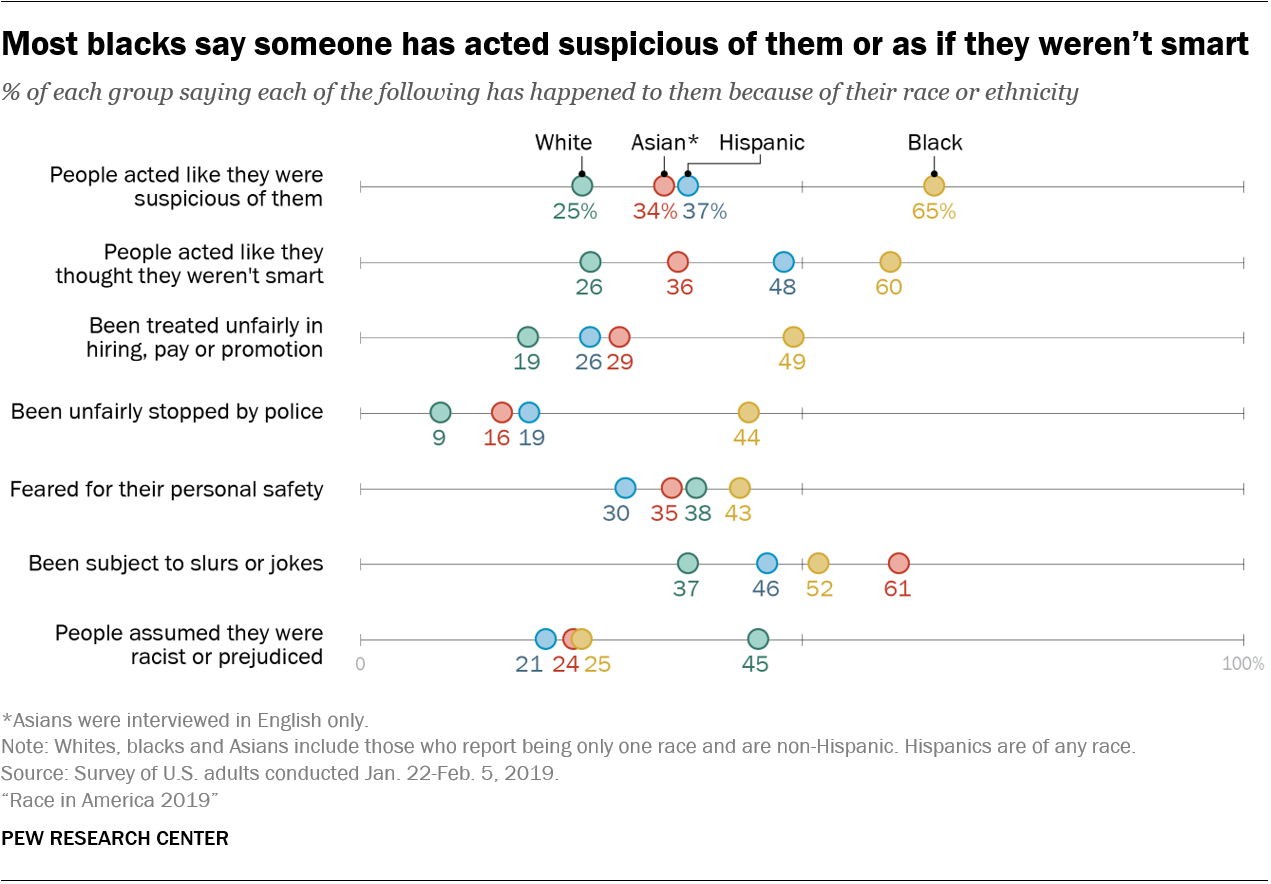
When black people express views that the vast majority of blacks agree with, sometimes the response seems to imply that there's something suspicious about black people, or that they are easily manipulated and can't think for themselves, that they don't understand what's going on in their lives as well as we do.

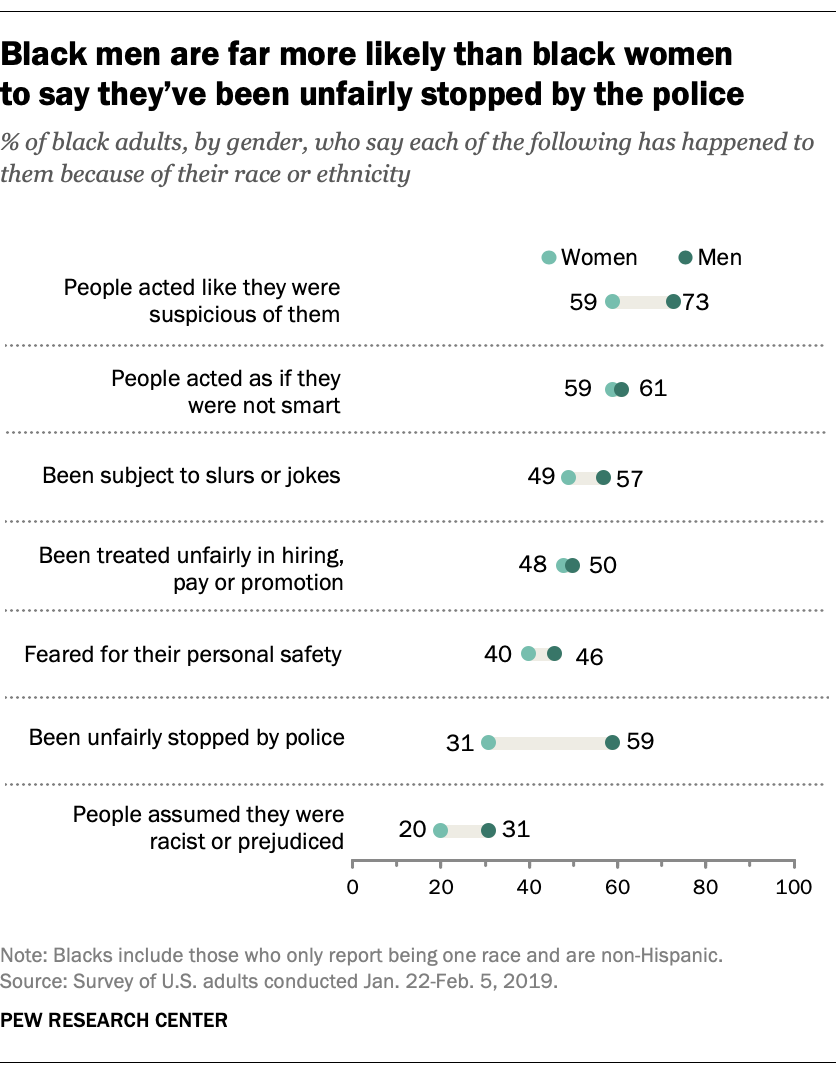
Oh ... that kind of attitude is something many of them encounter regularly, if we believe what they say. Especially for men.

Image

Here are similar numbers for both genders.

Image
0 x
joshuabgood

Re: Who speaks for the black community?

Post by joshuabgood »

Robert wrote:
joshuabgood wrote:there is a reason black people are arrested more and convicted more and given harsher sentences.
The only area I would say that may still have systematic racism is the judiciary in sentencing. This is not a Police issue. This is the courts and long standing court history that does need to be reevaluated.

This is not why there are 6% of the population causing 55% of the crimes. Young black males are doing this. Fatherless homes is the biggest deterrent and fix for this. This is not systematic, but cultural within the inner city culture. It exists in white, brown and black families. Most inner cities have a larger population of blacks then other ethnic groups. This makes their numbers go up above others. I see it much more cultural then racial. It happens to all colors living in the inner city. Many government programs actually keep people locked in. Those policies are not racial, but are systemic to those living in that environment. So it is not systemic racism, but systemic single parent homes that is the real issue.
Why are there fatherless homes in black communities do you think? Could it be that centuries of slavery, a century of lynching and apartheid. And 50 years of legal policies that targeted the black man...are a very significant factor in the breakup of the black family?
0 x
Bootstrap

Re: Who speaks for the black community?

Post by Bootstrap »

Robert wrote:Fatherless homes is the biggest deterrent and fix for this. This is not systematic, but cultural within the inner city culture.
I agree that fatherlessness is a big problem.

I think the government can at least try to build a police force and a criminal justice system that treats people fairly regardless of race. Overwhelming percentages of black people think we do not have that now.

I'm not sure what the government can do to reduce fatherlessness except (1) make sure that food stamps does not punish people for being married, and (2) avoid jailing people for minor crimes or inability to pay fines and make sure people are not jailed without sufficient evidence. Do you have other suggestions for that? I don't think fatherlessness should be used as an excuse to say that black people are not experiencing the things they say they experience.
0 x
Ken
Posts: 21863
Joined: Thu Jun 13, 2019 12:02 am
Location: Washington State
Affiliation: former MCUSA

Re: Who speaks for the black community?

Post by Ken »

Bootstrap wrote:
Robert wrote:Fatherless homes is the biggest deterrent and fix for this. This is not systematic, but cultural within the inner city culture.
I agree that fatherlessness is a big problem.

I think the government can at least try to build a police force and a criminal justice system that treats people fairly regardless of race. Overwhelming percentages of black people think we do not have that now.

I'm not sure what the government can do to reduce fatherlessness except (1) make sure that food stamps does not punish people for being married, and (2) avoid jailing people for minor crimes or inability to pay fines and make sure people are not jailed without sufficient evidence. Do you have other suggestions for that? I don't think fatherlessness should be used as an excuse to say that black people are not experiencing the things they say they experience.
There is a direct and nearly linear relationship between fatherless families and poverty. Both in the black community and the white community.

I happen to have many black friends that I have made over the years, mostly through work and school (or work colleagues of my wife) so they are all middle or upper middle class and all married with on exception. And that one exception is a divorced family in which the father is equally involved in the kids lives as the mother so they would not remotely be considered "fatherless"

At the same time I have also had many many black students (and white students) who do not have fathers in their lives. Almost without exception they are living in poverty, or close to it. Most certainly not upper middle class.

If you want to address "fatherlessness" then you have to address poverty. And yes, there is no small "chicken and egg" cause and effect issue going on there in that fatherlessness also leads to poverty. But there you have it. And, of course, addressing ingrained, multi-generational poverty is one of the most difficult things a society can do. There are no easy fixes. All the solutions are incredibly hard and complex. And they are all interconnected and include: education, economic opportunity, health care, criminal justice housing, child care, public transportation and many other difficult issues.
0 x
A fool can throw out more questions than a wise man can answer. -RZehr
User avatar
Robert
Site Janitor
Posts: 12078
Joined: Wed Oct 19, 2016 4:16 pm
Affiliation: Anabaptist

Re: Who speaks for the black community?

Post by Robert »

joshuabgood wrote:Why are there fatherless homes in black communities do you think? Could it be that centuries of slavery, a century of lynching and apartheid. And 50 years of legal policies that targeted the black man...are a very significant factor in the breakup of the black family?
Well, since this was not the case until the 1960's, I would not tie it to slavery. They actually had higher percentages of intact families until that time.
0 x
Try hard not to offend. Try harder not to be offended.
I think I am funnier than I really am.
barnhart
Posts: 7729
Joined: Tue Jul 23, 2019 9:59 pm
Location: Brooklyn
Affiliation: Mennonite

Re: Who speaks for the black community?

Post by barnhart »

Bootstrap wrote:
Robert wrote:Fatherless homes is the biggest deterrent and fix for this. This is not systematic, but cultural within the inner city culture.
I agree that fatherlessness is a big problem.
Fatherlessness is not a good thing, but some perspective here might be in order. A few years ago the CDC released a study showing that black fathers on average spend more time with their children than white and asian. Somehow that didn't make a lot of headlines, it didn't inform the plot lines of the sitcoms and it hasn't really made much penetration on Mennonet either.
0 x
User avatar
Robert
Site Janitor
Posts: 12078
Joined: Wed Oct 19, 2016 4:16 pm
Affiliation: Anabaptist

Re: Who speaks for the black community?

Post by Robert »

Bootstrap wrote:Do you have other suggestions for that?
Do what my parents did. I was born in the inner city of Baltimore. We moved out when I was 6 years old.
0 x
Try hard not to offend. Try harder not to be offended.
I think I am funnier than I really am.
Post Reply