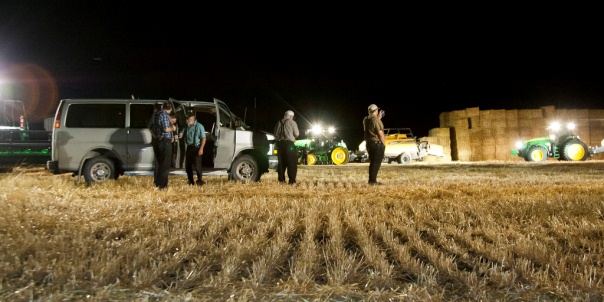
…Despite the increasing rate of allergic diseases, both in industrialized and in developing countries, the Amish remain exceptionally - and bafflingly - resistant. Only 7 percent of Amish children had a positive response to one or more common allergens in a skin prick test, compared with more than half of the general U.S. population. Even children from other traditional farming families, who still have lower rates of allergic disease than nonfarm children, are more allergic than the Amish.
In fact, one Amish community living in northern Indiana is considered one of the least allergic populations ever measured in the developed world.
“Generally, across the country, about 8 to 10 percent of kids have asthma. In the Amish kids, it’s probably 1 to 2 percent,” said Carole Ober, chair of human genetics at the University of Chicago. “A few of them do have allergies, but at much, much lower rates compared to the general population.”
…The study found that hay fever and eczema were less common among children born into larger families. Strachan wondered whether unhygienic contact with older siblings served as a protection against allergies.
Subsequent findings have given support to the hygiene hypothesis, such as that children who grow up with more household pets are less likely to develop asthma, hay fever or eczema. Perhaps even more beneficial than having older siblings or pets, however, is growing up on a farm. (More than 150 years ago, hay fever was known as an “aristocratic disease,” almost wholly confined to the upper classes of society. Farmers appeared relatively immune.)
This “farm effect” has been confirmed by studies on agricultural populations around the world, including in the United States, Europe, Asia and South America. But even among farming communities, the most pronounced effect appears to be in the Amish. In a study of 60 schoolchildren by Ober, Vercelli and their colleagues, the prevalence of asthma was four times lower in the Amish as compared with the Hutterites, another U.S. farming community with a similar genetic ancestry and lifestyle.
The prevalence of allergic sensitization - the development of antibodies to allergens and the first step to developing an allergy - was six times higher in the Hutterites. The researchers first ruled out a genetic cause; in fact, an analysis showed that the Amish and Hutterite children were remarkably similar in their ancestral roots. Instead, the main difference between these two populations seemed to be the amount of exposure as young children to farm animals or barns.
“The Hutterite kids and pregnant moms don’t go into the animal barns. Kids aren’t really exposed to the animal barns until they’re like 12 or so, when they start learning how to do the work on the farm,” Ober said. “The Amish kids are in and out of the cow barns all day long from an early age.”
When analyzing samples of Amish and Hutterite house dust, they found a microbial load almost seven times higher in Amish homes. Later experiments showed that the airways of mice that inhaled Amish dust had dramatically reduced asthmalike symptoms when exposed to allergens. Mice that inhaled Hutterite dust did not receive the same benefit.
https://www.yahoo.com/news/allergies-se ... 41687.htmlIn 2021, Järvinen-Seppo and her colleagues compared the gut microbiomes of 65 Old Order Mennonite infants from a rural community in New York with 39 urban/suburban infants from nearby Rochester. Like the Amish, the Old Order Mennonites follow a traditional agrarian lifestyle. Almost three-fourths of Mennonite infants in the study were colonized with B. infantis, a bacterium associated with lower rates of allergic diseases, in contrast to 21 percent of Rochester infants.
“The colonization rate is very low in the United States and other Western countries, compared to very high rates in Mennonite communities, similar to some developing countries,” Järvinen-Seppo said. “This mirrors the rates of autoimmune and allergic diseases.” These clues about the origin of the farm effect represent a step toward the prevention of allergic diseases, Järvinen-Seppo says.
Whatever form the treatment takes, the impact on prevention of allergic diseases, which affect millions of people worldwide and reduce quality of life, could be enormous, experts say.
“I don’t know that we can give every family a cow. … But we are learning from these time-honored and very stable environments what type of substances and exposures are needed,” Vercelli said.