Are you saying the last two categories in my list or only the last one?Ken wrote: ↑Mon Jun 02, 2025 4:32 pmOne thing I notice is that Mainstream/Progressive groups tend to engage in wider Peace and Justice activism: Gaza protests, Anti-apartheid protests, Nuclear freeze, Black Lives Matter, etc. Whereas more conservative groups, if they engage in wider political protest at all, it tends to be anti-abortion related.Ernie wrote: ↑Mon Jun 02, 2025 4:14 pmHere are some proposed categories. You all can help me flesh this out and even suggest different terms if you like.
Theologically Conservative Anabaptists (non-Plain) - Do not ordain women and do not invite ordained women from other Anabaptist churches to preach or lead in a mixed worship assembly. (In general, women's roles are more defined - more of a complementarian model.) Emphasize things like evangelism, inerrancy (and more literal interpretation of scripture), substitutionary atonement, personal salvation, etc. Do not permit certain types of divorce and remarriage (although not as strict as Plain Anabaptists).
Moderate Mainline/Mainstream Anabaptists - Ordain women pastors and bishops. Do not permit practicing LGBTQ as members.
Liberal Mainline/Mainstream Anabaptists - Accept practicing LGBTQ folks in the church, but do not celebrate LGBTQ or ordain such folks.
Progressive Anabaptists - Celebrate LGBTQ
Mainline/Mainstream Anabaptists
Re: Mainline/Mainstream Anabaptists
0 x
A wee little man can’t say, I’m sorry. A big man owns his mistakes and apologizes.
A wee little man trusts himself and his own discernment. A big man is humble enough to know that he needs the counsel and input of others.
A wee little man trusts himself and his own discernment. A big man is humble enough to know that he needs the counsel and input of others.
-
Ken
- Posts: 21863
- Joined: Thu Jun 13, 2019 12:02 am
- Location: Washington State
- Affiliation: former MCUSA
Re: Mainline/Mainstream Anabaptists
Well, for example, you will see MCUSA churches regularly participating in anti-war and pro-justice type political protests out here on the west coast. Not just random individuals, but as an identifiable group. For example, this is a Gaza protest in Washington DC:Ernie wrote: ↑Mon Jun 02, 2025 4:42 pmAre you saying the last two categories in my list or only the last one?Ken wrote: ↑Mon Jun 02, 2025 4:32 pmOne thing I notice is that Mainstream/Progressive groups tend to engage in wider Peace and Justice activism: Gaza protests, Anti-apartheid protests, Nuclear freeze, Black Lives Matter, etc. Whereas more conservative groups, if they engage in wider political protest at all, it tends to be anti-abortion related.Ernie wrote: ↑Mon Jun 02, 2025 4:14 pm
Here are some proposed categories. You all can help me flesh this out and even suggest different terms if you like.
Theologically Conservative Anabaptists (non-Plain) - Do not ordain women and do not invite ordained women from other Anabaptist churches to preach or lead in a mixed worship assembly. (In general, women's roles are more defined - more of a complementarian model.) Emphasize things like evangelism, inerrancy (and more literal interpretation of scripture), substitutionary atonement, personal salvation, etc. Do not permit certain types of divorce and remarriage (although not as strict as Plain Anabaptists).
Moderate Mainline/Mainstream Anabaptists - Ordain women pastors and bishops. Do not permit practicing LGBTQ as members.
Liberal Mainline/Mainstream Anabaptists - Accept practicing LGBTQ folks in the church, but do not celebrate LGBTQ or ordain such folks.
Progressive Anabaptists - Celebrate LGBTQ
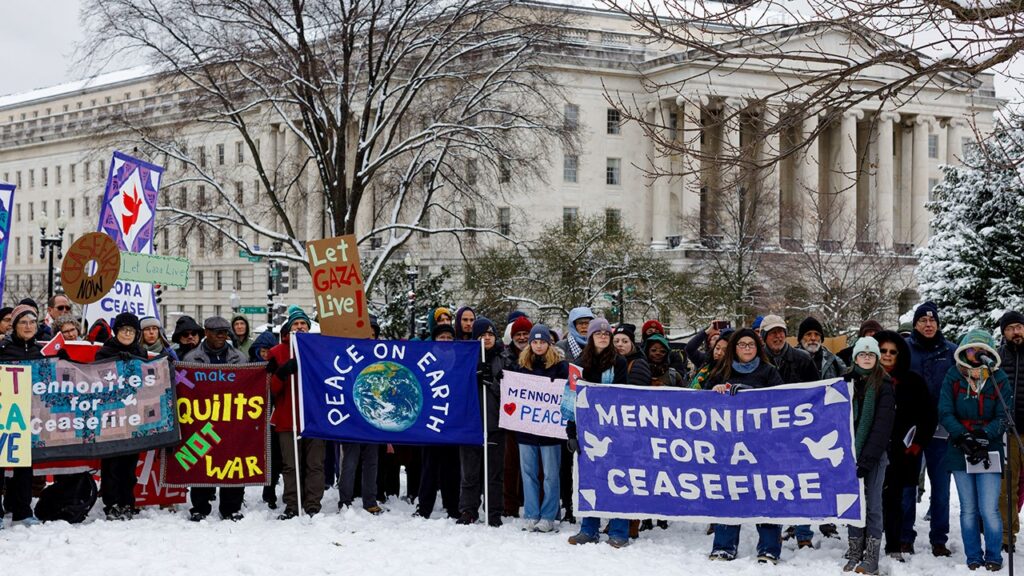
And I have relatives in CMC churches that I know are actively engaged in the wider political pro-life movement, going to marches and rallies and so forth. At least judging from their Facebook feeds. Beyond that I really can't generalize. I have no idea the extent to which LMC churches engage in either of those things, for example.
0 x
A fool can throw out more questions than a wise man can answer. -RZehr
Re: Mainline/Mainstream Anabaptists
These seem like good categories, although I don't know the finer details of the difference between moderate and libreal mainline/mainstream. (I was using the term "mainstream" to refer to "moderate mainline/mainstream", and "mainline" to refer to "liberal mainline/mainstream", but I think your names are better.) However, I would call them this, because of the close similarities to other mainline Protestant denominations:Ernie wrote: ↑Mon Jun 02, 2025 4:14 pmHere are some proposed categories. You all can help me flesh this out and even suggest different terms if you like.
Theologically Conservative Anabaptists (non-Plain) - Do not ordain women and do not invite ordained women from other Anabaptist churches to preach or lead in a mixed worship assembly. (In general, women's roles are more defined - more of a complementarian model.) Emphasize things like evangelism, inerrancy (and more literal interpretation of scripture), substitutionary atonement, personal salvation, etc. Do not permit certain types of divorce and remarriage (although not as strict as Plain Anabaptists).
Moderate Mainline/Mainstream Anabaptists - Ordain women pastors and bishops. Do not permit practicing LGBTQ as members.
Liberal Mainline/Mainstream Anabaptists - Accept practicing LGBTQ folks in the church, but do not celebrate LGBTQ or ordain such folks.
Progressive Anabaptists - Celebrate LGBTQ
Moderate Mainline Anabaptist - analogous to Anglican Church of North America, Diocese of the Great Lakes
Liberal Mainline Anabaptist - analogous to the United Church of Christ's Biblical Witness Fellowship
Progressive Mainline Anabaptist - analogous to The Episcopal Church (U.S.), Diocese of New York
Yes, I would agree with that observation (and I think this goes back quite a few decades, back to even the Vietnam era when the Central District / General Conference sort of crowd engaged in some anti-Vietnam War protests; if I recall correctly, Lancaster Conference eschewed such protests.)Ken wrote: ↑Mon Jun 02, 2025 4:32 pmOne thing I notice is that Mainstream/Progressive groups tend to engage in wider Peace and Justice activism: Gaza protests, Anti-apartheid protests, Nuclear freeze, Black Lives Matter, etc. Whereas more conservative groups, if they engage in wider political protest at all, it tends to be anti-abortion related.
Participation in one or the other is probably on a continuum from TCA - MMA - LMA - PMA.
Theological-conservative Anabaptists tend to be becoming generic North American evangelical Christians, and so tend to adopt the same ideas they have. If they aren't adopting this identity, then they still have more in common with fundamental-conservative (what Ernie calls progressive-conservative) Anabaptists.And I have relatives in CMC churches that I know are actively engaged in the wider political pro-life movement, going to marches and rallies and so forth. At least judging from their Facebook feeds. Beyond that I really can't generalize. I have no idea the extent to which LMC churches engage in either of those things, for example.
One consequence of this is that an LMC church might be a little more connected to some Anabaptist ideals, including less participation in war, than a theological-conservative Anabaptist group that has adopted an evangelical identity. If I could make a stereotype, I would say that TCA is the "least" Anabaptist of any of the alignments.
0 x
Re: Mainline/Mainstream Anabaptists
I stand my ground. My GSD was non resistant (well trained) and definitely was into separate (she did not warm to anyone outside the family). Definitely a better Anabaptist than most in LMC
Lighten up, but it is true. The question is less where is LMC than will it not continue to roll simply 20-25 years behind mainstream Protestant churches. Hope I am wrong.
Lighten up, but it is true. The question is less where is LMC than will it not continue to roll simply 20-25 years behind mainstream Protestant churches. Hope I am wrong.
0 x
Re: Mainline/Mainstream Anabaptists
I suspect most LMC members are more Anabaptist than Catholics, though.JayP wrote: ↑Mon Jun 02, 2025 5:42 pm I stand my ground. My GSD was non resistant (well trained) and definitely was into separate (she did not warm to anyone outside the family). Definitely a better Anabaptist than most in LMC
Lighten up, but it is true. The question is less where is LMC than will it not continue to roll simply 20-25 years behind mainstream Protestant churches. Hope I am wrong.
0 x
Re: Mainline/Mainstream Anabaptists
Categorizing the denominations in the OP as mainline and mainstream does not make a lot of sense to me. Mainstream seems to be used interchangeably with mainline. Mainline has a clear definition, I don’t think mainstream does. When I use mainstream Anabaptists, I am thinking of any assimilated Anabaptist group from Rosedale to MC USA.
There seems to be a consensus on this forum that women’s ordination is a marker of mainline identity. I disagree. All mainline churches ordain women, but not all churches that ordain women are mainline. The Assemblies of God ordains women, and they are not mainline. Denominations do not ordain women for the same reasons. Many mainline churches see women’s ordination as a justice issue. Denominations like the Assemblies of God and LMC have a higher view of Biblical authority and make their case for women’s ordination using Scripture.
I don't see LMC as mainline, because it generally does not associate with mainline churches. Children of LMC parents marry other evangelicals. Many MC USA churches affiliate with other mainline denominations in interfaith organizations, etc. At a MC USA church in my area, a UCC pastor served as an interim pastor until they found a pastor.
Here is my tentative taxonomy for assimilated Anabaptists
Conservative evangelical Anabaptists - Rosedale, parts of LMC and Brethren in Christ. Do not ordain women, Lean more towards fundamentalism, inerrancy.
Neo-evangelical Anabaptists - The majority of LMC and Brethren in Christ, a few exiting MC USA congregations. Ordain women. Less fundamentalist, open to neo-evangelical biblical interpretation. Pastors go to seminary at places like Gordon Conwell or Fuller Seminary
Conservative mainline - Large chunk of MC USA and COB. Accept practicing LGBTQ folks in the church, but do not celebrate LGBTQ or ordain such folks. Holding onto more theological orthodoxy
Moderate mainline - Large chunk of MC USA and COB. Affirm and celebrate same-sex marriage. Use the language of Christianity. Not sure what they believe about the Bible. Embrace and celebrate doubt, curiosity over certainty
Progressive mainline - Some percentage of MC USA and COB. Same-sex marriage is a justice issue, and the traditional position is oppressive. May or may not believe in the divinity of Jesus
There seems to be a consensus on this forum that women’s ordination is a marker of mainline identity. I disagree. All mainline churches ordain women, but not all churches that ordain women are mainline. The Assemblies of God ordains women, and they are not mainline. Denominations do not ordain women for the same reasons. Many mainline churches see women’s ordination as a justice issue. Denominations like the Assemblies of God and LMC have a higher view of Biblical authority and make their case for women’s ordination using Scripture.
I don't see LMC as mainline, because it generally does not associate with mainline churches. Children of LMC parents marry other evangelicals. Many MC USA churches affiliate with other mainline denominations in interfaith organizations, etc. At a MC USA church in my area, a UCC pastor served as an interim pastor until they found a pastor.
Here is my tentative taxonomy for assimilated Anabaptists
Conservative evangelical Anabaptists - Rosedale, parts of LMC and Brethren in Christ. Do not ordain women, Lean more towards fundamentalism, inerrancy.
Neo-evangelical Anabaptists - The majority of LMC and Brethren in Christ, a few exiting MC USA congregations. Ordain women. Less fundamentalist, open to neo-evangelical biblical interpretation. Pastors go to seminary at places like Gordon Conwell or Fuller Seminary
Conservative mainline - Large chunk of MC USA and COB. Accept practicing LGBTQ folks in the church, but do not celebrate LGBTQ or ordain such folks. Holding onto more theological orthodoxy
Moderate mainline - Large chunk of MC USA and COB. Affirm and celebrate same-sex marriage. Use the language of Christianity. Not sure what they believe about the Bible. Embrace and celebrate doubt, curiosity over certainty
Progressive mainline - Some percentage of MC USA and COB. Same-sex marriage is a justice issue, and the traditional position is oppressive. May or may not believe in the divinity of Jesus
1 x
Re: Mainline/Mainstream Anabaptists
Thanks for that, Cooper. Do most pastors in Mainline Anabaptist churches go to seminary? If so, which seminaries for each category?Here is my tentative taxonomy for assimilated Anabaptists
Conservative mainline - Large chunk of MC USA and COB. Accept practicing LGBTQ folks in the church, but do not celebrate LGBTQ or ordain such folks. Holding onto more theological orthodoxy
Moderate mainline - Large chunk of MC USA and COB. Affirm and celebrate same-sex marriage. Use the language of Christianity. Not sure what they believe about the Bible. Embrace and celebrate doubt, curiosity over certainty
Progressive mainline - Some percentage of MC USA and COB. Same-sex marriage is a justice issue, and the traditional position is oppressive. May or may not believe in the divinity of Jesus
Last edited by ohio jones on Mon Jun 02, 2025 11:01 pm, edited 1 time in total.
Reason: coding
Reason: coding
0 x
A wee little man can’t say, I’m sorry. A big man owns his mistakes and apologizes.
A wee little man trusts himself and his own discernment. A big man is humble enough to know that he needs the counsel and input of others.
A wee little man trusts himself and his own discernment. A big man is humble enough to know that he needs the counsel and input of others.
Re: Mainline/Mainstream Anabaptists
Mainline pastors are much more likely to be seminary educated than evangelical Anabaptists. This categorization business is a little arbitrary, life is a lot messier. Probably the more conservative and moderate mainline Anabaptists are more likely to come from places like Fuller or denominational seminaries like Eastern Mennonite Seminary, AMBS, or for COB Bethany Seminary. For the more progressive mainline Anabaptist pastors, they are more likely to study outside Anabaptist seminaries. Lancaster Theological Seminary (UCC), Princeton Theological Seminary (PC USA) etc.
0 x
-
Ken
- Posts: 21863
- Joined: Thu Jun 13, 2019 12:02 am
- Location: Washington State
- Affiliation: former MCUSA
Re: Mainline/Mainstream Anabaptists
That may not be true in the wider Protestant world. But I think it is a pretty true marker in the Anabaptist/Mennonite world.cooper wrote: ↑Mon Jun 02, 2025 8:54 pmThere seems to be a consensus on this forum that women’s ordination is a marker of mainline identity. I disagree. All mainline churches ordain women, but not all churches that ordain women are mainline. The Assemblies of God ordains women, and they are not mainline. Denominations do not ordain women for the same reasons. Many mainline churches see women’s ordination as a justice issue. Denominations like the Assemblies of God and LMC have a higher view of Biblical authority and make their case for women’s ordination using Scripture.
0 x
A fool can throw out more questions than a wise man can answer. -RZehr
Re: Mainline/Mainstream Anabaptists
Women's ordination in Anabaptist circles is simply fundamentally different from other groups. For example, conservative Holiness Methodist groups like the ones who run Allegheny Wesleyan College life a lifestyle that is essentially the same as fundamental-conservative Anabaptists, yet they have always ordained women are completely comfortable with it. The same is true of Oneness Pentecostals, whose lifestyles are equal to or more conservative than fundamental-conservatives, and they have also been ordaining women for 100 years, although it is not very common, and they wouldn't be ordained as a bishop alone (but they might do so as part of a married couple). (In this sense, they are very similar Lancaster Conference.)
Cooper, overall, I like your nuances and terminology. I never particularly liked the term "theological-conservative Mennonites", since a lot of their theology wasn't conservative in a Mennonite sense at all. However, "conservative evangelical Anabaptists" is a somewhat confusing term. I'm not sure what a better one would be. The term "conservative" applied to any non-plain groups is going to confuse a lot of people.
Cooper, overall, I like your nuances and terminology. I never particularly liked the term "theological-conservative Mennonites", since a lot of their theology wasn't conservative in a Mennonite sense at all. However, "conservative evangelical Anabaptists" is a somewhat confusing term. I'm not sure what a better one would be. The term "conservative" applied to any non-plain groups is going to confuse a lot of people.
0 x