A thread to discuss writings and pictures from the early centuries AD.
This can include scripture, books that did not make it into the canon, ante-Nicene writings written by Christians, and other writings not written by Christians.
Reading and benefitting from media from the first centuries AD
Reading and benefitting from media from the first centuries AD
Last edited by Ernie on Wed Apr 16, 2025 2:40 pm, edited 1 time in total.
1 x
A wee little man can’t say, I’m sorry. A big man owns his mistakes and apologizes.
A wee little man trusts himself and his own discernment. A big man is humble enough to know that he needs the counsel and input of others.
A wee little man trusts himself and his own discernment. A big man is humble enough to know that he needs the counsel and input of others.
Reading and benefitting from media from the first centuries AD
I see the early church writings in the NT as addressing matters of their day, not an attempt to address everything that might come up in the future. (much like most writings today) I believe that God superintended this process and made sure that all necessary principles and descriptions for living a godly life and having healthy churches were included in the NT.
If, for example, the lot continued to be used by the Apostles, but was not recorded in the NT, I would assume this is a good practice for Christians to consider using today, although not prescriptive. Since we have no record of using the lot more than once, (before the Holy Spirit was given) then I don't see it as being a practice to model today.
The same is true with anointing one's head and washing one's face. There is no further mention of this practice in the ante-Nicene writings.
Regarding men being instructed in the NT to lift hands in prayer, I would assume that was something for a particular time or a particular place, (similar to anointing one's head and washing one's face before fasting) if it were not for the fact that quite a few early writers from different areas affirmed this practice.
I am not aware of infant baptism being practiced for sure before the early 200's.
I like to study beliefs and practices not mentioned in the NT and ask, "When did this idea originate? Who first promoted this idea? What precipitated this idea? What is the fruit of this idea? Does it disagree with what we read in the NT? If the latter, then it is definitely not something we should believe or practice today!
0 x
A wee little man can’t say, I’m sorry. A big man owns his mistakes and apologizes.
A wee little man trusts himself and his own discernment. A big man is humble enough to know that he needs the counsel and input of others.
A wee little man trusts himself and his own discernment. A big man is humble enough to know that he needs the counsel and input of others.
Re: Reading and benefitting from media from the first centuries AD
Well, "first centuries" would encompass that... I am a firm believer in adult baptism but also strongly believe the consensus is real that infant baptism is an error the church fell into very quickly. It's a reason I think the NT needs to be our guide.
Yes, as an area for essentially secular study it is fine.I like to study beliefs and practices not mentioned in the NT and ask, "When did this idea originate? Who first promoted this idea? What precipitated this idea? What is the fruit of this idea? Does it disagree with what we read in the NT? If the latter, then it is definitely not something we should believe or practice today!
1 x
Re: Reading and benefitting from media from the first centuries AD
I agree that looking at the early church beyond the NT can be really valuable. But it takes time and effort to do that with the New Testament, and doing it beyond the New Testament is even harder. I think same principles for understanding the NT writers also apply when reading the ante-Nicene writers:
1. You have to read each writer in context. Just like the NT, these early writers were addressing specific issues in specific communities. You can’t just skim them or pull quotes and expect to understand what they meant.
2. Getting an accurate picture takes time. You have to read multiple authors and compare what they’re saying across different times and places. It’s a much bigger task than just finding a few quotes to support a view.
3. There's no shortcut. Reading just to find a list of beliefs or practices - without understanding the flow of thought - can easily mislead. These writers lived in a very different world than we do, and wrote and thought differently than we do.
I think we all know the difference between reading entire books of the New Testament together, comparing them to other books, doing that prayerfully and together. The same thing applies to ante-Nicene writings. For most of us, doing that with just the Bible takes quite a bit of time. I have only read a portion of the ante-Nicene writings in any depth, and generally want to be careful with these writings.
Also, I think it's helpful to look at one book at a time. Didache, or Shepherd of Hermas, etc. Generalities about "the early church" aren't as helpful as looking at specifics. That's also similar to the Bible. "The Bible says" doesn't always help me understand what the Bible actually says. Looking carefully at Ruth together, a little at a time, does. Or Genesis. Or 1 Peter. Or Galatians. Then considering them together ...
I'm not implying that anyone in this thread is or is not doing it this way. But I do think it takes a lot of time. And for most of us, doing this for just the Bible is already a lot of effort.
0 x
1. Are we discussing the topic? Good.
2. Are we going around and around in a fight? Let's stop doing that.
3. Is there some serious wrongdoing or relational injury? Let's address that, probably not in public and certainly not for show.
2. Are we going around and around in a fight? Let's stop doing that.
3. Is there some serious wrongdoing or relational injury? Let's address that, probably not in public and certainly not for show.
-
JohnL
- Posts: 2790
- Joined: Tue Oct 29, 2024 1:40 pm
- Location: The Bionic Hillbilly
- Affiliation: Free Will Baptist
Re: Reading and benefitting from media from the first centuries AD
Here’s my take- The NT is a book that reveals Jesus and his role in the Trinity. It’s also a book that teaches us how we should conform our spiritual life and attitudes to be like Jesus. I don’t think outward religious practices are really treated like absolute directives because Jesus emphasized that our actions are to reflect our inner beliefs like the Good Samaritan, the woman at the well and what have you. Jesus’ sermon on the mount really made that connection.
0 x
Free Will Baptist <-> Anabaptist
”Try hard not to offend. Try harder not to be offended.” Robert Martz
”Try hard not to offend. Try harder not to be offended.” Robert Martz
Re: Reading and benefitting from media from the first centuries AD
Are there any outward religious practices in the New Testament that you think should be treated like absolute directives?JohnL wrote: ↑Wed Apr 16, 2025 5:08 pm Here’s my take- The NT is a book that reveals Jesus and his role in the Trinity. It’s also a book that teaches us how we should conform our spiritual life and attitudes to be like Jesus. I don’t think outward religious practices are really treated like absolute directives because Jesus emphasized that our actions are to reflect our inner beliefs like the Good Samaritan, the woman at the well and what have you. Jesus’ sermon on the mount really made that connection.
0 x
A wee little man can’t say, I’m sorry. A big man owns his mistakes and apologizes.
A wee little man trusts himself and his own discernment. A big man is humble enough to know that he needs the counsel and input of others.
A wee little man trusts himself and his own discernment. A big man is humble enough to know that he needs the counsel and input of others.
-
JohnL
- Posts: 2790
- Joined: Tue Oct 29, 2024 1:40 pm
- Location: The Bionic Hillbilly
- Affiliation: Free Will Baptist
Re: Reading and benefitting from media from the first centuries AD
Hebrews 10Ernie wrote: ↑Wed Apr 16, 2025 7:22 pmAre there any outward religious practices in the New Testament that you think should be treated like absolute directives?JohnL wrote: ↑Wed Apr 16, 2025 5:08 pm Here’s my take- The NT is a book that reveals Jesus and his role in the Trinity. It’s also a book that teaches us how we should conform our spiritual life and attitudes to be like Jesus. I don’t think outward religious practices are really treated like absolute directives because Jesus emphasized that our actions are to reflect our inner beliefs like the Good Samaritan, the woman at the well and what have you. Jesus’ sermon on the mount really made that connection.
Attending church or fellowship or Bible study I think should be "a" directive just not an absolute one. Better to call it a "guidance for spiritual health in my experience.25 not forsaking the assembling of ourselves together, as is the manner of some, but exhorting one another, and so much the more as you see the Day approaching.
If someone is away for a long time there's a tendency for going astray in many ways in the spiritual walk. There's many legit reasons for remaining at home such as illness or caregiving.
I think if it's noticed that someone has stopped attending then go visit and pray with them. Take the assembly to them. We don't know what's brewing in their coffeepot so to speak that's keeping them away until we go and let them tell us. During the COVID lockdown a lot of people just kind of turned inwards on themselves and forgot the need to be around others. Depression, loneliness and other emotional problems plagued them.
We don't have to be around others all the time but I think it's important to encourage that assembly in the name of the Lord at least once a week because it helps to provide balance and perspective in our walk with Jesus.
1 x
Free Will Baptist <-> Anabaptist
”Try hard not to offend. Try harder not to be offended.” Robert Martz
”Try hard not to offend. Try harder not to be offended.” Robert Martz
Re: Reading and benefitting from media from the first centuries AD
Patheos / Communal Reading In The Ancient World & The Early Church
https://www.patheos.com/blogs/geneveith ... ly-church/
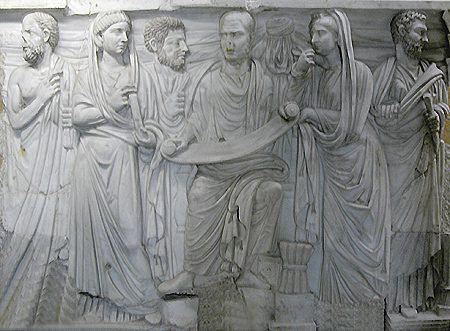
Illustration: Sarcophagus relief, woman standing among men around a seated male (teacher?) with a scroll open on his lap.
Roman, late imperial/Christian. Rome, Vatican Museum. Via VROMA. Public Domain
https://www.patheos.com/blogs/geneveith ... ly-church/
In the ancient world, people read out loud, even when they were by themselves. Thus, Stephen could overhear the Ethiopian eunuch reading The Book of Isaiah as he drove by in his chariot. Not only that, as new research shows, people also read out loud to each other.
In his book Communal Reading in the Time of Jesus: A Window into Early Christian Reading Practices, Brian J. Wright shows that people were reading to each other all the time–at home, in the marketplace, in the taverns, in the public baths, whenever friends got together, whenever strangers got together. Prof. Wright quotes bystanders complaining about the racket!
Not everyone could read–though perhaps more than has been realized–but even those who were illiterate had access to books, which had been read to them. And they internalized what they had heard. Prof. Wright cites examples of individuals catching mistakes, noting differences with what the listeners had heard before.
Communal reading was thus the television, the movies, and the internet of the time!
The communal reading would have included the works of Homer, the speeches of Cicero, the satirical poets, the Greek and Roman historians, the accounts of Caesar’s conquests. And it would have also included the epistles of St. Paul and the Gospels of Matthew, Mark, Luke, and John.
This must have been a key factor in the spread of Christianity. People were likely evangelized not so much by “witnessing,” as we think of it today, but by actually hearing texts of Scripture being read aloud. And, as we are told in those Scriptures, “faith comes from hearing, and hearing through the word of Christ” (Romans 10:17).
Hearing. The Word of God is an oral communication, meant to be heard.
Such communal reading, of course, is also the context for the public, oral reading of the Bible as a central part of Christian worship. This liturgical reading of Scripture is accompanied by preaching, in which the pastor explains, discusses, and applies what was read.
I suspect something similar happened informally in the communal readings, with the reader reflecting upon the text and the group talking about what had been read.
Read the interview with Brian Wright in Christianity Today.
Not until around 400 A.D. do we find the first mention of someone reading silently, with St. Augustine marveling in his Confessions that his mentor St. Ambrose had this power. (“When he read, his eyes travelled across the page and his heart sought out the sense, but voice and tongue were silent.” [Book VI. Chapter 3]) But always reading out loud persisted for most people as late as the 10th century. (See this history of reading.)
Do you think something was lost–or at least changed–once reading became primarily a private, interior activity?
Do you think we might bring back communal reading? Some families read books out loud, primarily for the benefit of young children, but everyone seems to enjoy it. I remember in primary school having teachers who read books to the class–particularly, the whole Little House on the Prairie saga–and I still remember how vivid the story became, even more so than when I later read the books to myself. Many good Bible studies consist of just taking turns reading the text aloud, then talking about it.
What about reading out loud to yourself? I have heard that this can be a powerful way to read the Bible, preventing getting lost and distracted in the interior musings of one’s mind.
Illustration: Sarcophagus relief, woman standing among men around a seated male (teacher?) with a scroll open on his lap.
Roman, late imperial/Christian. Rome, Vatican Museum. Via VROMA. Public Domain
0 x
i’m perfectly comfortable with an older, wiser, more docile Trump.
”Try hard not to offend. Try harder not to be offended.” Robert Martz
”Try hard not to offend. Try harder not to be offended.” Robert Martz
Re: Reading and benefitting from media from the first centuries AD
People historically had to read out loud even when alone and children usually learn to read out loud first. Even today almost everyone reading silently is still making microscopic tongue movements as they read.temporal1 wrote: ↑Thu Apr 17, 2025 12:02 am Patheos / Communal Reading In The Ancient World & The Early Church
https://www.patheos.com/blogs/geneveith ... ly-church/
Most early Christians probably never read the Bible but had it read to them and in that they would have had access to information that’s lost to us. For example 1 Corinthians 10:23: “All things are lawful for me, but all things are not expedient: all things are lawful for me, but all things edify not.” Who is saying “all things are lawful for me”? Paul or someone Paul is arguing against? A lot of translations put that part in quotes and based on the rest of 1 Corinthians it sounds like something the Corinthians would say—“I can do whatever I want.” Who the intended “speaker” is is information that can easily be conveyed when reading out loud. Try reading it both ways, first in one voice as a single sentence, then in two voices, argument and response: “‘All things are lawful for me’—but all things are not expedient.” And the readers would have known the intended tone to use from having heard it before themselves going back to the first messenger from Paul. Early Christian writings might enlighten some of the context for things like this for us that we might otherwise miss.
Anyway that’s why I read MennoNet out loud, even in public. You should see the looks you people get for some of the things you say.
3 x
Re: Reading and benefitting from media from the first centuries AD


I’d like to see/hear that! What voices and tones do you choose?
1 x