Ken wrote: ↑Wed Mar 19, 2025 1:55 pmYes, Amish and conservative Mennonite communities are, in fact, insular and largely reject outsiders.
Perhaps some do, but many don't. There are plenty of "outsiders" in my particular denomination. There are even in Amish circles, although they can be somewhat hard to identify since, well, they tend to all look the same due to attire, haircuts and so forth.
If you are a young non-Amish single man, what are the chances that you will be able to find an Amish wife? Slim to none I would suggest.
Most single people who join an Amish or Mennonite church end up "marrying in". It is just an inevitability. The ones who do not, well, they are usually very odd people who either don't want to get married or are very socially "off".
And there are whole threads here on Mennonet about all the steps and "secret handshake" stuff that seekers need to go through to break into a conservative Anabaptist congregation. As well as all the anecdotal reports about how long it takes (if ever) for an outsider to be fully accepted as a member. That is the very definition of an insular community.
Again, that is true maybe of some groups but not others and certainly not all.
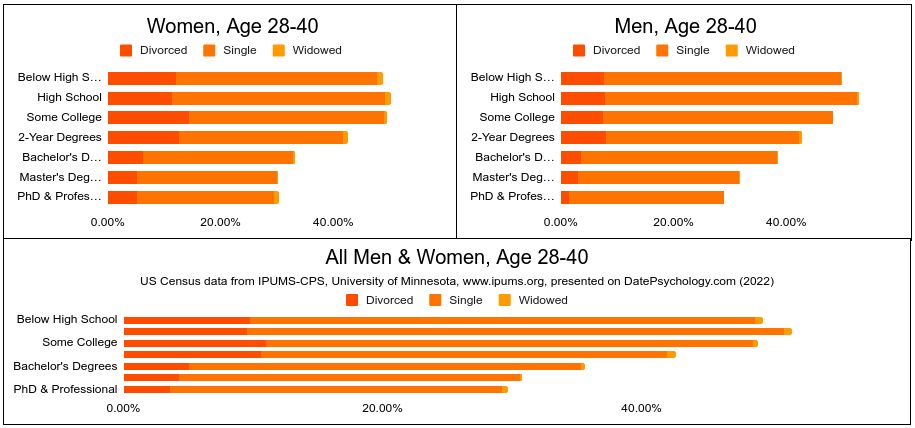
And what is this nonsense about rain making streets wet? The fact of the matter is that BOTH being Amish and being college educated are linked to higher marriage and lower divorce rates for perfectly well understood and well studied reasons.
But the fact Amish almost entirely reject college yet have very high marriage rates and very low divorce rates means that college is not actually the cause. Instead, it is correlating with something else; my guess is it is a correlation with general intelligence and with social class. People with higher general intelligence are less likely to be criminal, less impulsive, do better at delaying gratification and so forth. It is not particularly helpful, though, to observer that "If you could just be born smarter, then you would have more desirable life outcomes."
Or are you saying that your "streets wet" analogy applies to the Amish as well? And that there is nothing particular about being Amish that leads to higher marriage rates, it is just coincidence?
What I am saying is that simply saying if you send someone to college, it will make them more likely to get married and not divorced, may be entirely incorrect, because you could be missing a third factor that leads
both to people going to college and getting married/not divorced.
What is happening with the Amish is something different entirely, because it does not have any self-selection. The entire population (almost) gets married and divorce is (almost) nonexistent. This holds true even for people who are somewhat marginal, perhaps not very intelligent, or otherwise have setbacks that would cause them to have worse life outcomes in a non-Amish setting. It would seem that whatever the Amish and plain Mennonite lifestyle it is, it leads to better life outcomes (in certain dimensions).