The farm we live on was cut in half about 25-30 years ago by I-99. (Literally cut in half as a 100'+ gorge was literally cut through the farm.)
When the 10-acre farm where we live was purchased about 10 years ago, it was rather landlocked, so it didn't cost very much. But the other half of the farm on the other side of I-99 is currently for sale for about 10M.
Freeway Removal. Freeway Lids
-
Bootstrap
Re: Freeway Removal. Freeway Lids
I know mostly the way this happened in Durham, NC. A lot of this happened with "urban renewal" programs linked to highway projects. They promised a renewal that did not happen.
This page describes it well:
https://www.bullcity150.org/uneven_grou ... ing_hayti/
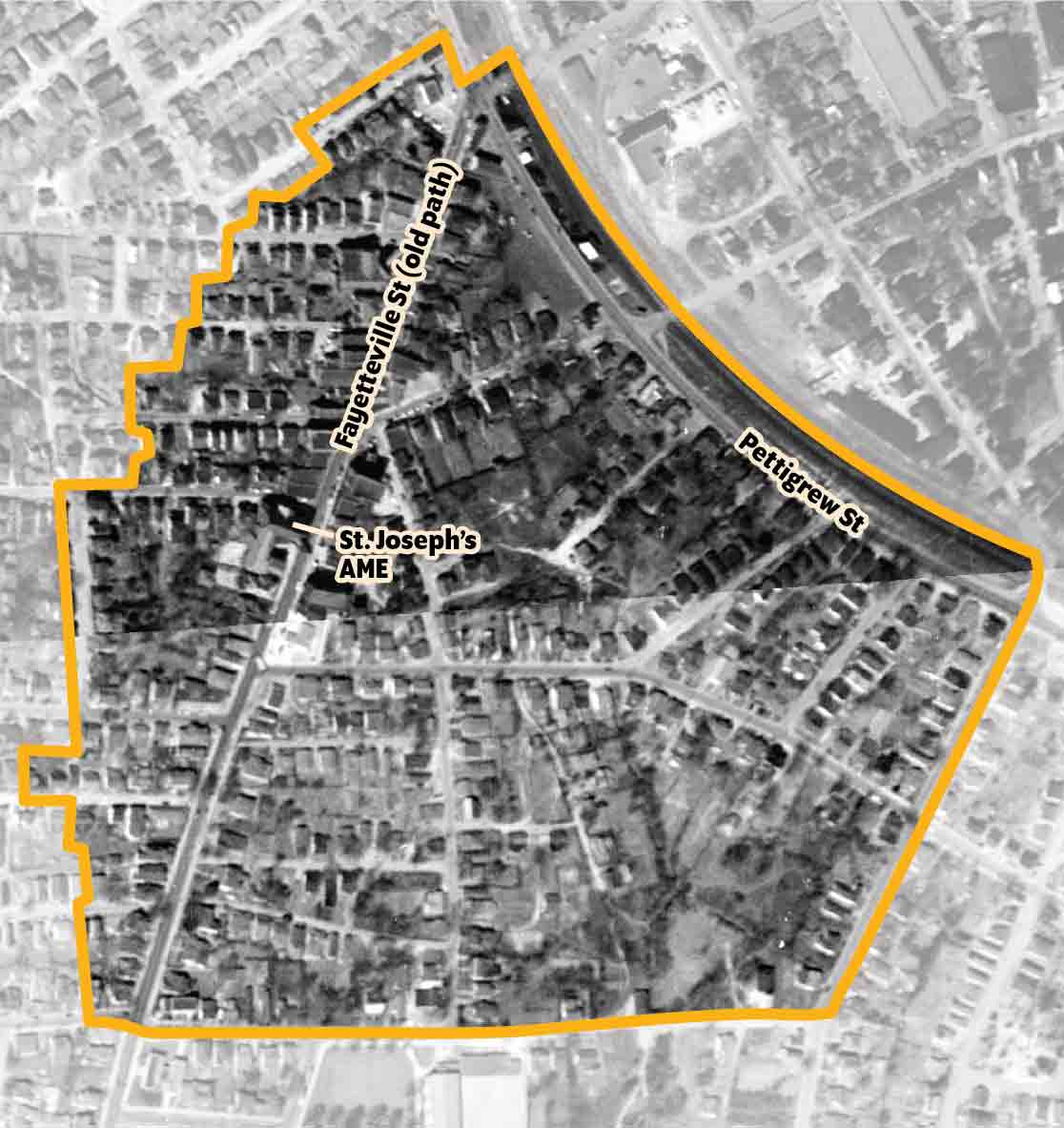
Before:In the late 1960s, city officials planned to demolish every building in the outlined area except for St. Joseph’s AME church.
After:
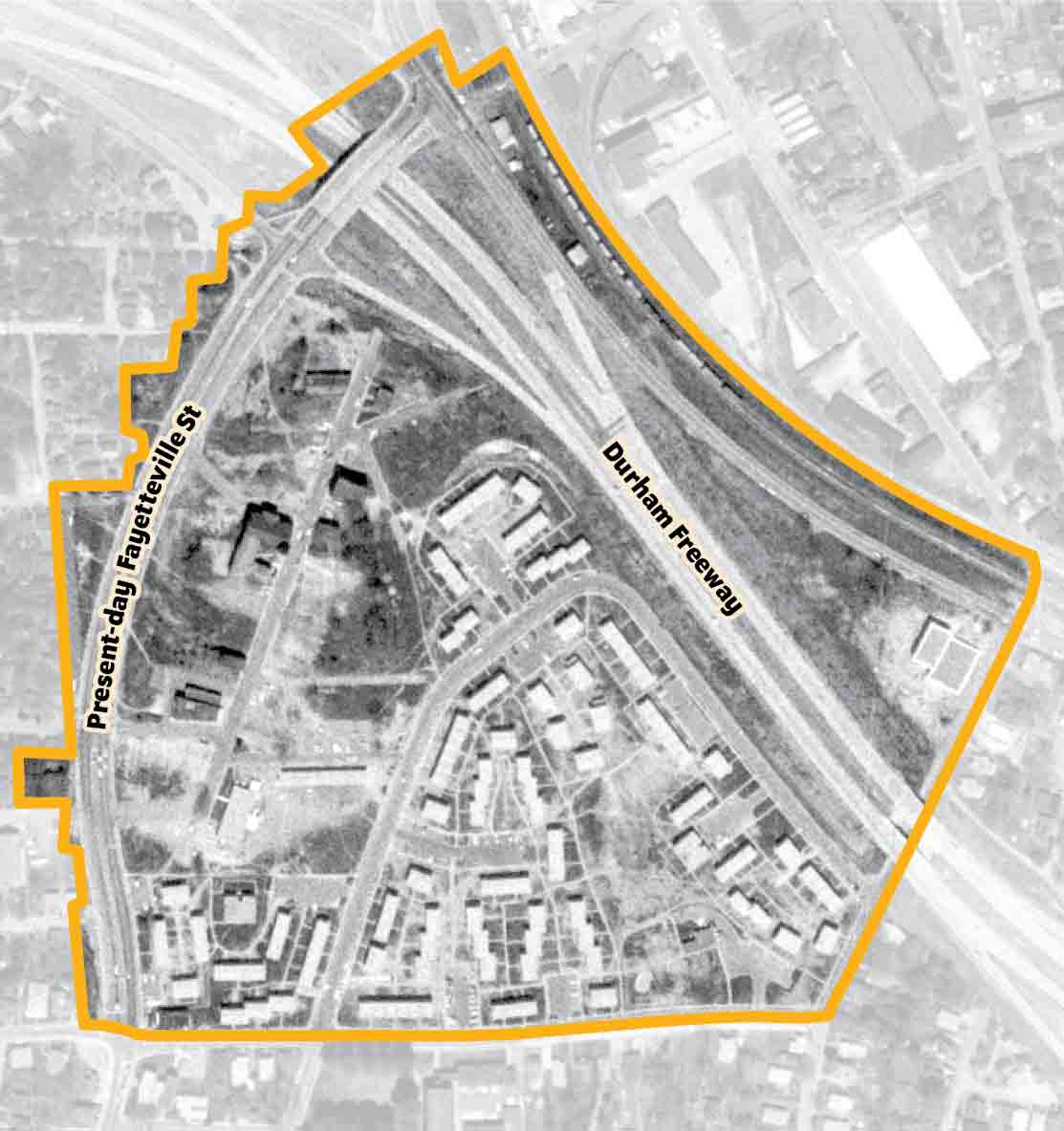
Urban renewal and the Durham Freeway destroyed much and would replace little.
In the end, over 4,000 families and 500 businesses were displaced. The price tag for the destruction of Hayti was $300 million in today’s dollars, three-quarters of which was paid for by the federal government.
But the promise of a renewed Hayti never came.
0 x
Re: Freeway Removal. Freeway Lids
Proposals putting a lid of parkland on sections of the cross bronx expressway have been floated but so far, no one has put up the money.Ernie wrote: ↑Sat Aug 31, 2024 3:32 pm https://en.wikipedia.org/wiki/Freeway_removal
https://en.wikipedia.org/wiki/Freeway_lid
This is a thread to discuss Freeway Removal, Freeway Lids (caps and stitches), etc.
A more urgent project is replacing the triple level cantilever section of the Brooklyn Queens expressway which probably qualifies as one of the first lidded expressways dating back to the 60's. Portions of it are for cars only as it can no longer near the weight of trucks. The top layer is the Brooklyn promenade overlooking the East River toward Manhattan. Proposals I have seen are to put the road completely underground with parkland terraces descending over it. It's a fascinating project deserving a google search.
0 x
-
Ernie
Re: Freeway Removal. Freeway Lids
That is indeed fascinating. So a final plan has not yet been set in concrete?
0 x
Re: Freeway Removal. Freeway Lids
Not yet. The traffic snarl from the construction will be monumental.
0 x
-
Josh
Re: Freeway Removal. Freeway Lids
For an example of a “lid”, see Boston’s Big Dig - $10 billion for a few miles of road.
0 x
-
Biblical Anabaptist
Re: Freeway Removal. Freeway Lids
https://www.google.com/maps/@39.9672669 ... QAw%3D%3DErnie wrote: ↑Sat Aug 31, 2024 3:37 pm Wikipedia says this...
I have no doubt that freeways were often built through minority neighborhoods in urban centers.Freeway removals most often occur in cities where highways were built through dense neighborhoods - a practice common in the 20th Century, particularly in U.S. cities following the 1956 enactment of the National Interstate and Defense Highways Act. These highways often created blight that minimized use of land space and reduced the quality of life for city residents. In the United States, the routes for interstate highways were often built through minority neighborhoods in urban centers, which often led to increasing racial segregation by creating physical barriers between neighborhoods.
What I'd like to know is whether they were also often built in non-minority neighborhoods AND whether the planners deliberately avoided middle class and upper-class neighborhoods.
I am told this curve in I 81 North of Chambersburg was to go around an existing golf course.
0 x
-
Ernie
Re: Freeway Removal. Freeway Lids
I've been through that big dig and it is indeed impressive. 6 lanes wide plus exit and entrance ramps.
0 x
-
Ernie
Re: Freeway Removal. Freeway Lids
never heard that.Biblical Anabaptist wrote: ↑Sat Aug 31, 2024 11:21 pmhttps://www.google.com/maps/@39.9672669 ... QAw%3D%3DErnie wrote: ↑Sat Aug 31, 2024 3:37 pm Wikipedia says this...
I have no doubt that freeways were often built through minority neighborhoods in urban centers.Freeway removals most often occur in cities where highways were built through dense neighborhoods - a practice common in the 20th Century, particularly in U.S. cities following the 1956 enactment of the National Interstate and Defense Highways Act. These highways often created blight that minimized use of land space and reduced the quality of life for city residents. In the United States, the routes for interstate highways were often built through minority neighborhoods in urban centers, which often led to increasing racial segregation by creating physical barriers between neighborhoods.
What I'd like to know is whether they were also often built in non-minority neighborhoods AND whether the planners deliberately avoided middle class and upper-class neighborhoods.
I am told this curve in I 81 North of Chambersburg was to go around an existing golf course.

0 x
-
Ken
- Posts: 21863
- Joined: Thu Jun 13, 2019 12:02 am
- Location: Washington State
- Affiliation: former MCUSA
Re: Freeway Removal. Freeway Lids
The question is actually larger than that.Ernie wrote: ↑Sat Aug 31, 2024 3:37 pm Wikipedia says this...
I have no doubt that freeways were often built through minority neighborhoods in urban centers.Freeway removals most often occur in cities where highways were built through dense neighborhoods - a practice common in the 20th Century, particularly in U.S. cities following the 1956 enactment of the National Interstate and Defense Highways Act. These highways often created blight that minimized use of land space and reduced the quality of life for city residents. In the United States, the routes for interstate highways were often built through minority neighborhoods in urban centers, which often led to increasing racial segregation by creating physical barriers between neighborhoods.
What I'd like to know is whether they were also often built in non-minority neighborhoods AND whether the planners deliberately avoided middle class and upper-class neighborhoods.
The freeway building boom of the 1950s and 1960s also coincided with the suburbanization of America. So not only were freeways slicing through inner-city neighborhoods which were often poor and minority neighborhoods. They were doing so to advantage and promote development of middle class and affluent suburbs on the periphery. Without freeways, affluent far-flung suburbs would not have been viable. Commuting out to far-flung affluent suburbs 10-20 miles from the city center isn't going to work if all you have are 2-lane country roads and surface streets.
Look at any large American city. And with a few exceptions like NYC, the affluent neighborhoods are mostly not in the center, they are on the periphery. Much of American freeway building wasn't about interstate commerce across the country. It was about suburbanization and opening up land development on the periphery of American cities.
As for why this all happened? I would suggest it was a perfect storm of a lot of overlapping forces. Yes there was racism and "white flight" happening. But also an immense highway lobby looking for profit and business opportunities, an immense construction and real estate industry also looking for the same, a banking and finance sector looking to finance and profit off of this immense construction wave, and an auto industry also looking to do the same. And very few people with very little power who were "standing in the way of progress" and saying slow down.
That is how most American urban areas became sprawling and car-centric compared to European cities that are more compact and dense. Was racism a factor? Sure. But it was far from the only force at play.
0 x
A fool can throw out more questions than a wise man can answer. -RZehr