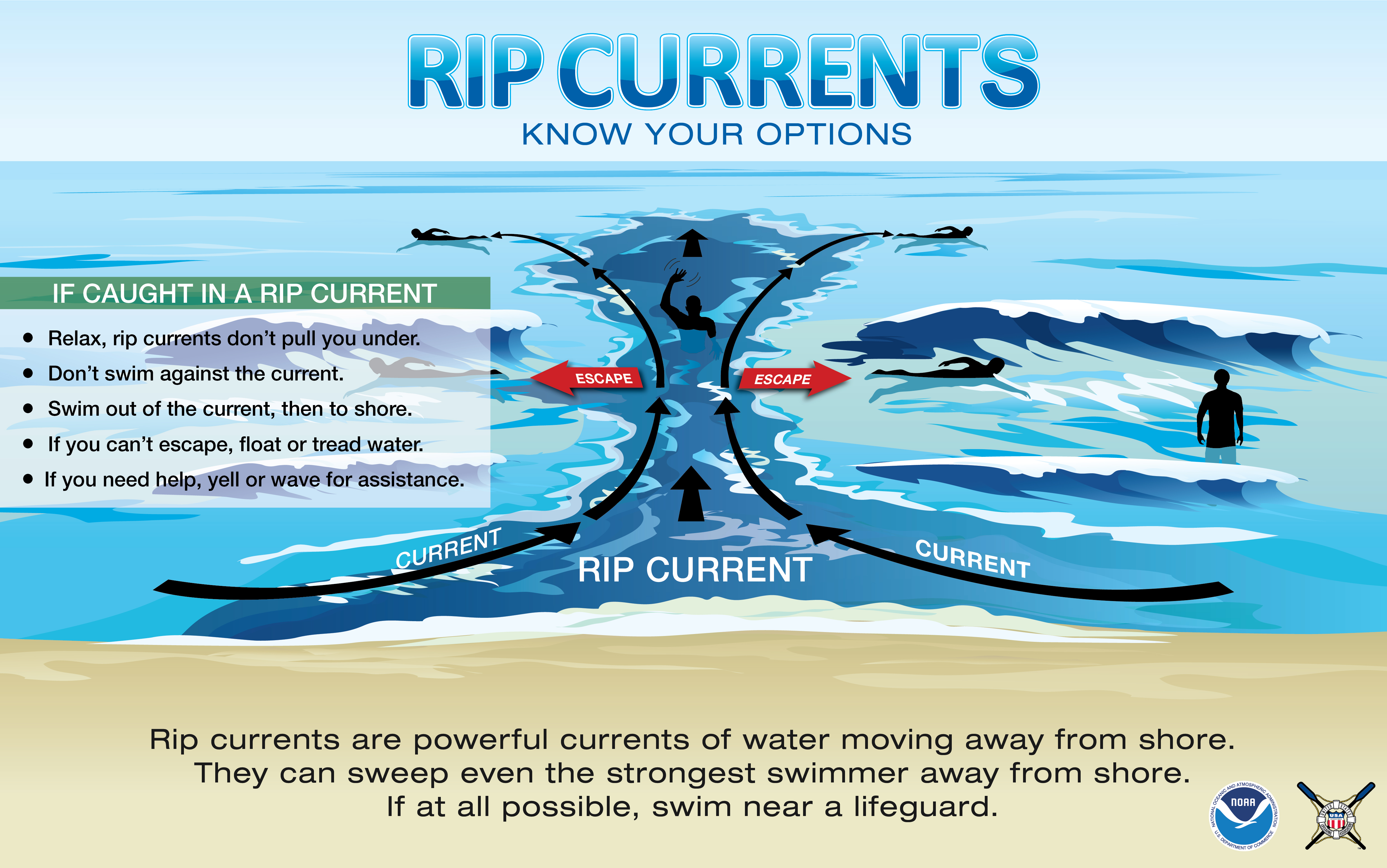
The methods of avoiding being taken out to sea are as follows:
-Swim parallel to the shoreline until you exit the rip. You may encounter a feeder rip or be in a feeder rip that hits the main rips. It does not matter, keep swimming along the shoreline. This may seem like it will take a long time, but rips are generally narrow and dissipate as you reach deeper water, so staying the course is one effective option, but it uses energy you need to get back to shore. Recommended for strong swimmers as a solution as they will likely get out of the rip more quickly. Also recommended in cold water as getting back to shore more quickly to avoid hypothermia is important.
-Keep your head above water and wait it out. You will go further out to sea, but once you are in sufficiently deep water, the rip will fade and you can approach from outside the rip. If the current moved you to one side as well as out toward deep water, you want to be certain not to swim back toward the rip, so try to swim straight in from where the rip faded.
-Do not panic. Use your head and think your way out of the situation. Learn to read the water, learn to recognize rips before you enter the water. There are plenty more videos like these that can help you recognize rips before you encounter them. Some, I can see easily, others can be hidden well by local conditions, but if you look that the water itself, you can see the spots on the beaches where water returns to the ocean.
-Be aware of “long shore currents.” These currents are caused by the incoming waves and will move you along the beach, particularly if you do not have your feet on the ground. “Longshore currents are common at any beach that is exposed to breaking surf. A longshore current is an ocean current that moves parallel to shore. It is caused by large swells sweeping into the shoreline at an angle and pushing water down the length of the beach in one direction.” These currents will eventually take you to a tide rip.
I ran into rips all the time when I used to surf off of San Diego. They are a lot easier to deal with on a surfboard since you can rest, but it is true that it is nearly impossible to try to paddle hard enough into them to get out of them. You need to travel parallel to shore first and then try to go back into shore. (You can also go farther out into the ocean, which seems illogical, but it gets you out of the rip.)
When you are stuck in one you can look around and see it - the water is swirling in a circle around you.
A common newbie mistake (like me) was to see a spot where there weren't any other surfers... and think "Oh, that's a good nice spot for me to go park in".
I was caught in one once in Puerto Escondido Mexico. Scary.
It makes more sense if you look at a diagram. They happen where two longshore currents moving in opposite directions meet. The water has to go somewhere and the only place for it to go is out to sea.
0 x
A fool can throw out more questions than a wise man can answer. -RZehr
We have rip currents where I live off the tip of Point Pelee. There are quite a number of people who regard themselves as strong swimmers that have drowned there. I have stood at the waters edge and felt the sand under my feet giving way and pulling me out into the water. Just like Niagra Falls there will always be those who will risk their lives to prove they can get away with something. The pride of man.
Wife: I never have, although I’ve gotten pretty tired in the wave pool at Elitch Gardens, if that counts. I did recently see a video for how to spot rip currents, and NOAA has produced some more updates on it since a bunch of people have died recently in the gulf.
If you’re going to the beach, check the flags, and do not swim on double red and maybe you should find a better activity to do with a single red flag. All the deaths I heard about were tourists (I remember one last year was a Mennonite dad) who may have been uninformed, and there was recently a couple with their six children with them from Pennsylvania (from prior marriages, teens and early 20s) that got caught in one along with the two older boys, and the boys got to shore, and were telling them to swim sideways while the parents were panicking and ended up drowning. Usually, the rip current itself will not drown you, and panic is the worst part of it. Supposedly, males in their teens and 20s are the most likely to die, probably because they’re more likely to be engaging in risky behavior/drinking.
Here is a decent video I found on YouTube
[media] [/media]