Where can you afford a home on your income?

Things that are not part of politics happening presently and how we approach or address it as Anabaptists.
Ken
Posts: 21863
Joined: Thu Jun 13, 2019 12:02 am
Location: Washington State
Affiliation: former MCUSA

Re: Where can you afford a home on your income?

Post by Ken »

Josh wrote: ↑Mon Jul 01, 2024 9:14 am
barnhart wrote: ↑Mon Jul 01, 2024 8:22 am
Ken wrote: ↑Mon Jul 01, 2024 12:21 am The housing market is not immune from the laws of supply and demand. In fact if you want to make the private equity firms lose their shirts, build LOTs more housing.
Just changing building codes away from single family homes on leafy lots to allow medium density housing would dramatically reduce housing costs in many markets.
Could you explain to us how we had single-family zoning for decades and yet didn't have unaffordable housing?

Likewise, can you explain how California has outlawed SFH zoning including outlawing minimum lot sizes, yet housing prices there haven't budged?

This has become almost an axiom in centre-left circles, yet we don't actually have any evidence that it's true. What I see is a strong push to create poorer-quality housing in overcrowded conditions, which benefits nobody except developers and landowners, and falsely claim is to "improve affordability". The main impediments to housing affordability right now are (1) the cost of building materials and (2) the cost of labour. Unless you're going to propose that we should pay people less than minimum wage, (2) can't be fixed, and (1) can't be fixed either unless we magically stop having trouble with inflation in our economy.
You do realize that housing is one of the most intensely studied area of economics around the world? There are literally thousands of articles and books on the subject. All of which do, in fact, confirm that housing is just like any other good. It follows the laws of supply and demand.

As for liberal cities? My experience has been the opposite. Rather than to simply recognize that housing is a good like any other and that housing markets operate under the rules of supply and demand. And that a Byzantine array of regulations interferes with the market’s ability to adjust supply to demand. The liberal tendency is to double-down and increase regulation in an attempt to micro-manage the housing economy top-down. These solutions tend to be exceedingly expensive, ineffectual, serve very few people, and are often counter productive. It is the housing approach to what RZehr describes with OSHA.

For example, Portland is currently doing two things to try to increase affordable housing. First, they are trying to actually build public housing. Which turns out to be enormously expensive since public projects always cost more than private projects and the taxpayers are left holding the bag for millions of dollars of expense to build a tiny number of new housing units. When they could instead just let private developers build more housing at zero cost to the public.

And the second thing Portland is doing is what they call inclusionary zoning in which developers are forced to include certain numbers of below-market rate units in any new project that get rented out to certain privileged people who can pass a battery of means-testing thresholds. In effect, what they are doing is asking the private sector so subsidize low-income housing. What is the actual effect of such programs? We know this because people actually study it. What happens is two things. First, some projects just never get built because the economics for builders don’t pencil out if they are forced to subsidize low income housing on their own. Second, less market-rate housing gets built. Which reduces the overall supply of market-rate housing in the community. The reality is that the vast majority of low-income people in any given city occupy market-rate housing. Perhaps as high as 99%. So every measure that restricts the housing supply will raise rents for the vast majority of low income people who aren’t benefiting from special subsidized low income housing programs. And conversely, every measure that increases the supply of market-rate housing tends to bring down the cost for everyone.

Rent control is another liberal program that tends to be counter-productive. Luckily that hasn’t made it to the west coast but not for lack of liberals trying to implement it in cities like Portland. Again, anything to avoid the elephant in the room which is the simple fact that housing supply hasn’t kept pace with housing demand.
0 x
A fool can throw out more questions than a wise man can answer. -RZehr
RZehr

Re: Where can you afford a home on your income?

Post by RZehr »

I had two separate conversations this morning with people in the building industry. One had it that for his trade, masonry, that Bend, Oregon was the busiest place in Oregon. Apparently the rest of Oregon is slowing a bit, and the bigger mason companies are focusing on Bend.
My second conversation was with a building supply wholesaler company near Bend. I asked if they were slowing down any. He said that they were a little. But that in Bend there is a lot of "5 over 2's" going up. I wasn't familiar with that term. He explained that it is a building with 5 residential spaces built over 2 commercial spaces.
0 x
Josh

Re: Where can you afford a home on your income?

Post by Josh »

For comparison I bought an SFH inside village limits for $75k about 1400 sq ft and slightly under an acre. Old building. Would rent for $1000/mo. Worth prob. $150k now and would rent for $1750.

I looked at a downtown building with 2 apartments each about 950 sq ft, 2 bed 1 bath each, plus a downstairs commercial building about 2000 sq ft for $100k. Also old, needed some work. Apts rented for $600 each. Commercial space was pulling around $300/mo and was hard to keep leased. Asking price on the building hasn’t changed in 2 years.

I recently looked at a downtown building later that was even nicer - over 2000 sq ft, downstairs commercial space was a shoe store… upstairs had 2 recently rehabbed appartments around 1000 sq ft each, 2br 2ba. Asking $125k. I think it sold for $110. Apartments rent for $700-$800/mo. Commercial space would probably lease for $450, unless it was significantly remodelled.

For whatever reason, the mixed use buildings simply didn’t command a price premium over the single family home in terms of square footage.

The SFH doubled in value in 2 years and is clearly more desirable. The village has zoning, but the surrounding townships do not.
0 x
Ken
Posts: 21863
Joined: Thu Jun 13, 2019 12:02 am
Location: Washington State
Affiliation: former MCUSA

Re: Where can you afford a home on your income?

Post by Ken »

RZehr wrote: ↑Mon Jul 01, 2024 2:23 pm I had two separate conversations this morning with people in the building industry. One had it that for his trade, masonry, that Bend, Oregon was the busiest place in Oregon. Apparently the rest of Oregon is slowing a bit, and the bigger mason companies are focusing on Bend.
My second conversation was with a building supply wholesaler company near Bend. I asked if they were slowing down any. He said that they were a little. But that in Bend there is a lot of "5 over 2's" going up. I wasn't familiar with that term. He explained that it is a building with 5 residential spaces built over 2 commercial spaces.
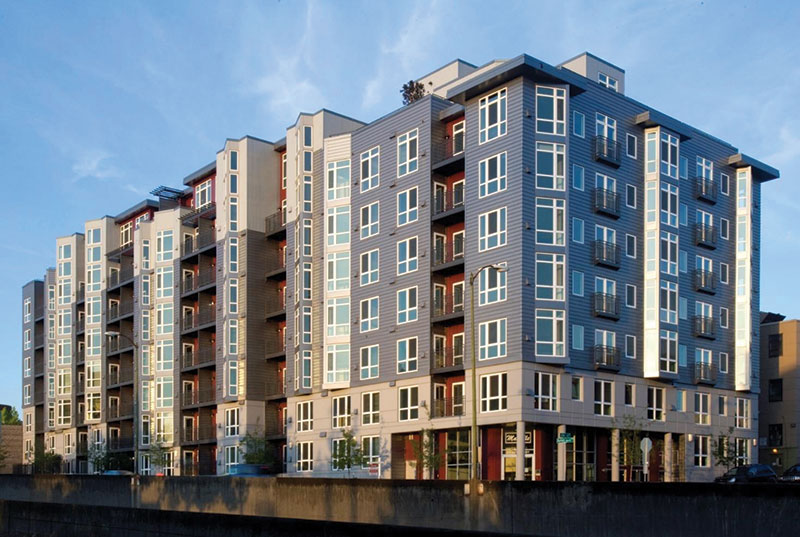
The 5 over 2 refers to floors not units.

Basically for whatever reason to do with codes and engineering, about the highest you can go with traditional stick-built wood frame construction is 5 stories. More than 5 stories you need to switch to steel and concrete construction that is used with all modern high-rise buildings. However due to whatever quirks of building design, you can actually build a 2-story podium of concrete and rebar (often used for commercial space but doen’t have to be) and then build your 5 stories of wood frame construction on top. Hence 5 over 2.

Why is this popular? Because your generic framing crew used to working with 2x4 construction and nail guns can throw them up quickly using the same basic residential construction techniques that are used for single family homes. And there are a LOT of builders and carpenters who can do that. But if you go any higher you are getting into steel and concrete construction which is an entirely different thing and requires bigger construction firms with experience doing steel work. That raises the costs hugely. And to make it pencil out you have to go higher which isn’t always possible in places like Bend with really rigid height limits.

This is your typical 5 over 2 construction that you see everywhere these days in larger urban areas and apparently now Bend: https://www.structuremag.org/?p=10934. This sort of thing is going up all over Vancouver WA.

Image
Last edited by Ken on Mon Jul 01, 2024 3:02 pm, edited 1 time in total.
0 x
A fool can throw out more questions than a wise man can answer. -RZehr
RZehr

Re: Where can you afford a home on your income?

Post by RZehr »

I see. How is parking handled for the residents, and for the businesses, and customers?
0 x
Ken
Posts: 21863
Joined: Thu Jun 13, 2019 12:02 am
Location: Washington State
Affiliation: former MCUSA

Re: Where can you afford a home on your income?

Post by Ken »

RZehr wrote: ↑Mon Jul 01, 2024 3:01 pm I see. How is parking handled for the residents, and for the businesses, and customers?
Once you go taller than 5 over 2 you get into this sort of thing which is all steel, concrete, and glass with no wood at all. Completely different construction process and more expensive because high rise steel workers are a much more highly skilled and highly paid specialty than your typical framer with a nail gun who knows how to build wood frame homes. And then you need big construction cranes for all the structural steel and the whole thing just compounds in cost and complexity. And then you need 15 or 20 floors or more to make the whole thing pencil out in terms of economies of scale.

Parking is a separate issue. Less and less cities are requiring it so if you want to park you separately pay for private parking which is as it should be. I lived in Washington DC in a building without private parking. If I had wanted to bring a car I would have had to pay for a private space in a garage next door. Supply and demand. I’m in favor of letting the market deal with parking as well. If there is a demand for it, people will build it just like anything else.

My daughter is a student in Seattle. Her building has no parking which is fine with her because she doesn’t own a car. There is an underground lot next door that she could use for a couple hundred dollars a month if she wanted. But she isn’t forced to pay for parking that she doesn’t use which is a good thing.

Image
Last edited by Ken on Mon Jul 01, 2024 3:17 pm, edited 3 times in total.
0 x
A fool can throw out more questions than a wise man can answer. -RZehr
ohio jones

Re: Where can you afford a home on your income?

Post by ohio jones »

RZehr wrote: ↑Mon Jul 01, 2024 2:23 pm He explained that it is a building with 5 residential spaces built over 2 commercial spaces.
It doesn't necessarily have to be residential above and commercial below, but that's a common configuration. The lower floors could be, or include, a parking garage for example.
0 x
Josh

Re: Where can you afford a home on your income?

Post by Josh »

RZehr wrote: ↑Mon Jul 01, 2024 3:01 pm I see. How is parking handled for the residents, and for the businesses, and customers?
It isn't. You end up traffic and parking nightmares.

I have spent about half my adult life living in places like that, and finding parking is always a constant hassle. Plus a hassle for your guests, etc.

In a less dense suburban setting, even if it takes longer to drive somewhere, it usually balances out because you don't have to look for parking. And no, I'm not interested in paying $40/day to park, and most other people aren't either.
0 x
Josh

Re: Where can you afford a home on your income?

Post by Josh »

Ken wrote: ↑Mon Jul 01, 2024 3:08 pm Parking is a separate issue. Less and less cities are requiring it so if you want to park you separately pay for private parking which is as it should be. I lived in Washington DC in a building without private parking. If I had wanted to bring a car I would have had to pay for a private space in a garage next door. Supply and demand. I’m in favor of letting the market deal with parking as well. If there is a demand for it, people will build it just like anything else.
The "market" has spoken rather clearly that most people prefer to shop and visit places with parking. The reason some cities require parking minimums is to reduce the problems of one free rider refusing to build adequate parking, and then everyone else's parking spots fill up, or the need arises to have stricter parking enforcement and so on.

Most people actually don't want to live in NYC... the people who do already live there. The fantasy of living without a car in Seattle might work OK for a student, but when I lived in NYC, I was surprised at just how many people had cars. (45% of NYC households have a car; 78% of Cleveland households have a car. That's not that different.) They just have to spend a small fortune finding places for them to park.
0 x
Ken
Posts: 21863
Joined: Thu Jun 13, 2019 12:02 am
Location: Washington State
Affiliation: former MCUSA

Re: Where can you afford a home on your income?

Post by Ken »

Josh wrote: ↑Mon Jul 01, 2024 3:51 pm
Ken wrote: ↑Mon Jul 01, 2024 3:08 pm Parking is a separate issue. Less and less cities are requiring it so if you want to park you separately pay for private parking which is as it should be. I lived in Washington DC in a building without private parking. If I had wanted to bring a car I would have had to pay for a private space in a garage next door. Supply and demand. I’m in favor of letting the market deal with parking as well. If there is a demand for it, people will build it just like anything else.
The "market" has spoken rather clearly that most people prefer to shop and visit places with parking. The reason some cities require parking minimums is to reduce the problems of one free rider refusing to build adequate parking, and then everyone else's parking spots fill up, or the need arises to have stricter parking enforcement and so on.

Most people actually don't want to live in NYC... the people who do already live there. The fantasy of living without a car in Seattle might work OK for a student, but when I lived in NYC, I was surprised at just how many people had cars. (45% of NYC households have a car; 78% of Cleveland households have a car. That's not that different.) They just have to spend a small fortune finding places for them to park.
No one cares if you want to live in NYC and own a car. If that is what you want to do, go for it. There are bazillions of private parking lots and parking garages in NYC that will be happy for your business.

The only thing people object to is having to subsidize other people’s car ownership. Pay for your own parking and car infrastructure and no one cares. Like you say, let the market sort it out. We are in agreement there. If parking is important to people they will pay for it which is as it should be.

But you are, of course wrong about where people want to live. People leave places like West Virginia where there is endless cheap housing and free parking. And they move to cities like NYC where housing is expensive and parking is scarce. Which is why there are maybe 5-times more people living in NYC alone than the entire state of West Virginia.

Unlike you, I’m happy to let the economy provide a diversity of options for things like housing and let the market sort it out. If no one wants to live in high-rise condos or dense townhouses without garages then no one will buy them and developers will lose their shirts. And then adjust. So what? That is how free markets work. I’ve worked in government long enough to know that while some regulation is always necessary, less is usually better than more, and market or incentive-based solutions area almost always superior to top-down regulatory approaches. Whether you are talking about commercial fisheries management, housing, or parking.
0 x
A fool can throw out more questions than a wise man can answer. -RZehr
Post Reply