Wayne in Maine wrote:Bootstrap wrote:Consensus means agreement. When scientific associations pretty much all agree that something has been proven, that tells you something. Scientists know how to evaluate scientific evidence. That includes
these 18 American scientific associations,
these 200+ international scientific associations, the IPPC, and the vast majority of university programs.
What alternative do you propose? Do you believe that anything is ever scientifically proven? How can people know if something has been proven? For almost any scientific question, I look at comprehensive literature reviews, what the scientific associations say, etc. How do you approach this? How do you figure out what mainstream scientists believe about a subject? How can two people agree on that?
I'm actually surprised that you, an educated person working in technology, understands so little about what science is.
Wayne, I really do think you are plainly wrong about the role of consensus in science. If you have such superior knowledge, please demonstrate that knowledge with answers, not with insults.
Building consensus and the process of coming to agreement is a huge part of what science is. This is the kind of thing you study in history of science or philosophy of science - how do the scientists in a field become convinced that something is true and communicate that to the public?
Wayne in Maine wrote:To steal and paraphrase a quote: "Science is the business of testing theories with measured data from the outside world." Consensus simply has no role in this process. The data either establishes the hypothesis or it does not.
Who decides if it established the hypothesis or not?
Consensus is the result of testing theories with measured data, looking at results from a wide range of experiments, and deciding which theories have been proven based on the data. Scientists look at the data and make a judgement. If there is widespread agreement that the theory has been proven, then the theory is accepted. People are involved in that process, which needs to be transparent - disclosing the data, funding sources, potential conflicts of interest, and the way that decisions are made.
When science has ramifications for policy making, scientists form groups like scientific associations to build consensus about what the science says. They do to make it easier for policy makers to sort out the crackpots from mainstream science, because some people keep loudly proclaiming the same thing long after it has been disproven.
Wayne in Maine wrote:Climate science involves creating mathematical models which hypothetically predict phenomena when certain variables are altered. One cannot easily test these models which predict events 100 years in the future, though one can test these models on real sets of data from the past to see if the results over recent times are consistent with the models.
Right. And of course, you can then track performance of these models over time.
Wayne in Maine wrote:Few modern climate models actually produce temperatures (let alone other results) that have been measured over the past couple of decades without these measurements being "adjusted" --- to fit the models, or as one climatologists put it "to hide the decline". That is not science, in spite of the politically popular consensus that human produces Carbon Dioxide is driving global atmospheric temperatures higher.
Ah, now we're starting to discuss the science!
Actually, I think
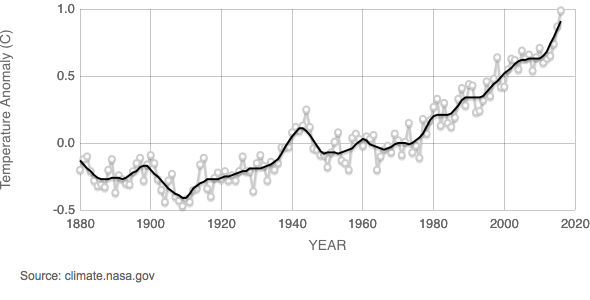
the models have done well, and predictions by skeptics that we were entering a phase of cooling were simply wrong.
- GlobalTemp.png (39.91 KiB) Viewed 662 times
This graph illustrates the change in global surface temperature relative to 1951-1980 average temperatures. Sixteen of the 17 warmest years in the 136-year record all have occurred since 2001, with the exception of 1998. The year 2016 ranks as the warmest on record. (Source: NASA/GISS). This research is broadly consistent with similar constructions prepared by the Climatic Research Unit and the National Oceanic and Atmospheric Administration.
Also, I think you are using "adjusted" and "hide the decline" out of context in a way that is misleading, implying that someone is fudging data. "Hide the decline" has become a slogan for skeptics, who mostly have no idea what the phrase means or where it came from. It is not about a decline in global temperature, it is about a decline in tree growth at that happens at high-latitudes which makes tree-ring measurements inaccurate.
This is precisely the kind of thing that scientific associations and the IPPC have studied in depth, and they have reached different conclusions than you do.
Wayne in Maine wrote:The bottom line is this: The models on which politicians are being forced to make policy have not been verified by actual measurements, on the contrary, they have been found to be deficient. This is not "denial", this is the opposite, it is acceptance and recognition of facts.
"Have been found to be deficient" by whom? When scientific associations look at them, they endorse the models. When the IPPC conducts a very transparent literature review of every single published article - including the articles published by people who do not believe in global warming - they endorse the models.
So which scientists are you asking me to trust more than these scientists, and why? What process do they use to reach consensus? What kinds of conflicts of interest do they have - do they work as lobbyists, for instance? These are people too, how do they reach their decisions?