Josh wrote: ↑Wed Sep 07, 2022 2:17 pm
Ken’s confidence of technological progress (compared with ignorance of urban realities) is almost inspiring. You know, that world where urban crime and property crime are going down, electricity is abundant and cheap, and electric cars are widely available and don’t cost as much as my parents’ house did in the 1990s.
I currently pay 8.16 cents per kwh for electricity from our public co-op that comes mainly from hydro and wind power. I can see over 30 Nissan Leaf electric cars in my zip code on CarFax starting at $7,000 so there are cheap electric cars out there. And more coming on line every day. You don't have to buy a new Tesla Model S. Living in a dense urban area where you have no car parking is a choice. It makes car ownership inconvenient no matter what the type of car and you likely have decent transit options in that case. An e-bike you can park in your apartment probably makes more sense than a car for many people. I have lived in big urban areas and I didn't use a car. I used public transit and bike and rented a car on the rare occasions that I needed one to leave the city.
Hydro power is very cheap. Unfortunately, there isn’t enough hydro to power the whole country.
I am familiar with the Leaf that has about a 30 mile range. I would be better off with a horse and buggy.
One of the problems with public transit is that it isn’t safe anymore. Robberies, sexual assaults, etc. have become unfortunately common.
Josh wrote: ↑Thu Sep 08, 2022 2:10 pm
Hydro power is very cheap. Unfortunately, there isn’t enough hydro to power the whole country.
I am familiar with the Leaf that has about a 30 mile range. I would be better off with a horse and buggy.
I used to love those water wheels the Amish used to use to power various things on their farms. I used to joke with my nephew (an engineer major) that if I was an engineer I'd open my own business called "Water Wheels R Us."
'Course, there's probably not much call for those these days.
Falco Underhill wrote: ↑Thu Sep 08, 2022 2:46 pm
Hydro power is very cheap. Unfortunately, there isn’t enough hydro to power the whole country.
I am familiar with the Leaf that has about a 30 mile range. I would be better off with a horse and buggy.
The standard leaf has a 150 mile range. The extended one is about 215 miles. So an older one with a 50% degraded battery will still have a 75 mile range which is more than the vast majority of urban commuters drive on a daily basis.
0 x
A fool can throw out more questions than a wise man can answer. -RZehr
Falco Underhill wrote: ↑Thu Sep 08, 2022 2:46 pm
Hydro power is very cheap. Unfortunately, there isn’t enough hydro to power the whole country.
I am familiar with the Leaf that has about a 30 mile range. I would be better off with a horse and buggy.
The standard leaf has a 150 mile range. The extended one is about 215 miles. So an older one with a 50% degraded battery will still have a 75 mile range which is more than the vast majority of urban commuters drive on a daily basis.
What about the amount of petroleum and other resources that have to be extracted to construct that leaf?
If it is a used vehicle then it is already constructed and someone might as well make use of it.
If you are buying a new vehicle then it is not really a question of what resources go into the car, but how the resources used to make the EV compare to the resources used to make the IC vehicle that you would otherwise buy instead.
Obviously the most ecological approach is not to buy a car at all, but to bike, walk, and use transit.
But people actually have done the calculation that you ask and they have compared the lifetime carbon and resource usage of a new EV to a new IC vehicle. You can look it up if you are curious. For example, if you compare a new Tesla Model 3 to a new Toyota Corolla the break even point is 13,000 miles. Every mile after that the Tesla generates less and less impact on the environment compared to the Toyota. https://www.reuters.com/business/autos- ... 021-06-29/
It is also not just about carbon impacts. The EV is instantly superior when it comes to smog and particulate emissions. The poor air quality and smog in many American cities is due largely to all the IC vehicles. Especially diesel trucks and buses.
0 x
A fool can throw out more questions than a wise man can answer. -RZehr
The standard leaf has a 150 mile range. The extended one is about 215 miles. So an older one with a 50% degraded battery will still have a 75 mile range which is more than the vast majority of urban commuters drive on a daily basis.
What about the amount of petroleum and other resources that have to be extracted to construct that leaf?
If it is a used vehicle then it is already constructed and someone might as well make use of it.
If you are buying a new vehicle then it is not really a question of what resources go into the car, but how the resources used to make the EV compare to the resources used to make the IC vehicle that you would otherwise buy instead.
Obviously the most ecological approach is not to buy a car at all, but to bike, walk, and use transit.
But people actually have done the calculation that you ask and they have compared the lifetime carbon and resource usage of a new EV to a new IC vehicle. You can look it up if you are curious. For example, if you compare a new Tesla Model 3 to a new Toyota Corolla the break even point is 13,000 miles. Every mile after that the Tesla generates less and less impact on the environment compared to the Toyota. https://www.reuters.com/business/autos- ... 021-06-29/
It is also not just about carbon impacts. The EV is instantly superior when it comes to smog and particulate emissions. The poor air quality and smog in many American cities is due largely to all the IC vehicles. Especially diesel trucks and buses.
Right. There goes the public transportation you were going to use instead of having your own vehicle. Maybe the big cities should bring back the electric street cars (no batteries required). Or, maybe go back to small autonomous communities, even if they are just sub-divisions of large cities, making the biking and walking even more reasonable.
The standard leaf has a 150 mile range. The extended one is about 215 miles. So an older one with a 50% degraded battery will still have a 75 mile range which is more than the vast majority of urban commuters drive on a daily basis.
What about the amount of petroleum and other resources that have to be extracted to construct that leaf?
If it is a used vehicle then it is already constructed and someone might as well make use of it.
If you are buying a new vehicle then it is not really a question of what resources go into the car, but how the resources used to make the EV compare to the resources used to make the IC vehicle that you would otherwise buy instead.
Obviously the most ecological approach is not to buy a car at all, but to bike, walk, and use transit.
But people actually have done the calculation that you ask and they have compared the lifetime carbon and resource usage of a new EV to a new IC vehicle. You can look it up if you are curious. For example, if you compare a new Tesla Model 3 to a new Toyota Corolla the break even point is 13,000 miles. Every mile after that the Tesla generates less and less impact on the environment compared to the Toyota. https://www.reuters.com/business/autos- ... 021-06-29/
It is also not just about carbon impacts. The EV is instantly superior when it comes to smog and particulate emissions. The poor air quality and smog in many American cities is due largely to all the IC vehicles. Especially diesel trucks and buses.
The carbon analysis are leaving out a huge piece of the picture. The ecological impact from mining raw materials for the batteries is astronomical. Drilling for oil is really bad yes, but it's not even close to as bad as what goes on for batteries.
What about the amount of petroleum and other resources that have to be extracted to construct that leaf?
If it is a used vehicle then it is already constructed and someone might as well make use of it.
If you are buying a new vehicle then it is not really a question of what resources go into the car, but how the resources used to make the EV compare to the resources used to make the IC vehicle that you would otherwise buy instead.
Obviously the most ecological approach is not to buy a car at all, but to bike, walk, and use transit.
But people actually have done the calculation that you ask and they have compared the lifetime carbon and resource usage of a new EV to a new IC vehicle. You can look it up if you are curious. For example, if you compare a new Tesla Model 3 to a new Toyota Corolla the break even point is 13,000 miles. Every mile after that the Tesla generates less and less impact on the environment compared to the Toyota. https://www.reuters.com/business/autos- ... 021-06-29/
It is also not just about carbon impacts. The EV is instantly superior when it comes to smog and particulate emissions. The poor air quality and smog in many American cities is due largely to all the IC vehicles. Especially diesel trucks and buses.
Right. There goes the public transportation you were going to use instead of having your own vehicle. Maybe the big cities should bring back the electric street cars (no batteries required). Or, maybe go back to small autonomous communities, even if they are just sub-divisions of large cities, making the biking and walking even more reasonable.
You don't like battery powered busses?
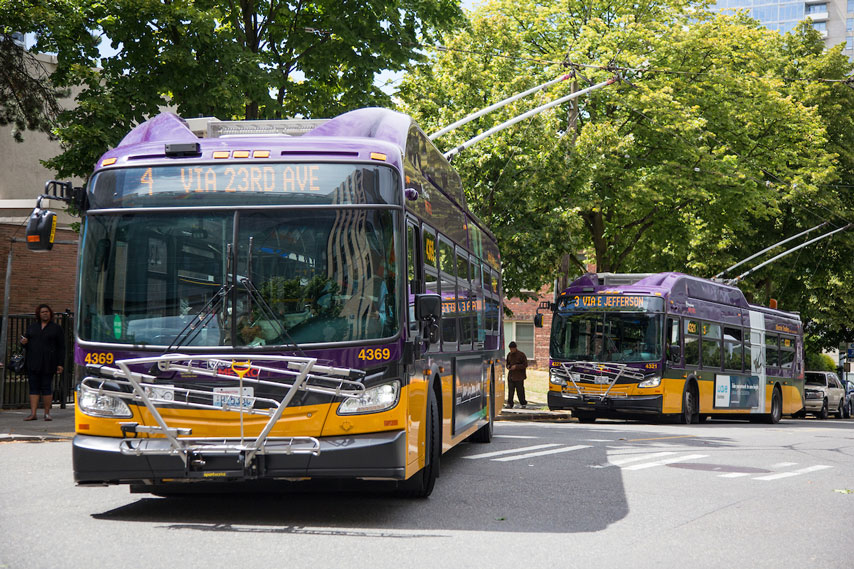
Seattle has one of the largest fleets of electric buses in the country. They are not battery powered. The were actually rolled out many years ago because the high-torque electric motors do better than diesel for constant stopping and starting on Seattle’s steep hills. The climate and emissions benefits are a more recent side-benefit.
0 x
A fool can throw out more questions than a wise man can answer. -RZehr
So, sort of like street cars w/o the tracks. But what is the energy source at the electricity generation plant? I can sort of see the point of it, even if the answer is 'natural gas', or even 'coal', because it "exports the pollution" out of the city, where it otherwise becomes concentrated. (I'm not trying to be secretly critical. Cities have for a long time "exported" pollution associated with the production of many of the products consumed there.)