ken_sylvania wrote: ↑Tue May 10, 2022 1:42 pm
If you're going to soar on the wind, please be sure not to go too close to the sun!

sour
ken_sylvania wrote: ↑Tue May 10, 2022 1:42 pm
If you're going to soar on the wind, please be sure not to go too close to the sun!
Not very loudly since those two produce such a small amount of the power currently.
temporal1 wrote: ↑Fri Jun 24, 2022 7:43 amThe only sure thing about this is, some are counting on billions+trillions in transfer of wealth in the process;.. Maybe even of greater importance is the concern about catastrophic climate change, which I expect will kill many more people than abortion.
the condition of the planet, the welfare of the masses, being a distant second.
Wayne spoke to this in Robert’s Climate Warning thread. Wayne was a smart guy.
none of these things is happening out of the “goodness of the heart” / pro bono, etc.
in times of actual catastrophe, people give of themselves for the greater good. (a clue regarding for-profit abortion corporations.)
i don’t intend to be overly critical of profiteers, i honestly have no idea how i would fare spiritually;
faced with such enormous sums, i shudder to think of the temptations, i question the depth of my faith.
i just know it would be very very hard to maintain a level head in such circles. frankly, it’s terrifying. i’m thankful i’m not wealthy.
scriptures describes it very well. i take the warnings literally. the grave temptations of power and greed.
- - - - - - -
Wayne used the words, “Redistribution of wealth:”temporal1 wrote: ↑Tue Dec 07, 2021 4:37 am 2017: Page 41PeterG wrote:
Who will acknowledge that their own side in the climate debate has been highly politicized?Wayne in Maine wrote: ↑Tue Sep 12, 2017 3:42 pm
Redistribution of wealth, among other things.
Some environmental organizations are pushing for particular energy sources such as wind and solar (certainly not nuclear, there is though a consensus among scientists that nuclear is the best option to reduce Carbon Dioxide emissions). I'll let other speak to this.
Oil companies are some of the largest and most efficient "redistributers of wealth" that this planet has ever seen. Not just in this country but worldwide from Venezuela, Nigeria, Russia, Saudi Arabia, Iraq, and Iran. And control over oil (and now gas) has been at the root of endless wars and conflicts since it became the fuel for industrial economies in the last 19th century.temporal1 wrote: ↑Fri Jun 24, 2022 12:14 pm From another thread:
temporal1 wrote: ↑Fri Jun 24, 2022 7:43 amThe only sure thing about this is, some are counting on billions+trillions in transfer of wealth in the process;.. Maybe even of greater importance is the concern about catastrophic climate change, which I expect will kill many more people than abortion.
the condition of the planet, the welfare of the masses, being a distant second.
Wayne spoke to this in Robert’s Climate Warning thread. Wayne was a smart guy.
none of these things is happening out of the “goodness of the heart” / pro bono, etc.
in times of actual catastrophe, people give of themselves for the greater good. (a clue regarding for-profit abortion corporations.)
i don’t intend to be overly critical of profiteers, i honestly have no idea how i would fare spiritually;
faced with such enormous sums, i shudder to think of the temptations, i question the depth of my faith.
i just know it would be very very hard to maintain a level head in such circles. frankly, it’s terrifying. i’m thankful i’m not wealthy.
scriptures describes it very well. i take the warnings literally. the grave temptations of power and greed.
- - - - - - -
Wayne used the words, “Redistribution of wealth:”
Yes, that's great, but we have to be honest, and prepared with the need to reduce our energy consumption buy a LOT to make local, renewable generation realisticKen wrote: ↑Fri Jun 24, 2022 12:38 pm Oil companies are some of the largest and most efficient "redistributers of wealth" that this planet has ever seen. Not just in this country but worldwide from Venezuela, Nigeria, Russia, Saudi Arabia, Iraq, and Iran. And control over oil (and now gas) has been at the root of endless wars and conflicts since it became the fuel for industrial economies in the last 19th century.
Even if we completely set aside the disastrous environmental consequence of fueling economies on oil and other fossil fuels. A shift towards more local and decentralized energy sources like wind, solar, geothermal, hydro, and biofuels has to be a good thing from the point of view of redistribution of wealth and power.
A local community in Nebraska, Ethiopia, or India that can supply its own energy needs locally through wind, solar, geothermal, biofuels, etc. is going to have a healthier and more sustainable economy than one dependent on oil supplied by massive monopolistic multinational corporations that have enormous supply chains and require enormous public infrastructure to sustain. And they will be able to keep far more of the fruits of their labor within their local economy rather than transferring it directly to the shareholders of multinational oil companies in order to keep their lights on and economy moving.
Look at how many people here in the US are complaining about or being affected by high gas prices right now. That is a symptom of the very problem I am talking about. And the solution isn't to kick the can on down the road by throwing more public subsidies into oil to temporarily drive the price down a few notches. But to find alternatives so that people's lives and lifestyles aren't wholly dependent on oil provided by these giant multi-national corporations.
Yes of course. It requires both individual action and collective action.nett wrote: ↑Fri Jun 24, 2022 12:50 pmYes, that's great, but we have to be honest, and prepared with the need to reduce our energy consumption buy a LOT to make local, renewable generation realisticKen wrote: ↑Fri Jun 24, 2022 12:38 pm Oil companies are some of the largest and most efficient "redistributers of wealth" that this planet has ever seen. Not just in this country but worldwide from Venezuela, Nigeria, Russia, Saudi Arabia, Iraq, and Iran. And control over oil (and now gas) has been at the root of endless wars and conflicts since it became the fuel for industrial economies in the last 19th century.
Even if we completely set aside the disastrous environmental consequence of fueling economies on oil and other fossil fuels. A shift towards more local and decentralized energy sources like wind, solar, geothermal, hydro, and biofuels has to be a good thing from the point of view of redistribution of wealth and power.
A local community in Nebraska, Ethiopia, or India that can supply its own energy needs locally through wind, solar, geothermal, biofuels, etc. is going to have a healthier and more sustainable economy than one dependent on oil supplied by massive monopolistic multinational corporations that have enormous supply chains and require enormous public infrastructure to sustain. And they will be able to keep far more of the fruits of their labor within their local economy rather than transferring it directly to the shareholders of multinational oil companies in order to keep their lights on and economy moving.
Look at how many people here in the US are complaining about or being affected by high gas prices right now. That is a symptom of the very problem I am talking about. And the solution isn't to kick the can on down the road by throwing more public subsidies into oil to temporarily drive the price down a few notches. But to find alternatives so that people's lives and lifestyles aren't wholly dependent on oil provided by these giant multi-national corporations.

temporal1 wrote: ↑Thu Jun 23, 2022 2:27 pm Nuts! Nuts! Nuts!RZehr wrote: ↑Wed May 04, 2022 8:23 pm People should eat more filberts. Or hazelnuts.
Here is some information on almonds and water. This is from 2015, and the droughts are a lot worse since then. https://www.motherjones.com/environment ... ts-charts/California’s worst drought on record isn’t stopping the state from growing massive amounts of nuts:
The state produces over 80 percent of the world’s almonds and 43 and 28 percent of the world’s pistachios and walnuts, respectively. As Mother Jones’ Tom Philpott details in this longread, the state’s almond market in particular has taken off: What was a $1.2 billion market in 2002 became $4.8 billion market by 2012.
Why are the almond growth rates so…nuts? (Sorry.) One reason is that the average American now eats two pounds of the crunchy snack per year—more than twice as much as a decade ago. But the biggest demand is coming from abroad: The US now exports 70 percent of almonds.
The thing is, nuts use a whole lot of water:
it takes about a gallon of water to grow one almond, and nearly five gallons to produce a walnut. Residents across the state are being told to take shorter showers and stop watering their lawns, but the acreage devoted to the state’s almond orchards have doubled in the past decade. The amount of water that California uses annually to produce almond exports would provide water for all Los Angeles homes and businesses for almost three years
Water. It requires power to get it where it’s needed.
i was reminded of RZehr when reading this:
“Illinois could see controlled power outages this summer”
https://www.lincolncourier.com/story/ne ... 690341001/.. Rolling blackouts or brownouts typically associated with Western states may be necessary in Illinois and other Midwest states in the Midcontinent Independent System Operator (MISO) footprint. MISO is the regional electric grid operator that oversees power in 15 states, including the southern two-thirds of Illinois.
Several factors are contributing to the heightened risk, including some early generator retirements, changes to the generation resource mix and increased demand for electricity, Brandon Morris, MISO adviser-strategic communications, told FarmWeek. ..More gov incompetence+corruption... If my power goes out and it was a very hot day, or a very cold day, we could lose our livestock.
They wouldn’t have water. The heaters wouldn’t kick on. The fans wouldn’t kick on,” he said during the hearing.
Meier recently spent thousands on a new generator to ensure his livestock would be able to survive if he’s not home to flip the switch.
“We need a reliable baseload energy source,” Meier said. “I’m not against clean energy.

Aside from logistical issues on the farm during a power outage, Meier pointed out another concern – energy prices.
Ameren Illinois warned customers they will pay more for electricity because of inflation, the conflict in eastern Europe
and the closure of coal-fired electric generation facilities.
The average customer could see an increase of more than $600 annually.
But farmers aren’t the average customer.
“Can you imagine a farm when we go into drying grain?
What that’s going to do (to our bills) now?” Meier told FarmWeek.
In the coming weeks, Meier plans to issue safety advisories, such as warning people not to run generators in their garages or homes.
“We need to be putting out reminders all summer long knowing that this is going to be a possibility,” he said.
Among the most vulnerable areas heading into summer is southern Illinois, according to a forecast by the North American Electric Reliability Corp. (NERC), a regulatory authority that monitors risks to the grid.
“Industry prepares its equipment and operators for challenging summer conditions.
Persistent, extreme drought and its accompanying weather patterns, however, are out of the ordinary and tend to create extra stresses on electricity supply and demand,” said Mark Olson, NERC’s manager of Reliability Assessments, in a news release. “Grid operators in affected areas will need all available tools to keep the system in balance this summer.”
Morris said temporary, coordinated power outages are extremely rare and a last-step emergency measure implemented to protect the electric grid.
temporal1 wrote: ↑Fri Jun 24, 2022 1:15 pm “Illinois could see controlled power outages this summer”
https://www.lincolncourier.com/story/ne ... 690341001/More gov incompetence+corruption... Rolling blackouts or brownouts typically associated with Western states may be necessary in Illinois and other Midwest states in the Midcontinent Independent System Operator (MISO) footprint. MISO is the regional electric grid operator that oversees power in 15 states, including the southern two-thirds of Illinois.
. . .
Morris said temporary, coordinated power outages are extremely rare and a last-step emergency measure implemented to protect the electric grid.
Old saying:
“Don’t break your arm patting yourself on your back.”
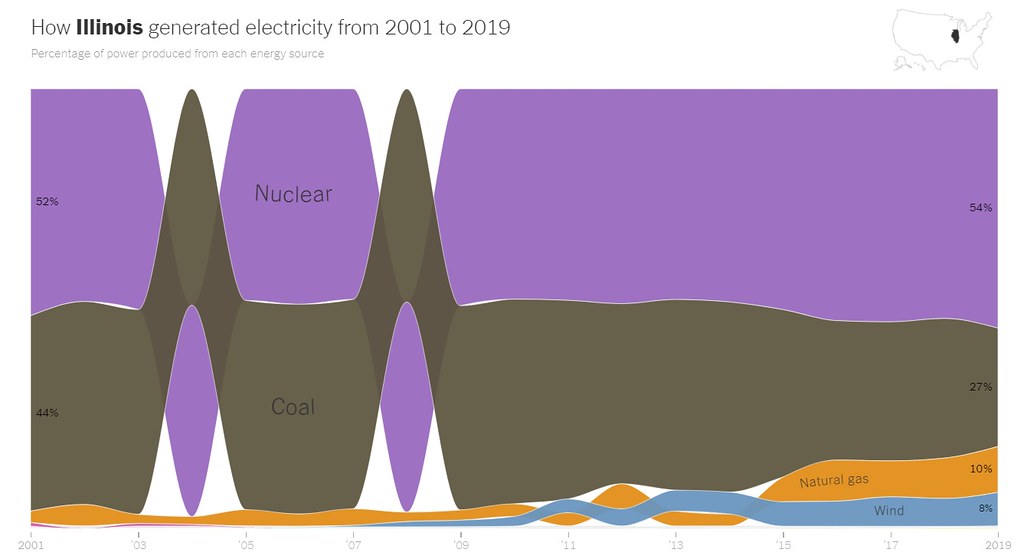
Great minds.Wayne in Maine wrote: ↑Tue Sep 12, 2017 2:42 pm
Redistribution of wealth, among other things.
Some environmental organizations are pushing for particular energy sources such as wind and solar (certainly not nuclear,
there is though a consensus among scientists that nuclear is the best option to reduce Carbon Dioxide emissions).
I'll let other speak to this.

