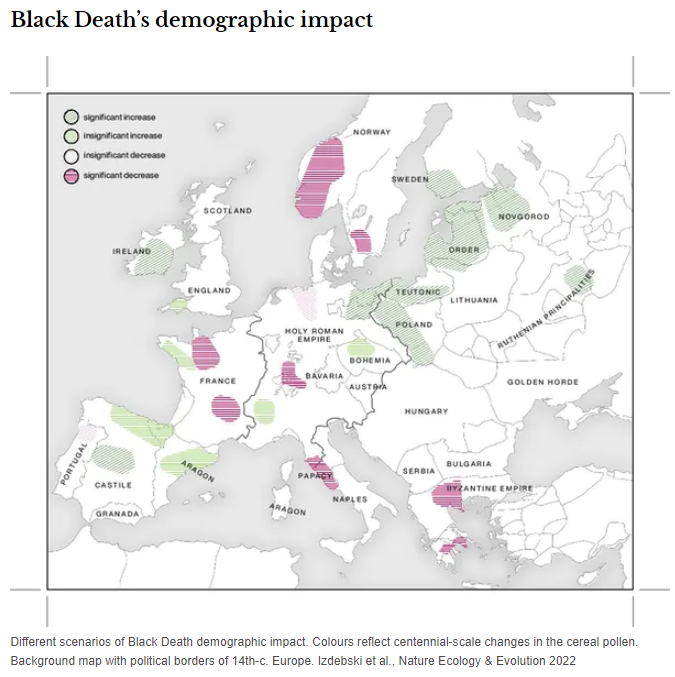
In popular imagination, the Black Death is the most devastating pandemic to have ever hit Europe. Between 1346 and 1353, plague is believed to have reached nearly, if not every, corner of the continent, killing 30%-50% of the population. This account is based on texts and documents written by state or church officials and other literate witnesses.
But, as with all medieval sources, the geographical coverage of this documentation is uneven. While some countries, like Italy or England, can be studied in detail, only vague clues exist for others, like Poland. Unsurprisingly, researchers have worked to correct this imbalance and uncover different ways for working out the extent of the Black Death’s mortality.
In our new study, we used 1,634 samples of fossil pollen from 261 lakes and wetlands in 19 European countries. This vast amount of material enabled us to compare the Black Death’s demographic impact across the continent. The result? The pandemic’s toll was not as universal as currently claimed, nor was it always catastrophic.
Pandemic lessons
Our discovery of stunning regional variability in the Black Death has consequences, potentially in and beyond the study of plague’s past. It should prevent us from making quick generalisations about the spread and impact of history’s most infamous pandemic.
It should also change how the Black Death is used as a model for other pandemics. It may still be the “mother of all pandemics”, but what we think the Black Death was is changing. Our discovery might also prevent us from drawing easy conclusions about other pandemics, notably those less studied and with narratives based on fragmentary evidence.
Context matters. Economic activity can determine routes of dissemination, population density can influence how quickly and widely a disease spreads, and pathogen “behaviour” can differ between climates and landscapes. Medical and popular theories about disease causation will shape human behaviour, as trust in authorities will affect their ability to manage disease spread, and social inequalities will ensure disparities in an outbreak’s toll.
While no two pandemics are the same, the study of the past can help us discover where to look for our own vulnerabilities and how to best prepare for future outbreaks. To begin to do that, though, we need to reassess past epidemics with all the evidence we can.
0 x
Try hard not to offend. Try harder not to be offended.
I think I am funnier than I really am.
Josh wrote: ↑Sat Feb 12, 2022 11:56 am
Natural immunity doesn’t seem to result in all these positive tests that vaccinated people keep having
Actually it does. The latest research suggests that immunity from prior infection provides about the equivalent of one shot of vaccine. Researchers in the UK found prior infection to only be about 19% effective against Omicron. In other words, you would have to catch Covid 3 times to gain equal immunity to being fully vaccinated and boosted. But hey, I guess you would be well protected against catching Covid for a 4th time: https://www.imperial.ac.uk/news/232698/ ... from-past/
The new report (Report 49) from the Imperial College London COVID-19 response team estimates that the risk of reinfection with the Omicron variant is 5.4 times greater than that of the Delta variant. This implies that the protection against reinfection by Omicron afforded by past infection may be as low as 19%.
Might want to actually read the article Ken.
Is the mainstream still trying to push this? I wonder how long this comedy will continue.
It does seem a bit clunky. They could have multiplied the Y-axis by 30 and reported the monthly total with the simplified title: Leading causes of death in the United States from March 2020 to January 2022. Instead they had to compute the average daily number for each month just so February (which is conveniently omitted from the endpoints anyway) doesn't look like a dip for having fewer days. Not that it would really show up at that scale.
At least I think that's what it means.
On the other hand, 1 Cor. 15:31 might have something to do with it.
An interesting chart to compare Covid deaths with the other leading causes of death for the past couple of years.
It's interesting to me that some of the other death rates have not seen a discernible decline during COVID spiles...this undercuts the narrative that most COVID deaths are simply reassigned from other causes.
Dan Z wrote: ↑Fri Feb 18, 2022 12:04 pm
It's interesting to me that some of the other death rates have not seen a discernible decline during COVID spiles...this undercuts the narrative that most COVID deaths are simply reassigned from other causes.
Right. You can see that from the excess deaths charts, but this breaks it down more.
Public Health Scotland will no longer release data on vaccinated vs unvaccinated infections/deaths. The stated reason is that "this data is being used to promote vaccine misinformation".
Josh wrote: ↑Fri Feb 18, 2022 12:39 pm
Public Health Scotland will no longer release data on vaccinated vs unvaccinated infections/deaths. The stated reason is that "this data is being used to promote vaccine misinformation".
Hmm.
There is plenty of data out there from hundreds of different jurisdictions, states, and nations. See if you can find any data from anywhere in the world that shows a higher death rate or hospitalization rate for fully vaccinated compared to unvaccinated based on a apples to apples comparison (same age groups, time period, etc.)
0 x
A fool can throw out more questions than a wise man can answer. -RZehr
Josh wrote: ↑Fri Feb 18, 2022 12:39 pm
Public Health Scotland will no longer release data on vaccinated vs unvaccinated infections/deaths. The stated reason is that "this data is being used to promote vaccine misinformation".
Hmm.
There is plenty of data out there from hundreds of different jurisdictions, states, and nations. See if you can find any data from anywhere in the world that shows a higher death rate or hospitalization rate for fully vaccinated compared to unvaccinated based on a apples to apples comparison (same age groups, time period, etc.)
Just wait, As the vaccine gets increasingly ineffective the hospitalization rates will equalize as we are seeing with infection rates. Nearly half of the cases in Oregon are breakthrough cases.
Also to date, the natural immunity provides a more robust defense and I fully expect (assuming they publish the data) to swing for more cases on vaccinated side due to unvaccinated generally living their life and having already got it.