I am as well Robert. May God grant your sister and family comfort in this sad time.
Coronavirus Outbreak
-
Dan Z
Re: Coronavirus Outbreak
0 x
-
Josh
Re: Coronavirus Outbreak
How effective are masks when worn by children?
According to The Economist, not at all.

Now, can we stop the theological claims that one must accept mask-wearing to “love your neighbour”? It’s entirely a political issue.
According to The Economist, not at all.
Now, can we stop the theological claims that one must accept mask-wearing to “love your neighbour”? It’s entirely a political issue.
0 x
-
Valerie
Re: Coronavirus Outbreak
https://www.clarkcountytoday.com/opinio ... -covid-19/
Yes. Why are we not questioning. Oh Lord please open eyes.
Yes. Why are we not questioning. Oh Lord please open eyes.
0 x
Re: Coronavirus Outbreak
I think having the text here is very important. This is what I have been saying for a year now.Valerie wrote: ↑Sun Sep 05, 2021 11:31 pm https://www.clarkcountytoday.com/opinio ... -covid-19/
Yes. Why are we not questioning. Oh Lord please open eyes.
The article continues. Very much worth a read.
Clark County Today Administrator Heidi Wetzler shares what she believes is a medical tragedy that COVID-19 patients are not being treated immediately
If you walked into your doctor’s office with a case of shingles, what do you think would happen? Would you be sent home and instructed to return when the pain was unbearable – or would you be treated on the spot? While there is no cure for shingles, prompt treatment with prescription antiviral drugs can speed healing and reduce the risk of complications.
What about viral pneumonia, viral hepatitis, or HIV/Aids? Same question. Would you be treated? The answer of course, is yes. These all have treatment protocols, to speed recovery and increase comfort, even though viruses don’t necessarily have “cures.” Because viruses don’t respond to antibiotics, alternative treatments are important. And they all work best when started early. So why do we have a fatal viral infection ravaging the world, with barely a mention of ambulatory treatment?
Millions of people have tested positive for COVID-19, and are promptly sent home to quarantine and self-monitor their symptoms. No health care professional checks in on them. They are told to stay home and only come back if they are having trouble breathing. While I would imagine it is common knowledge in the medical community that early treatment for any ailment greatly improves the chance of a favorable outcome, why is there a virtual blackout of information surrounding the global conversation of early treatment protocol in order to AVOID hospitalization and death? Controlling the healthy with masks and social distancing and now vaccines, and then Herculean efforts involving the critically ill, have taken up all of the air, while the person in their first two weeks of the infection suffering at home is all but ignored by the medical community.
Dr. Peter McCullough, vice chief of Internal Medicine at Baylor University Medical Center in Dallas, Texas, and the most prolifically published academic physician in his field of heart and kidneys in history, has testified several times lately that there is a shocking suppression of early treatment for COVID-19 in medical literature. A review of several of his communications resulted in this summary of his findings. He calls this effort to suppress any hope of treatment, extraordinary. All of the patients he sees are considered high risk, and with the sequenced multi-drug approach he uses, he has only lost two. When he extrapolates the data he has personally acquired through treating his own very ill patients, and calculates what that would mean for the death rate worldwide if a similar treatment protocol was adopted globally, an astonishing 85 percent of COVID-19 deaths could have been prevented. The key is that treatment must begin early in order to avoid hospitalization. And that is the opposite of what has happened and is continuing to happen.
The treatment regimen includes 4-6 drugs taken in a specific time frame, starting with monoclonal antibodies, then antivirals, then anti-inflammatories, and then anticoagulants. It is recommended that anyone over 50 with at least one comorbidity begin this course of treatment immediately. Reduction of viral replication at the forefront of infection is key. There has been unconventional concern worldwide regarding the safety of certain therapeutics for this virus. In fact, in Australia doctors were threatened with a 6-month prison sentence if they dared to prescribe the antiviral, Hydroxychloroquine. This move is unprecedented. The use of Hydroxychloroquine for COVID-19 is off-label they said. But off-label use of older medicines for new uses occurs every day. In fact, 20 percent of all prescriptions in the U.S. are written for off-label uses when a doctor thinks a medicine will benefit a patient. Apparently, the list of what not to use is long and broad within the treatment recommendations. We are 16 months into this thing and as-of-yet, there are zero trials of multidrug therapies. There is no national or global panel of doctors in charge of early treatment protocol. Why? Maybe it’s because a vaccine is only allowed to be produced if there are no effective treatments.
0 x
Try hard not to offend. Try harder not to be offended.
I think I am funnier than I really am.
I think I am funnier than I really am.
Re: Coronavirus Outbreak
I find this quite informative. I have downloaded my copy.
https://aapsonline.org/CovidPatientTreatmentGuide.pdf

Yes, these are Doctors who have presented this.
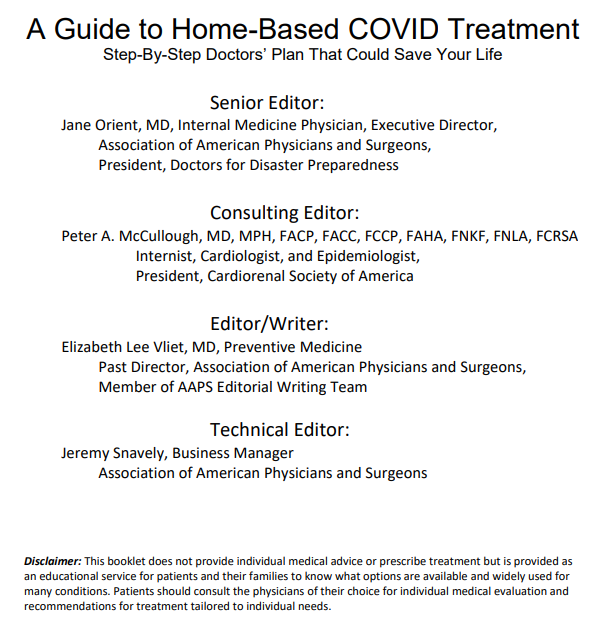
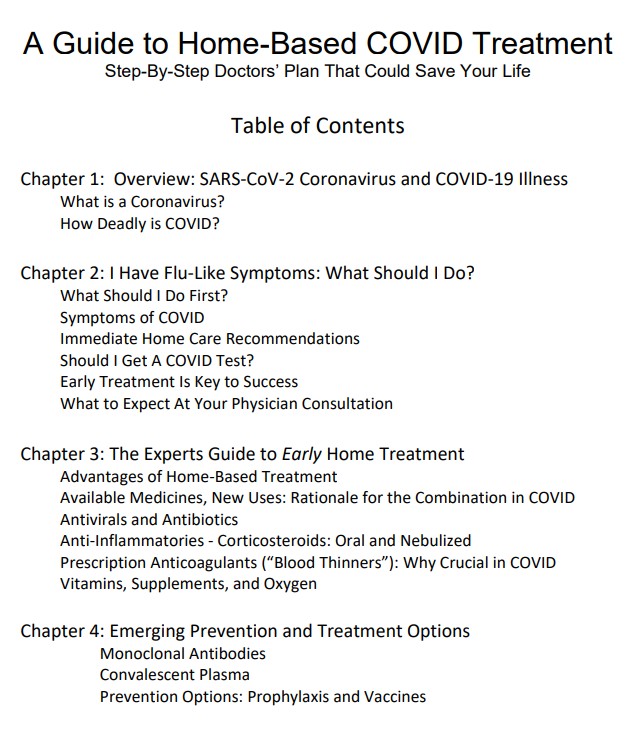
https://aapsonline.org/CovidPatientTreatmentGuide.pdf
Yes, these are Doctors who have presented this.
0 x
Try hard not to offend. Try harder not to be offended.
I think I am funnier than I really am.
I think I am funnier than I really am.
-
Somebody
Re: Coronavirus Outbreak
Thank you! Will be downloading a copy for us and sharing it with others!
0 x
Re: Coronavirus Outbreak
This is a question for the pro-vaxxers, like Ken or Boot. Do you consider Israel's vaccination campaign a success (compared to somewhere like Dehli or Tanzania)? If not a success, what do you think they did wrong?
This all seems pretty simple to me, if we are concerned about COVID case count, then Israel is an abject failure, with the worse rate in the world. They should be written off as a failure, because whatever they did was wrong.
Given Tanzania's rejection of the vaccine, and the fact COVID is over there, shouldn't we be looking into what they did right? Seems like we're missing something.
Yet you both continue to argue from the perspective of the vaccine being an accepted, proven solution to COVID. I just can't see how that can be. Israel was the first to vaccinate, and they ended up with the worst COVID rate in the world.
This all seems pretty simple to me, if we are concerned about COVID case count, then Israel is an abject failure, with the worse rate in the world. They should be written off as a failure, because whatever they did was wrong.
Given Tanzania's rejection of the vaccine, and the fact COVID is over there, shouldn't we be looking into what they did right? Seems like we're missing something.
Yet you both continue to argue from the perspective of the vaccine being an accepted, proven solution to COVID. I just can't see how that can be. Israel was the first to vaccinate, and they ended up with the worst COVID rate in the world.
0 x
-
Ken
- Posts: 21863
- Joined: Thu Jun 13, 2019 12:02 am
- Location: Washington State
- Affiliation: former MCUSA
Re: Coronavirus Outbreak
I don't really pretend to know what is going on in Israel Nett. When I google up information I find articles like this one which claim that the current wave of infections is largely composed of (1) younger unvaccinated patients, and (2) older vaccinated patients with a host of comorbidities and that are potentially immuno-compromised. So the failure in Israel may well be that they failed to protect their elderly vulnerable populations by failing to adequate vaccinate their younger populations that are actively spreading the disease.
So, circling back to your original question. Was the vaccination campaign in Israel a failure? To answer that question one would need to know what infection, hospitalization, and death rates would have been in the absence of vaccinations. All evidence suggests that infections, hospitalizations, and deaths would have been much higher in Israel in the absence of vaccines. And that even if the vaccines are not preventing break-through cases, they appear to still greatly reduce the severity of the disease when it does break through. No one there is claiming otherwise. So the conclusion I would reach is that a partial vaccination rate of 62% (Israel's current vaccination rate as of yesterday) is obviously insufficient to end the pandemic and that additional steps are clearly necessary. But that the vaccines are still greatly helping.
In any event, despite an early lead in vaccinations, Israel is now just middle of the pack when it comes to vaccinations. Still ahead of the US but well behind many other peer countries like Canada, Germany, and even Chile. And Israel's hospitalization and death rates are also just middle of the pack. Well below that of the US, which has a lower vaccination rate. But well ahead of countries like Canada and Germany which have higher vaccination rates than Chile.https://www.reuters.com/world/middle-ea ... 021-08-20/
JERUSALEM, Aug 20 (Reuters) - In Israel's COVID-19 wards, doctors are learning which vaccinated patients are most vulnerable to severe illness, amid growing concerns about instances in which the shots provide less protection against the worst forms of the disease.
Around half of the country's 600 patients presently hospitalized with severe illness have received two doses of the Pfizer Inc (PFE.N) shot, a rare occurrence out of 5.4 million fully vaccinated people.
The majority of these patients received two vaccine doses at least five months ago, are over the age of 60 and also have chronic illnesses known to exacerbate a coronavirus infection. They range from diabetes to heart disease and lung ailments, as well as cancers and inflammatory diseases that are treated with immune-system suppressing drugs, according to Reuters interviews with 11 doctors, health specialists and officials.
"The vaccinated patients are older, unhealthy, often they were bedridden before infection, immobile and already requiring nursing care," said Noa Eliakim-Raz, head of the coronavirus ward at Rabin Medical Centre in Petach Tikva.
In contrast, "the unvaccinated COVID patients we see are young, healthy, working people and their condition deteriorates rapidly," she said. "Suddenly they're being put on oxygen or on a respirator."
. . . .
In Israel, daily new cases have increased from the single digits in June to around 8,000 since the arrival of Delta. Approximately half of the cases - the majority of them mild to moderate - are in vaccinated people.
Those vaccinated first in Israel were at high-risk, including people age 60 and up. The immune response of some may have weakened by the time Delta hit Israel. But for others with underlying health conditions, the vaccine may have not kicked in at all.
"For some of them the vaccine did not trigger an immune response, they had no antibodies, because of the illness itself or because they are treated with medication that suppresses the immune system," said Dror Mevorach, who heads the coronavirus ward at Hadassah hospital in Jerusalem. He cited examples such as chronic lymphocytic leukemia and lymphoma.
Among 3 million vaccinated Israelis covered by Clalit, the country's largest healthcare provider, 600 have suffered severe breakthrough cases since June. Around 75% of them were above the age of 70 and were at least 5 months after their second dose, according to Ran Balicer, Clalit's chief innovation officer. Nearly all of them have chronic illnesses.
"We are hardly seeing young vaccinated people in severe condition," said Balicer.
In the UK, doctors described similar characteristics among vaccinated patients who fall severely ill.
"In those people who come in, because of their age, because of their co-morbidities, they might be people that you would expect that the vaccine is not quite so efficacious as other age groups," said Tom Wingfield, a clinical lecturer at the Liverpool School of Tropical Medicine.
A new surge in U.S. coronavirus cases and deaths has been fueled by Delta, particularly in states where vaccination rates remain low. Among vaccinated patients who become infected, there is evidence of older people being hit harder.
In Texas, 92% of the vaccine breakthrough cases that resulted in death were in people over the age of 60 and 75% had a known underlying condition that put them at high risk from COVID-19, according to a public health department spokesperson.
Initial data in Israel suggests the booster shots administered in the last few weeks are reducing the risk of infection in older people compared with those who have received only two doses. read more .
Even without boosters, Israeli doctors say that vaccinated patients tend to recover more quickly.
"The vaccinated patients I've treated usually left the ICU in about three days. The unvaccinated patients took a week or two until they stabilized," said Yael Haviv-Yadid, head of the critical care ward at Sheba Medical Centre near Tel Aviv.
Even if the vaccine did not stop them getting ill, it may have mitigated their illness, said Alex Rozov, head of the coronavirus ward at Barzilai Medical Centre in Ashkelon.
"Our cautious impression is that the vaccinated patients suffer an easier course of illness - the treatment is more effective among those who have antibodies."
So, circling back to your original question. Was the vaccination campaign in Israel a failure? To answer that question one would need to know what infection, hospitalization, and death rates would have been in the absence of vaccinations. All evidence suggests that infections, hospitalizations, and deaths would have been much higher in Israel in the absence of vaccines. And that even if the vaccines are not preventing break-through cases, they appear to still greatly reduce the severity of the disease when it does break through. No one there is claiming otherwise. So the conclusion I would reach is that a partial vaccination rate of 62% (Israel's current vaccination rate as of yesterday) is obviously insufficient to end the pandemic and that additional steps are clearly necessary. But that the vaccines are still greatly helping.
1 x
A fool can throw out more questions than a wise man can answer. -RZehr
Re: Coronavirus Outbreak
I can find articles like that all too, I put very little weight on anecdotes of individual doctors, because it can be so easily fabricated, especially when there is so much pressure to say that the vaccines are working. eg. Oklahoma fake news article.Ken wrote: ↑Mon Sep 06, 2021 3:48 pm I don't really pretend to know what is going on in Israel Nett. When I google up information I find articles like this one which claim that the current wave of infections is largely composed of (1) younger unvaccinated patients, and (2) older vaccinated patients with a host of comorbidities and that are potentially immuno-compromised. So the failure in Israel may well be that they failed to protect their elderly vulnerable populations by failing to adequate vaccinate their younger populations that are actively spreading the disease.
In any event, despite an early lead in vaccinations, Israel is now just middle of the pack when it comes to vaccinations. Still ahead of the US but well behind many other peer countries like Canada, Germany, and even Chile. And Israel's hospitalization and death rates are also just middle of the pack. Well below that of the US, which has a lower vaccination rate. But well ahead of countries like Canada and Germany which have higher vaccination rates than Chile.https://www.reuters.com/world/middle-ea ... 021-08-20/
JERUSALEM, Aug 20 (Reuters) - In Israel's COVID-19 wards, doctors are learning which vaccinated patients are most vulnerable to severe illness, amid growing concerns about instances in which the shots provide less protection against the worst forms of the disease.
Around half of the country's 600 patients presently hospitalized with severe illness have received two doses of the Pfizer Inc (PFE.N) shot, a rare occurrence out of 5.4 million fully vaccinated people.
The majority of these patients received two vaccine doses at least five months ago, are over the age of 60 and also have chronic illnesses known to exacerbate a coronavirus infection. They range from diabetes to heart disease and lung ailments, as well as cancers and inflammatory diseases that are treated with immune-system suppressing drugs, according to Reuters interviews with 11 doctors, health specialists and officials.
"The vaccinated patients are older, unhealthy, often they were bedridden before infection, immobile and already requiring nursing care," said Noa Eliakim-Raz, head of the coronavirus ward at Rabin Medical Centre in Petach Tikva.
In contrast, "the unvaccinated COVID patients we see are young, healthy, working people and their condition deteriorates rapidly," she said. "Suddenly they're being put on oxygen or on a respirator."
. . . .
In Israel, daily new cases have increased from the single digits in June to around 8,000 since the arrival of Delta. Approximately half of the cases - the majority of them mild to moderate - are in vaccinated people.
Those vaccinated first in Israel were at high-risk, including people age 60 and up. The immune response of some may have weakened by the time Delta hit Israel. But for others with underlying health conditions, the vaccine may have not kicked in at all.
"For some of them the vaccine did not trigger an immune response, they had no antibodies, because of the illness itself or because they are treated with medication that suppresses the immune system," said Dror Mevorach, who heads the coronavirus ward at Hadassah hospital in Jerusalem. He cited examples such as chronic lymphocytic leukemia and lymphoma.
Among 3 million vaccinated Israelis covered by Clalit, the country's largest healthcare provider, 600 have suffered severe breakthrough cases since June. Around 75% of them were above the age of 70 and were at least 5 months after their second dose, according to Ran Balicer, Clalit's chief innovation officer. Nearly all of them have chronic illnesses.
"We are hardly seeing young vaccinated people in severe condition," said Balicer.
In the UK, doctors described similar characteristics among vaccinated patients who fall severely ill.
"In those people who come in, because of their age, because of their co-morbidities, they might be people that you would expect that the vaccine is not quite so efficacious as other age groups," said Tom Wingfield, a clinical lecturer at the Liverpool School of Tropical Medicine.
A new surge in U.S. coronavirus cases and deaths has been fueled by Delta, particularly in states where vaccination rates remain low. Among vaccinated patients who become infected, there is evidence of older people being hit harder.
In Texas, 92% of the vaccine breakthrough cases that resulted in death were in people over the age of 60 and 75% had a known underlying condition that put them at high risk from COVID-19, according to a public health department spokesperson.
Initial data in Israel suggests the booster shots administered in the last few weeks are reducing the risk of infection in older people compared with those who have received only two doses. read more .
Even without boosters, Israeli doctors say that vaccinated patients tend to recover more quickly.
"The vaccinated patients I've treated usually left the ICU in about three days. The unvaccinated patients took a week or two until they stabilized," said Yael Haviv-Yadid, head of the critical care ward at Sheba Medical Centre near Tel Aviv.
Even if the vaccine did not stop them getting ill, it may have mitigated their illness, said Alex Rozov, head of the coronavirus ward at Barzilai Medical Centre in Ashkelon.
"Our cautious impression is that the vaccinated patients suffer an easier course of illness - the treatment is more effective among those who have antibodies."
So, circling back to your original question. Was the vaccination campaign in Israel a failure? To answer that question one would need to know what infection, hospitalization, and death rates would have been in the absence of vaccinations. All evidence suggests that infections, hospitalizations, and deaths would have been much higher in Israel in the absence of vaccines. And that even if the vaccines are not preventing break-through cases, they appear to still greatly reduce the severity of the disease when it does break through. No one there is claiming otherwise. So the conclusion I would reach is that a partial vaccination rate of 62% (Israel's current vaccination rate as of yesterday) is obviously insufficient to end the pandemic and that additional steps are clearly necessary. But that the vaccines are still greatly helping.
When I look at the hard data, I don't see a case for vaccines being made
I think your explanation would make a lot of sense, if you didn't have places like Dehli and Tanzania with COVID basically nonexistent.
I'm not suggesting that the vaccines have no effect, they clearly do, to me, the effect on the overall picture is unclear. you concede that 62% is not high enough to end the pandemic, if that's the case what is enough? It's hard to get much higher than that for a variety of reason. The UK recently announced they are not approving vaccines due < 15 years of age, that takes out a large chunk of your population. So realistically if we need a higher vaccination rate to end the pandemic, but the vaccination can't get that much higher, are the vaccines actually effective?
I think it's coming down to a matter of practicality now. Compliance with boosters will get lower and lower with each required boost. Nothing about this strategy seems sustainable to me.
Here's where I am. I'd appreciate your thoughts, as an opposing viewpoint
It seems at this point, it would have been much more in the interest of the common good to allow COVID to spread, and natural immunity to develop. In hindsight we know natural immunity lasts longer, against more strains, and is more protective than vaccination. The vaccines cost a tremendous amount of money to develop, are not without risk (especially as the booster counts adds up), and are causing a significant amount of public unrest due to mandates, and skepticism. At the same time, the vaccination rates we were told would lead to herd immunity are not proving to do so, and we're being told we need higher rates, more masks, and boosters, which will continue to reduce compliance.
A lot of people are simply moving on from COVID, you can see this in sporting events, and other public gathering where this is not a mask to be seen, nor social distancing. This means the spread we were once so afraid of is ultimately going to happen one way or another.
Once it became clear that COVID was not nearly as deadly as initially reported, if we had continued on with life as usual, we would have needed a few key infrastructure boosts.
- increased staffing and hospital funding to deal with the influx of patients in dense areas
- short, but strict lockdowns in dense, high risk areas to prevent inundation of the hospital systems
- Federally sponsored research and develop of treatments and palliative care standards for COVID
The benefit in terms of human condition are the simplest argument for this. Mental health and wealth equality are two of the most important indicators of a country's overall condition, and both of those took a dive due to COVID, which I believe means the approach was wrong.
The only downside I can see from a more Swedish approach, would be loss of life, but I'm not convinced it would be more than we had anyways. The positive outcomes of not shutting down the country intermittently would have been well worth anything we did experience.
Thoughts?
0 x
Re: Coronavirus Outbreak
While I hope Ken responds, I just wanted to touch on this point. In hindsight, yes, but I openly admit that this was very cloudy early on. I think after 6 months to a year in, this was known, but the vaccines looked so good they kept pushing them thinking they were going to be much more effective. They were hopeful, but wrong. After 1 year, I personally think there has been a determined attempt to hide this fact and to hide the fact that early treatment is much more effective. They just can't let go of their view that vaccines are better.
0 x
Try hard not to offend. Try harder not to be offended.
I think I am funnier than I really am.
I think I am funnier than I really am.