Ken wrote: ↑Wed Jun 30, 2021 12:34 pm
Although they would probably allow that when heat waves, hurricanes, etc. do occur they can be made more severe by climate change and a warming planet.
According to science, hurricanes are caused by the differential temperature between the tropics and the poles. As the planet warms, that temperature difference will decrease, thus decrease the severity of hurricanes.
Raise in temperature will increase the atmospheric levels of h2o thus increasing rain. More rain means more plants. More planets means more co2 consumption. Increased levels of co2 up to 100% above what we have now will increase plant growth since plants are almost starving for co2 currently. We are at the bottom level of co2 levels to allow plant growth right now.
Warmer oceans mean less o2 transference into the water. The o2 levels in the oceans can go down, but most life in the oceans live in lower o2 environments so there will not be as much loss because of the lower o2 levels int he ocenas. It will increase the 02 levels in the air which will allow for larger growth of terrestrial animals. Fatter cows and such.
0 x
Try hard not to offend. Try harder not to be offended.
I think I am funnier than I really am.
Ken wrote: ↑Wed Jun 30, 2021 12:34 pm
Although they would probably allow that when heat waves, hurricanes, etc. do occur they can be made more severe by climate change and a warming planet.
According to science, hurricanes are caused by the differential temperature between the tropics and the poles. As the planet warms, that temperature difference will decrease, thus decrease the severity of hurricanes.
Raise in temperature will increase the atmospheric levels of h2o thus increasing rain. More rain means more plants. More planets means more co2 consumption. Increased levels of co2 up to 100% above what we have now will increase plant growth since plants are almost starving for co2 currently. We are at the bottom level of co2 levels to allow plant growth right now.
Warmer oceans mean less o2 transference into the water. The o2 levels in the oceans can go down, but most life in the oceans live in lower o2 environments so there will not be as much loss because of the lower o2 levels int he ocenas. It will increase the 02 levels in the air which will allow for larger growth of terrestrial animals. Fatter cows and such.
Actually hurricanes FORM from small atmospheric disturbances that produce convection cells over tropical oceans like a thunderstorm, with hot air rising. But they need ideal conditions (not too windy) to properly form up into a tropical cyclone. Too much wind or wind sheer blows the storm apart before it can form. It is the same way that giant thunderstorms can form on hot still days in the great plains. But not on days that are really windy. But once a hurricane has formed and is moving across the Atlantic they are FUELED by hot ocean water. The hotter the surface water, the more the hurricane strength of the hurricane increases. Like Hurricane Michael in 2018 that spun up rapidly from a Category 2 to a Category 5 in a matter of hours as it approached the Florida panhandle while moving across unusually warm water in the Gulf.
So a warmer climate doesn't necessarily mean more hurricanes. It could mean less hurricanes if global warming increases the prevailing winds over the tropics. But when hurricanes do form, they will be predictably more powerful due to the warmer ocean water that the cross.
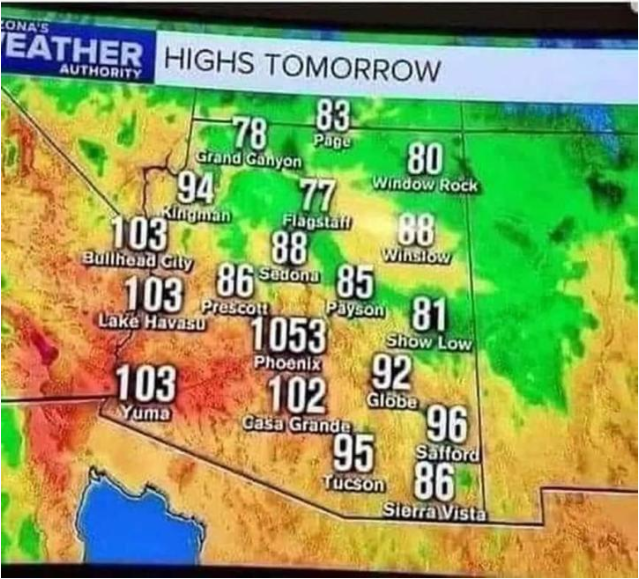
Warm air over the oceans can produce more rain. Warmer air over continental land masses can produce more drought because the hot air dries out the landscape and soil, and warmer air can absorb more moisture before reaching the saturation point that causes rain. So, for example, the same amount of moisture in the atmosphere over Phoenix on a 90 degree day might produce rains. But on a 115 degree day that same amount of moisture in the atmosphere will stay in vapor form and not rain. And instead of raining, the hotter air will dry out the surrounding landscape even more. If there is no source of new moisture over the desert (like nearby oceans) then hotter weather will cause more drought. Wet rainy areas near oceans may become wetter in a warming planet. Dry areas away from oceans may become drier in a warming planet.
0 x
A fool can throw out more questions than a wise man can answer. -RZehr
Ken wrote: ↑Wed Jun 30, 2021 8:42 pm
But on a 115 degree day that same amount of moisture in the atmosphere will stay in vapor form and not rain. And instead of raining, the hotter air will dry out the surrounding landscape even more.
Rain is formed in the upper atmosphere and not really directly affected by surface temperatures.
Water vapor affects climate more than co2. The more moisture, the more clouds which reflect more sun back out into space.
0 x
Try hard not to offend. Try harder not to be offended.
I think I am funnier than I really am.
Ken wrote: ↑Wed Jun 30, 2021 8:42 pm
But on a 115 degree day that same amount of moisture in the atmosphere will stay in vapor form and not rain. And instead of raining, the hotter air will dry out the surrounding landscape even more.
Rain is formed in the upper atmosphere and not really directly affected by surface temperatures.
Water vapor affects climate more than co2. The more moisture, the more clouds which reflect more sun back out into space.
Yes, but it's a water cycle. The moisture in the upper atmosphere has to come from someplace. Either evaporation from lakes and rivers, transpiration from forests and grasslands, or evaporation from the ocean. In places like the American southwest where it is already dry, increased heat makes it drier because with a warmer atmosphere the same amount of evaporation that would have generated rain in cooler temperatures fails to produce rain during heat waves. Because warmer air can absorb more water than colder air. And even if the air rises enough and cools enough to produce precipitation, the rain evaporates again before hitting the ground. You can now see rainstorms over the deserts that don't produce any rain that reaches the ground. They meteorological word for that is Virga and it is becoming more common with heat waves in the desert southwest. Places like the SE Gulf Coast and Florida are likely to get more rainy in a warming climate because of the increased ocean evaporation. Houston now gets 1000-year floods every few years or so. The desert southwest is likely to become more dry because they are too far from the ocean and the drier landscape is producing less evaporation.
This is Virga rainfall over a sun-baked landscape that is evaporating before reaching the ground.
0 x
A fool can throw out more questions than a wise man can answer. -RZehr
Ken wrote: ↑Thu Jul 01, 2021 3:17 am
The moisture in the upper atmosphere has to come from someplace. Either evaporation from lakes and rivers, transpiration from forests and grasslands, or evaporation from the ocean.
Most is from the oceans.
Are you aware that before the last ice age, the earth was warmer and the Sahara was not a desert.
As it turns out, what is now the Sahara Desert was the home of hunter-gatherers who lived off the animals and plants present in the savannas of the region and off the wooded prairies sometime between 5,000 and 11,000 years ago.
“It was 10 times as wet as today,” said lead author Jessica Tierney of the University of Arizona. Annual rainfall in the Sahara now ranges from about 4 inches to less than 1 inch (100 to 35 mm).
Although other research has already identified the existence of a “Green Sahara” period, Tierney and colleagues managed to compile a continuous record of rainfall in the region that existed 25,000 years ago.
Interestingly, archaeological evidence shows that humans occupied much of the Sahara during the wet period, but gradually withdrew some 8,000 years ago.
It greened again briefly around 6000 BC.
0 x
Try hard not to offend. Try harder not to be offended.
I think I am funnier than I really am.
Ken wrote: ↑Thu Jul 01, 2021 3:17 am
The moisture in the upper atmosphere has to come from someplace. Either evaporation from lakes and rivers, transpiration from forests and grasslands, or evaporation from the ocean.
Most is from the oceans.
Are you aware that before the last ice age, the earth was warmer and the Sahara was not a desert.
As it turns out, what is now the Sahara Desert was the home of hunter-gatherers who lived off the animals and plants present in the savannas of the region and off the wooded prairies sometime between 5,000 and 11,000 years ago.
“It was 10 times as wet as today,” said lead author Jessica Tierney of the University of Arizona. Annual rainfall in the Sahara now ranges from about 4 inches to less than 1 inch (100 to 35 mm).
Although other research has already identified the existence of a “Green Sahara” period, Tierney and colleagues managed to compile a continuous record of rainfall in the region that existed 25,000 years ago.
Interestingly, archaeological evidence shows that humans occupied much of the Sahara during the wet period, but gradually withdrew some 8,000 years ago.
It greened again briefly around 6000 BC.
What ? We don't have a young earth ?
I suspect there is a poll somewhere on this forum on how many here believe in a young earth (6,000 -10,000 years) and how many believe in an earth much older. Since Anabaptists do seem to take the Bible more literally than most, I suspect there are more YEC here ?
We had some in the MB church I attended that said if you can't take creation in a literal young earth sense, then you are not regarding God's Word as infallible and historically accurate.
Was there a poll taken here on this here ? I'm curious.
Arizona started drying out rapidly last spring and, since October, the entire state has been in some form of drought. Now all but 6% of the state is in dire “extreme” or “exceptional” drought that leaves wildlife and plants stressed.
“Whatever (snow) we do get, when it comes time to melt in the spring, it's just going to soak right into the ground,” said Nancy Selover, Arizona’s state climatologist. “The ground is so dry, it’s just gonna suck it up. We're not going to get a lot of good runoff, and we're not going to get a lot of good streamflow, reservoir infill or any of that kind of stuff, so we're concerned.”
She pointed out that instead of monsoon rains that raise humidity and lower temperatures through the summer, high-pressure and high temperatures were relentless for the second year in a row.
“We didn't have storms — we just had a lot of hot air,” said Selover, pointing to withering 110- and 115-degree days that led to a record number of 29 nights when the low never got below 90 degrees. “The previous record was 15 days.”
0 x
A fool can throw out more questions than a wise man can answer. -RZehr
Ken wrote: ↑Thu Jul 01, 2021 4:45 pm
It is about what Arizona will be like in 10-20 years.
They can not predict weather 5 days out presently. How do we know about the future?
With increased co2, plant can be much more efficient and require half the water to preform photosynthesis. This means arid places will be able to grow much more plants.
While there are negatives that we need to watch for, there is also many positives. It seems some only look at one side.
0 x
Try hard not to offend. Try harder not to be offended.
I think I am funnier than I really am.