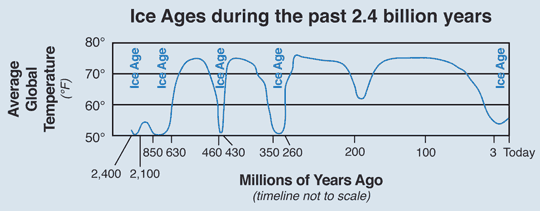
Robert wrote:Every warming period was caused by Malencivick cycles. They all showed sharp, fast warming periods. We are still 5 degrees C colder then the mean temperature of the planet through history. 10 degrees colder than the Jurassic.
How is discussion of ice ages NOT about climate? Temperature is part of climate.
You don't seem to be responding to anything I said here. I really would find it helpful if you would start by making sure you understand what I am saying before "refuting" it. That would make it a lot easier to have a scientific conversation.
In fact, I recently quoted this:
The past is the key to the future. Contrary to popular belief, climate models are not the principal basis for assessing human-made climate effects. Our most precise knowledge comes from Earth's paleoclimate, its ancient climate, and how it responded to past changes of climate forcings, including atmospheric composition. Our second essential source of information is provided by global observations today, especially satellite observations. which reveal how the climate system is responding to rapid human-made changes of atmospheric composition, especially atmospheric carbon dioxide (CO2). Models help us interpret past and present climate changes, and, in so far as they succeed in simulating past changes, they provide a tool to help evaluate the impacts of alternative policies that affect climate.
We need both historical data and modern measurements to make sense of what is going on. Here is a paragraph that relates the two:
Civilization developed during the Holocene, the interglacial period of the past 10,000 years during which global temperature and sea level have been unusually stable.
So the climate we have had during the last 10,000 years is the most familiar for human beings who live on earth today. It hasn't been a particularly friendly climate for dinosaurs, but it has been for human beings.
What were the sea levels when the temperature was higher in the past?
Figure 1 shows two prior interglacial periods that were warmer than the Holocene: the Eemian (about 130,000 years ago) and the Holsteinian (about 400,000 years ago). In both periods sea level reached heights at least 4-6 meters (13-20 feet) greater than today. In the early Pliocene global temperature was no more than 1-2°C warmer than today, yet sea level was 15-25 meters (50-80 feet) higher.
That's not the end of the world as we know it, but that would have a significant impact on the coastal areas where a large percent of human beings live.
Robert wrote:Bootstrap wrote:Even though you used that graph, you seem to reach different conclusions than the scientists who produced it.
What did i get wrong? I don't see it.
I mentioned some of it above. Here's another thing mentioned in that article:
Figure 2 shows that both Greenland and Antarctic ice sheets are now losing mass at significant rates, as much as a few hundred cubic kilometers per year. We suggest that mass loss from disintegrating ice sheets probably can be approximated better by exponential mass loss than by linear mass loss. If either ice sheet were to lose mass at a rate with doubling time of 10 years or less, multi-meter sea level rise would occur this century.
So I don't think the graph you quoted shows these fears are unjustified. The people who produced it thought it was part of the big picture showing that there is reason to be concerned. I don't think you have addressed their data or the claims they are making.