barnhart wrote:I think Anabaptism is always in crisis because it rejects the things that provide long term stability. The things it rejects are earthy, warm and provide a great deal of physical sustenance, things like militarism, nationalism, democracy, individual rights and materialism, and in place of those earthly comforts the offer of citizenship in an ethereal, heavenly Kingdom and the resources of an unseen King seem pale and don't command the eye.
The current crisis is not so much from hostility, but from an inability of the sheep to believe when other church movements seem to have it all, eternal citizenship and the red meat citizenship and comfort of this world. The more internally compromised we become, by giving in to the demands of earthly citizenship, the more watered down and luke-warm we become and loose attraction to God and to the on-looking world, salt that is no longer good for anything but to be thrown out and trod underfoot.
The issue of alienation among people who joint Anabaptist movements would simply go away if the movement constantly takes in new adult believers. In many cases this stopped generations ago, so the ability to nurture new life has atrophied. God usually gives new life where to young people who have the energy and vision for it, is it different in the spiritual world. Until a church is prepared to care for new life, I doubt there will be much.
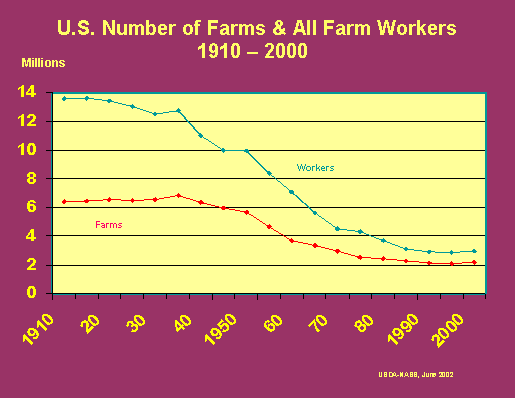
I don't know if I agree that Anabaptism is always in crisis. For centuries, Anabaptism did just fine following the two kingdom approach in which Anabaptists created intentional communities (mainly rural) and thrived by mainly turning their backs on the outside world except for business transactions. I think that is becoming increasingly difficult in the modern world in which the agricultural economy is rapidly changing. The percentage of Americans working in agriculture and the total number of farms has been on a steady decline over the past century:
And the percentage of farm workers who are itinerant employees vs family is also changing. Farm labor is increasingly something done by migrant workers on large farms and decreasingly something done by families on family-owned farms

What this means is that it is increasingly difficult to create an intentional rural community compared to 50 or 100 years ago. The economic trends are all in the wrong direction. Not impossible, Amish and other groups are still doing it. And there are members here who are doing it. But it is remarkably more difficult today than say in the 1880s when Mennonites could move to a place like Kansas in the thousands with little more than the clothes on their backs and build farms and communities in a largely agrarian economy with cheap abundant land. Those communities that still exist are largely legacy communities founded centuries ago (Holmes County, Belleville, Lancaster, etc.).
These days in an increasingly urbanized world economy and corporate ag economy it is just much more difficult to build an insular agrarian community. And for different reasons it is difficult to build a separate two-kingdom urban community in a place where people's jobs and careers are going to pull them in all different directions. In urban America you are going to spend most of your life outside church with people who don't share your faith. In a rural community of farms where the church is the center of the community and the area is predominantly Mennonite or Anabaptist, that is not the case.
I think the crisis (to the extent that there is one) today is that the urban/rural divide in this country is pulling the church (and individual families) in two directions just like it is pulling America in two directions. I don't think there is really any real solution.