The authors disclosed multiple plausible biases that led them to be unable to draw a conclusion on whether vaccination improved asymptomatic transmssion reduction. This is done to prevent people like you from cherry-picking studies, and enforcing inane vaccination policies on health care workers.Ken wrote: ↑Thu Aug 19, 2021 2:35 pm Nett: If you had actually read the study you cited regarding vaccinations and asymptomatic spread of Covid you would have reached the discussion section of the paper where the authors write:
This study found an association between vaccination with BNT162b2 in hospital employees and a decreased risk of symptomatic and asymptomatic infections with SARS-CoV-2. Limitations include the observational design; short follow-up time; small cohort size, which led to an inability to match the 2 groups and unequal follow-up; differential temporal risk during the surveillance; and that the group choosing not to be vaccinated may have been more prone to higher-risk behavior. The unequal follow-up time and the latter 2 limitations may have biased the results in favor of vaccination. Further research is needed to determine whether a reduction in risk of asymptomatic infection leads to reduced transmission
There's a lot to unpack about that analysis. I don't really have time to go through all of them right now, but A few obvious things:Ken wrote: ↑Thu Aug 19, 2021 2:35 pm
Delta is actually too new to have many long-term peer-reviewed studies about vaccines and transmissibility. But there is plenty of research to show that vaccines do reduce the transmissibility of Covid in general. Here is a discussion of the topic from Nature that was published recently: https://www.nature.com/articles/d41586-021-02054-z
As for Israel. Scientists and data analysists are now considering that what is happening with Israeli data may be an example of something called "Simpsons Paradox" https://en.wikipedia.org/wiki/Simpson%27s_paradox which happens when data in separate groups shows one strong tendency but disappears or reverses when the groups are combined. In this case in Israel, the unvaccinated population tilts strongly young and healthy while the older population is both more vaccinated and accounts for the bulk of severe covid cases. When data are not segregated by age you can get contradictory results from what age-segregated data show.COVID vaccines slash viral spread – but Delta is an unknown
Studies show that vaccines reduce the spread of SARS-CoV-2 by more than 80%, but the Delta variant is creating fresh uncertainty.
Many vaccines have been shown to provide strong protection against COVID-19. Now, growing evidence finds that they also substantially reduce the risk of passing on the virus SARS-CoV-2 — crucial information for governments making decisions about how best to control the pandemic.
However, the studies were done before the highly transmissible Delta variant became prevalent — and scientists say it might be more easily spread by vaccinated people than are earlier variants.
Two studies1,2 from Israel, posted as preprints on 16 July, find that two doses of the vaccine made by pharmaceutical company Pfizer, based in New York City, and biotechnology company BioNTech, based in Mainz, Germany, are 81% effective at preventing SARS-CoV-2 infections. And vaccinated people who do get infected are up to 78% less likely to spread the virus to household members than are unvaccinated people. Overall, this adds up to very high protection against transmission, say researchers.
The studies reflect population-level trends, say researchers. “It’s good news,” says Natalie Dean, a biostatistician at Emory University in Atlanta, Georgia. “But it’s not quite good enough,” she notes, because it means that vaccinated people can still occasionally spread the infection.
And the highly transmissible Delta variant is a major source of uncertainty. The Israeli studies and others are based on the circulation of earlier variants, in particular Alpha, but research suggests that vaccines offer slightly reduced protection against Delta.
Here is a recent discussion by a Biostatistician and biomedical researcher on Simpson's paradox and how it may be confounding analysis of Israeli Covid data: https://www.covid-datascience.com/post/ ... vaccinated
In any event. You do whatever you want. We are obviously never going to agree. I'll leave others to decide whether being vaccinated or unvaccinated better reduces your risk of contracting Covid and spreading it on to others.
If Simpson's paradox is at all in play here, it means that the two populations are that different, a common vaccination policy would be absurd.
An analysis will always be skewed towards which population is higher. If you reverse the analysis in a case like India's, you will get the opposite result.
Looking at overall case rates is more important than anything, and make this analysis basically null.
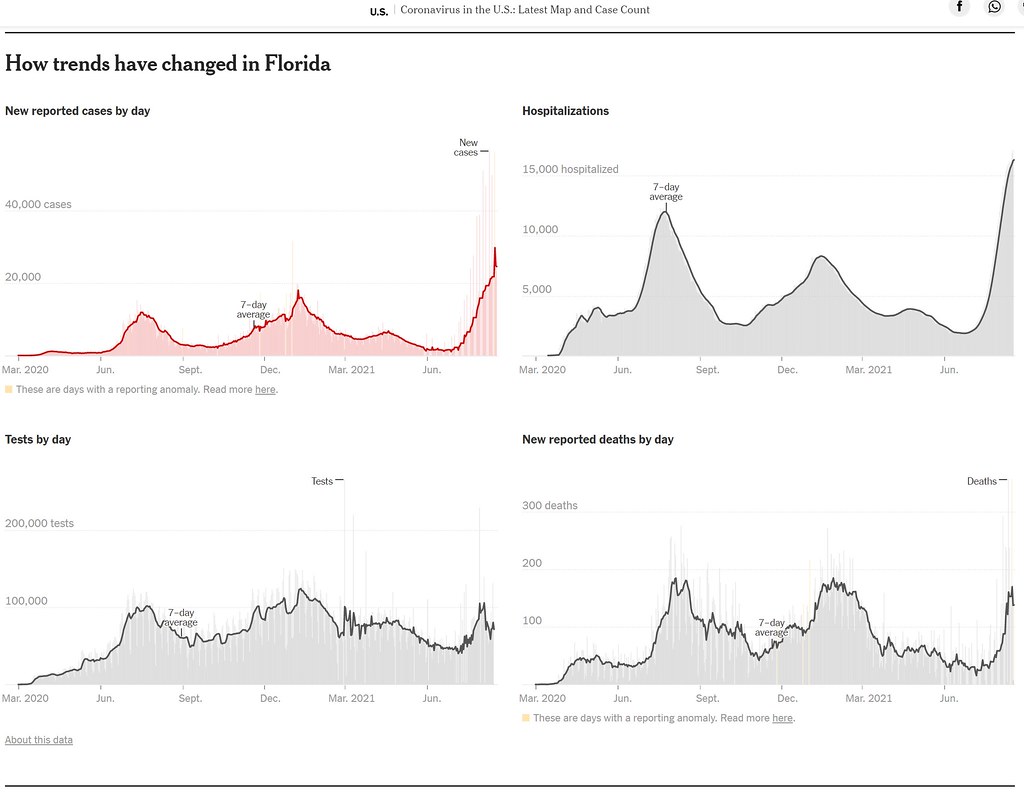
Here's the simple fact. Israel has a very high rate of vaccination in > 12 y/o. Despite that high rate of vaccination, they are experiencing case numbers rivaling what they experienced during the initial outbreak of COVID, because vaccines were available. the NYT article goes into detail about how their own experts are now questioning their vaccination strategy.
But young healthy people who work in health care still need to get the vaccine right? Your vacillation between fervor for vaccinating health care worker against will, and then providing milquetoast explanations like Simpson's paradox indicates to me that vaccination has become more a religion for you, than something based in data.