MaxPC wrote: ↑Fri Jun 16, 2023 10:30 pm
Likewise. I worked my sabbatical at Santa Clara College in the early 1960s and downtown San Francisco was lovely. Fisherman’s Wharf was not an amusement park then but was the home of fishing boats. The many walkable neighborhoods in northern SF were quite safe and the small family restaurants served outstanding seafood that was better than Cornwall or Bristol.
Three years ago I attended a reunion in the same area of San Francisco. It was shocking to see the level of decline. In broad daylight near a large group of people I saw two thefts of bags. The thieves simply walked over to the person and grabbed the handbags then ran. I am not surprised that the criminal bravado has negatively affected businesses’ ability to remain.
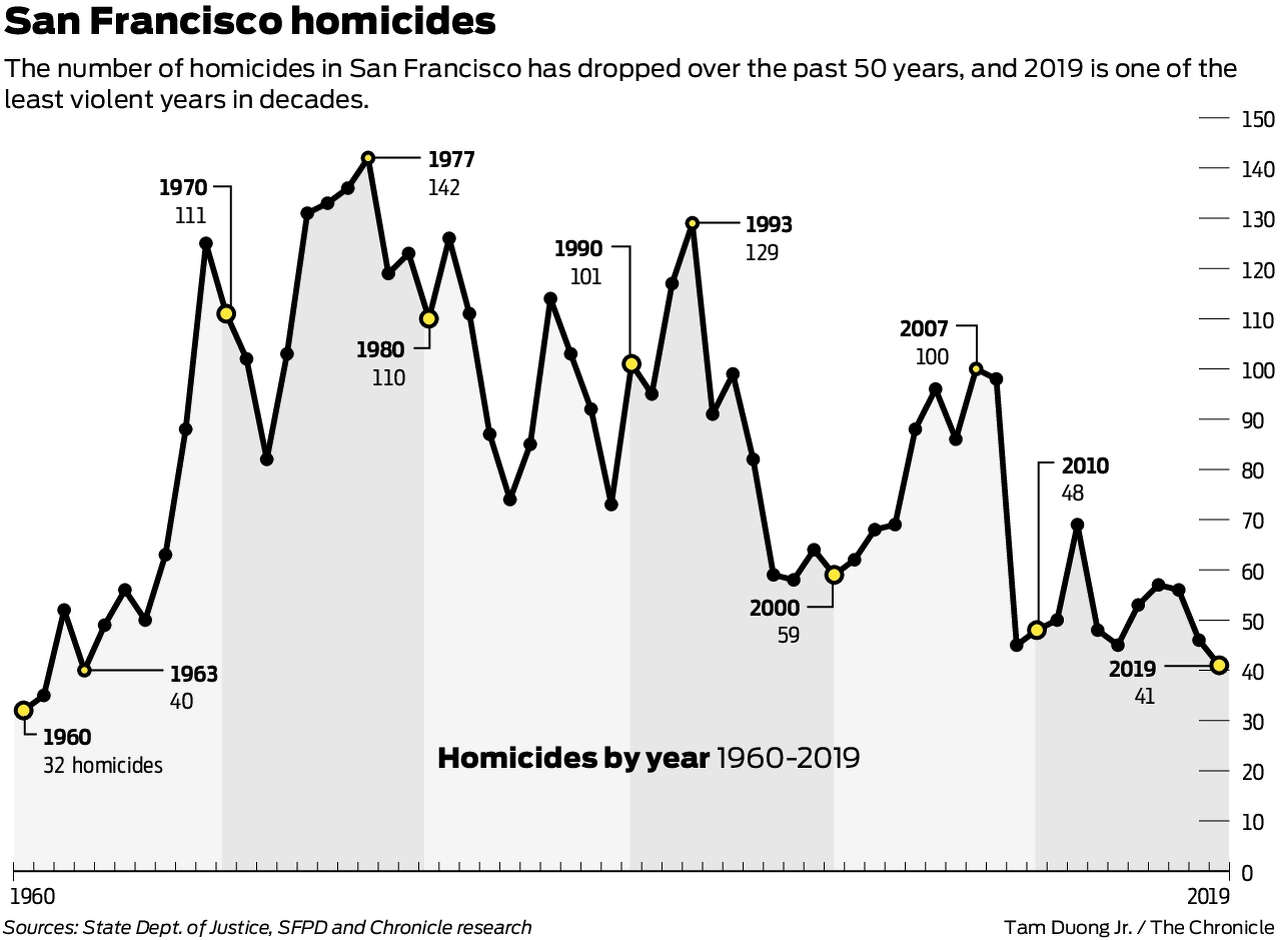
Actually the murder rate in San Francisco peaked in 1977 and dropped to a low in 2019. It has ticked up and was at 56 in both 2021 and 2022 which this chart doesn't show. But which means that last year in 2022 the murder rate in San Francisco was about equal to where it was in mid-1960s. So far through June 11 in 2023 there have been 22 murders which is a pace to reach in the mid 40s by year's end, erasing the pandemic-era increases and putting things back to the early 1960s.
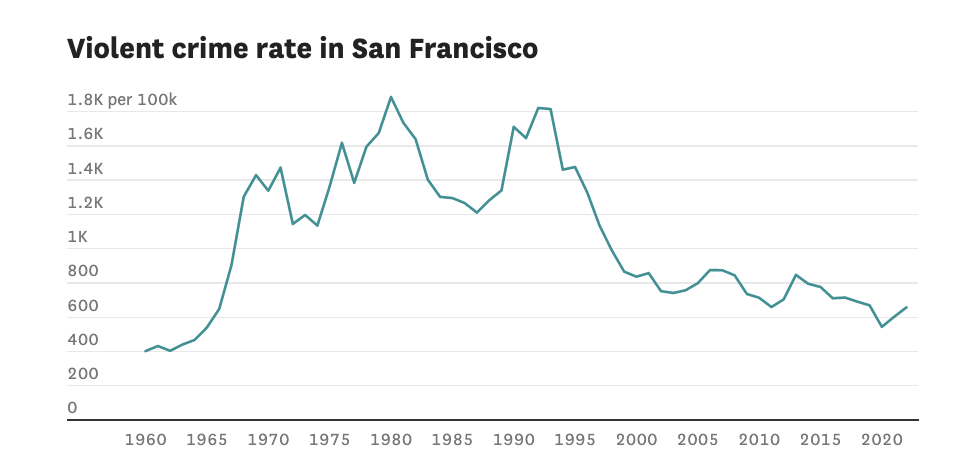
The violent crime rate follows a similar pattern, peaking between the late 1970s and early 1990s and falling in recent years to rates not seen since the 1960s
In the 1960s and 1970s much of San Francisco was a dilapidated wreck as middle class people were fleeing south and across the Bay Bridge to the suburbs and across the Golden Gate to Marin County due in part to desegregation but also just general suburbanization which was highly subsidized by the government. That is one reason the place was so cheap and became such a mecca for aimless hippies who could find cheap flop houses and rooms all over the city. The Zebra killers and other violent criminals were stalking the city. Heroin addiction was rampant through the 1960s and into the 1970s until it was eventually superseded by cocaine.
The difference between then and today are twofold.
First, we basically shut down our mental institutions in the 1970s which has flooded our streets with the dysfunctional mentally ill. This chart is actually somewhat deceptive because the prison population is the total prison population, not just the mentally ill, which only contributed about 5% of the increase. But it shows how we deinstitutionalized the mentally ill while switching to an intense incarceration approach to crime and drugs which has brought us where we are today

Second, we went through wave after wave of "urban renewal" in San Francisco and other cities across the country where tore down hundreds of thousands of cheap "flophouse" SRO hotels and such in the name of "urban renewal" and didn't replace them with much except parking lots and eventually office towers. So all those junkies who 50 years ago would have been shooting up 5 floors up in a flea bitten "two-bit 8x12 room paid for by 2 hours of pushing broom" to quote the Roger Miller song are now sitting on the sidewalk because the cheapest studio apartment in San Francisco probably costs $2,000/month with first and last months rent, security deposit, and good credit. There is literally no place else for them to go. There were over 3-times more SRO residential rooms in San Francisco in 1910 then there are today despite the population having doubled in that time. Would it be better for junkies to be shooting up in cheap flop houses like 50 years ago our on the sidewalks like today? I don't know. But out of sight, out of mind means we don't have to deal with the public effects so much.

The history of San Francisco's housing crisis is 100 years in the making and a story of racism and appeasement/coddling of the wealthy
https://www.fastcompany.com/90242388/th ... ing-crises
Crime is actually not really any worse than it was 50 years ago in many US cities, San Francisco included. But the dysfunctional vagrants are just WAY WAY more out in the open due to the predictable results of policy choices that we made. So it FEELS way worse. Instant social media and 24/7 cable news doesn't help.
The solutions are there and within reach but will take far more than just attacking crime from a law enforcement perspective. And understanding the roots of the problem makes the solutions obvious. It just takes the political will.