Who speaks for the black community?

Things that are not part of politics happening presently and how we approach or address it as Anabaptists.
Wade

Re: Who speaks for the black community?

Post by Wade »

Ms. Izzie wrote:So am I understanding correctly that for some of you living out Kingdom principles is solely done individually, one soul at a time, and for others it is done individually but also in a way where Gods' Kingdom on earth engages the earthly kingdom through_____________? I'm not sure what all is on that blank yet. For now, listening to the black community is on it. What else might belong on it?

(Sometimes it's easier to tell what a person is not promoting than what they are promoting.)
It isn't so rigid with one soul at a time as much as listening to the story of each person.

For example if I make a generalization about the black community because of allowing someone to speak for them then it is really likely I am going to offend at least a few people. I'd rather not put people in a box, which could very easily result in racism. People are people. And each person has a different story. When I try to share the love of Christ with someone I try to listen to them individually, rather than look at their skin colour and assume they have been oppressed, assume they have grown up privileged, or whatever it might be. Sometimes those things can relate but each person processes those differently with their own perspectives and experiences. I want to know their heart and what ministering needs to take place for them to find Christ and see His kingdom - and coming up with systems based on race just doesn't work because it is racist in itself and shuts out the opportunity to connect with people that opens a door into deeper conversations that effect eternity.

0 x
Bootstrap

Re: Who speaks for the black community?

Post by Bootstrap »

Wade wrote:
Ms. Izzie wrote:So am I understanding correctly that for some of you living out Kingdom principles is solely done individually, one soul at a time, and for others it is done individually but also in a way where Gods' Kingdom on earth engages the earthly kingdom through_____________? I'm not sure what all is on that blank yet. For now, listening to the black community is on it. What else might belong on it?

(Sometimes it's easier to tell what a person is not promoting than what they are promoting.)
It isn't so rigid with one soul at a time as much as listening to the story of each person.

For example if I make a generalization about the black community because of allowing someone to speak for them then it is really likely I am going to offend at least a few people. I'd rather not put people in a box, which could very easily result in racism. People are people. And each person has a different story. When I try to share the love of Christ with someone I try to listen to them individually, rather than look at their skin colour and assume they have been oppressed, assume they have grown up privileged, or whatever it might be. Sometimes those things can relate but each person processes those differently with their own perspectives and experiences. I want to know their heart and what ministering needs to take place for them to find Christ and see His kingdom - and coming up with systems based on race just doesn't work because it is racist in itself and shuts out the opportunity to connect with people that opens a door into deeper conversations that effect eternity.
I'm going to respond only to the part involving how we listen to black people.

I agree with what you say here, Wade, but I also think there's a place for polls and other reliable sources of information if we want to know whether the experiences of one person are similar to the experiences of many black people.

I don't think we should establish systems based on race, but I do think we should be bothered by systems that discriminate based on race. And I think black Americans are best positioned to tell us when they experience this. We should be careful not to shout them down when they speak out about their own experiences.
0 x
Ms. Izzie
Posts: 460
Joined: Fri Jun 28, 2019 7:47 pm
Affiliation: CA

Re: Who speaks for the black community?

Post by Ms. Izzie »

Bootstrap wrote:We should be careful not to shout them down when they speak out about their own experiences.
Could you articulate ways in which this is done?
0 x
Josh

Re: Who speaks for the black community?

Post by Josh »

Bootstrap wrote:
Josh wrote: (Directed at someone else)
The fact you appointed yourself the spokesman of the black community here. Your whitesplaining here is tiresome.
One of the main points of this thread is that we can use reliable polls and other approaches to find out what black Americans think. None of us white people need to be the arbiter of that.

Could we please avoid drowning out the topic with other topics?
That’s your opinion, but you pick the polls and surveys you like. People with other opinions choose the ones they right. There is not some universal consensus here.
0 x
User avatar
Robert
Site Janitor
Posts: 12078
Joined: Wed Oct 19, 2016 4:16 pm
Affiliation: Anabaptist

Re: Who speaks for the black community?

Post by Robert »

Robert wrote:
joshuabgood wrote: There is plenty of data that show the vast vast majority, beyond a super majority of 66%, feel that systemic racism is an issue they face in the USA. Are you prepared to tell them all that they are wrong and that you know better than they do what they experience? If so, that seems arrogant to me. That is all.
I know that many feel that way, but I think data shows it is not the case presently. We should not govern by feeling, but by facts and current circumstances.

I also think that 66% of the nation that thinks abortion, gender identity and climate change are wrong. I also think 90% of Christianity is wrong for supporting war.
I am prepared to speak to anyone on each of these issues.

So this makes me arrogant?
0 x
Try hard not to offend. Try harder not to be offended.
I think I am funnier than I really am.
Josh

Re: Who speaks for the black community?

Post by Josh »

joshuabgood wrote:Your first paragraph feels more fair. Thanks.

Regarding your second paragraph, no I am not accusing you of racism. I am advocating for believing the vast majority of the black community. That is not calling you a racist.
I disagree with you on what the “vast majority” is saying. A standard leftist debate tactic is try to control the facts, like when they tell us men are actually women, and then accuse anyone who disagrees of hate.
0 x
Bootstrap

Re: Who speaks for the black community?

Post by Bootstrap »

Josh wrote:That’s your opinion, but you pick the polls and surveys you like. People with other opinions choose the ones they right. There is not some universal consensus here.
If you have polling or studies from other reliable sources, please feel free to quote them here. When you get 90+ percent agreement on various topics, that tells you something.

Regardless, I would rather not see this thread drowned out by how white people feel or political grievances. It's not the topic of this thread.
0 x
Bootstrap

Re: Who speaks for the black community?

Post by Bootstrap »

Josh wrote:I disagree with you on what the “vast majority” is saying.
That's what polls are for.
Josh wrote:A standard leftist debate tactic is try to control the facts, like when they tell us men are actually women, and then accuse anyone who disagrees of hate.
If you have better facts, please provide them. And please avoid stirring up a fight. Just provide information on what black Americans believe about these topics, and explain why you believe a particular view is widely held.

Please don't appeal to political factions and the emotions surrounding them. That's not what this thread is about.
0 x
joshuabgood

Re: Who speaks for the black community?

Post by joshuabgood »

Robert wrote:
Robert wrote:
joshuabgood wrote: There is plenty of data that show the vast vast majority, beyond a super majority of 66%, feel that systemic racism is an issue they face in the USA. Are you prepared to tell them all that they are wrong and that you know better than they do what they experience? If so, that seems arrogant to me. That is all.
I know that many feel that way, but I think data shows it is not the case presently. We should not govern by feeling, but by facts and current circumstances.

I also think that 66% of the nation that thinks abortion, gender identity and climate change are wrong. I also think 90% of Christianity is wrong for supporting war.
I am prepared to speak to anyone on each of these issues.

So this makes me arrogant?
No it doesn't. Those are values you hold that are ethical judgements. That makes sense to me. But it seems different in kind, to me, from telling people they aren't experiencing what they tell you they are experiencing. That is where I am asking essentially, what gives us the grander knowledge to know better than them what they experienced?

That would feel arrogant to me...to tell someone they are wrong about their own experiences, unless there were strong prevailing evidences they were delusional. But delusions are not the consensus of vast majorities of our black brothers and sisters in Christ. So I am doubtful about whether it is a delusion.

Thanks for engaging in a respectful way.
0 x
Bootstrap

Re: Who speaks for the black community?

Post by Bootstrap »

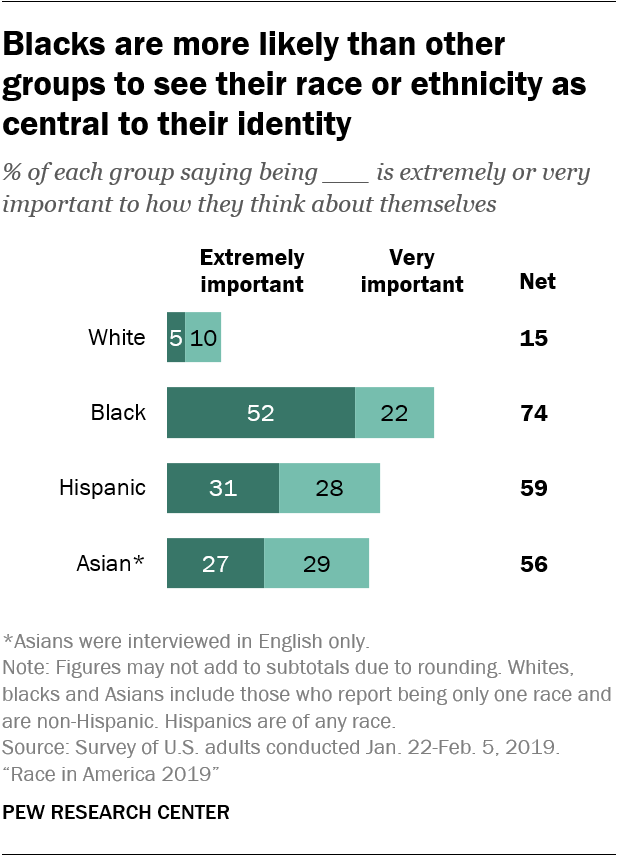
Worth mentioning: black Americans are much more likely than other groups to see their race as an important part of their identity. That is one thing that makes it hard for most whites to hear what they are saying - we do not connect to whiteness in the same way.

Image

And they connect to this identity in a positive way.
... experts agree that black Americans express high levels of connection to their blackness. Karyn Lacy, a University of Michigan sociology professor who wrote a book on black middle-class people living in the Washington, D.C., suburbs, said that the people she interviewed for her research wanted their children and grandchildren to be close to the broader black community.

“There is a lot of joy in being black,” Lacy said of the people she interviewed. “This is a really important point. Most of the media coverage of black people is negative. Scholars have spent a lot of time documenting the racial discrimination blacks experience. We do need to know about how and why discrimination persists. But there is very little attention to all the good things about being black.”

“We’re left with the impression that black people wake up every morning thinking, ‘Ugh, I’ve got to be black today, and it’s going to be awful.’ None of the people I interviewed held that view,” Lacy added. “They take a lot of pride in being black and worry that their kids might not embrace being black with the same enthusiasm.”
For black people I know, living out the Gospel in black churches, being black is not an illness to be diagnosed and cured. But some of the things I read seem to treat it that way.

To me, really listening to our black brethren also means being willing to appreciate pig pickings, Gospel music, and joyful hugs that we do not have in our local Mennonite church.
0 x
Post Reply