It is a poorly written article, I agree. But the ozone layer and Montreal Protocol have nothing really do to with climate change. It is about protecting the polar regions from intense UV radiation if the ozone disappears. It reads as if the author is conflating several environmental issues and confusing them. That's sometimes what happens when reporters write about something they don't entirely understand, whether it is atmospheric science or medicine or economics or religion.Robert wrote:https://www.theguardian.com/environment ... the-arctic
Low temperatures in the northern polar regions led to an unusual stable polar vortex, and the presence of ozone-destroying chemicals such as chlorine and bromine in the atmosphere – from human activities – caused the hole to form.This is just poor reporting. The hole formed from colder than usual temperature. Trying to attach it to pollution then saying it is not because of pollution at the very end of the article makes the author seem really suspect. This is what happens when you try to force everything into climate change.New sources of ozone-depleting chemicals were not a factor in the hole observed in the Arctic, said Peuch. “However, this is a reminder that one should not take the Montreal Protocol measures for granted, and that observations from the ground and from satellites are pivotal to avoid a situation where the chlorine and bromine levels in the stratosphere could increase again.”
Global Warning/Climate Change
-
Ken
- Posts: 21863
- Joined: Thu Jun 13, 2019 12:02 am
- Location: Washington State
- Affiliation: former MCUSA
Re: Global Warning/Climate Change
0 x
A fool can throw out more questions than a wise man can answer. -RZehr
Re: Global Warning/Climate Change
Good article.
https://www.dailywire.com/news/shellenb ... mate-scare
By: Michael Shellenberger
Michael Shellenberger is a Time Magazine “Hero of the Environment,” Green Book Award Winner, and author of Apocalypse Never: Why Environmental Alarmism Hurts Us All (Harper Collins, June 30, 2020). He is a frequent contributor to The New York Times, Washington Post, Wall Street Journal, Scientific American, and other publications. His TED talks have been viewed over five million times.
On behalf of environmentalists everywhere, I would like to formally apologize for the climate scare we created over the last 30 years. Climate change is happening. It’s just not the end of the world. It’s not even our most serious environmental problem.
I may seem like a strange person to be saying all of this. I have been a climate activist for 20 years and an environmentalist for 30.
But as an energy expert asked by Congress to provide objective expert testimony, and invited by the Intergovernmental Panel on Climate Change (IPCC) to serve as Expert Reviewer of its next Assessment Report, I feel an obligation to apologize for how badly we environmentalists have misled the public.
Here are some facts few people know:
Humans are not causing a “sixth mass extinction”
The Amazon is not “the lungs of the world”
Climate change is not making natural disasters worse
Fires have declined 25% around the world since 2003
The amount of land we use for meat — humankind’s biggest use of land — has declined by an area nearly as large as Alaska
The build-up of wood fuel and more houses near forests, not climate change, explain why there are more, and more dangerous, fires in Australia and California
Carbon emissions have been declining in rich nations including Britain, Germany and France since the mid-seventies
Adapting to life below sea level made the Netherlands rich not poor
We produce 25% more food than we need and food surpluses will continue to rise as the world gets hotter
Habitat loss and the direct killing of wild animals are bigger threats to species than climate change
Wood fuel is far worse for people and wildlife than fossil fuels
Preventing future pandemics requires more not less “industrial” agriculture
I know that the above facts will sound like “climate denialism” to many people. But that just shows the power of climate alarmism.
0 x
Try hard not to offend. Try harder not to be offended.
I think I am funnier than I really am.
I think I am funnier than I really am.
-
appleman2006
Re: Global Warning/Climate Change
Let me make a prediction. This guy, if not already, will be soon classified as a climate change denier.
0 x
-
Ken
- Posts: 21863
- Joined: Thu Jun 13, 2019 12:02 am
- Location: Washington State
- Affiliation: former MCUSA
Re: Global Warning/Climate Change
https://www.dailywire.com/news/shellenb ... mate-scare
Humans are not causing a “sixth mass extinction”: This argument is really a matter of definitions. The mass extinctions typically referenced by geologists were near world-ending events. The Permian extinction wiped out 96% of marine life and over 70% of terrestrial life. It is true, we are nowhere near anything like that. But we are also causing widespread extinctions. Here is a more nuanced article about the subject: https://www.theatlantic.com/science/arc ... ld/529545/
The Amazon is not “the lungs of the world”: True. They produce about 6% of the world's photosynthetic oxygen production but also consume about that same amount so the net effect is close to zero. Oxygen shortage is not the crisis, increased CO2 is. https://www.theatlantic.com/science/arc ... en/596923/
Climate change is not making natural disasters worse: This is a ridiculous statement. Some natural disasters are climate-driven (drought, hurricanes, monsoons) others are not (Tsunamis, earthquakes, volcanoes, etc.). Without a doubt, hurricane intensity has been increasing. Even Trump's science agencies concede this point. Here is a research summary put out by NOAA two weeks ago: https://www.gfdl.noaa.gov/global-warmin ... urricanes/ There is a direct link between sea surface temperatures and hurricane intensity.
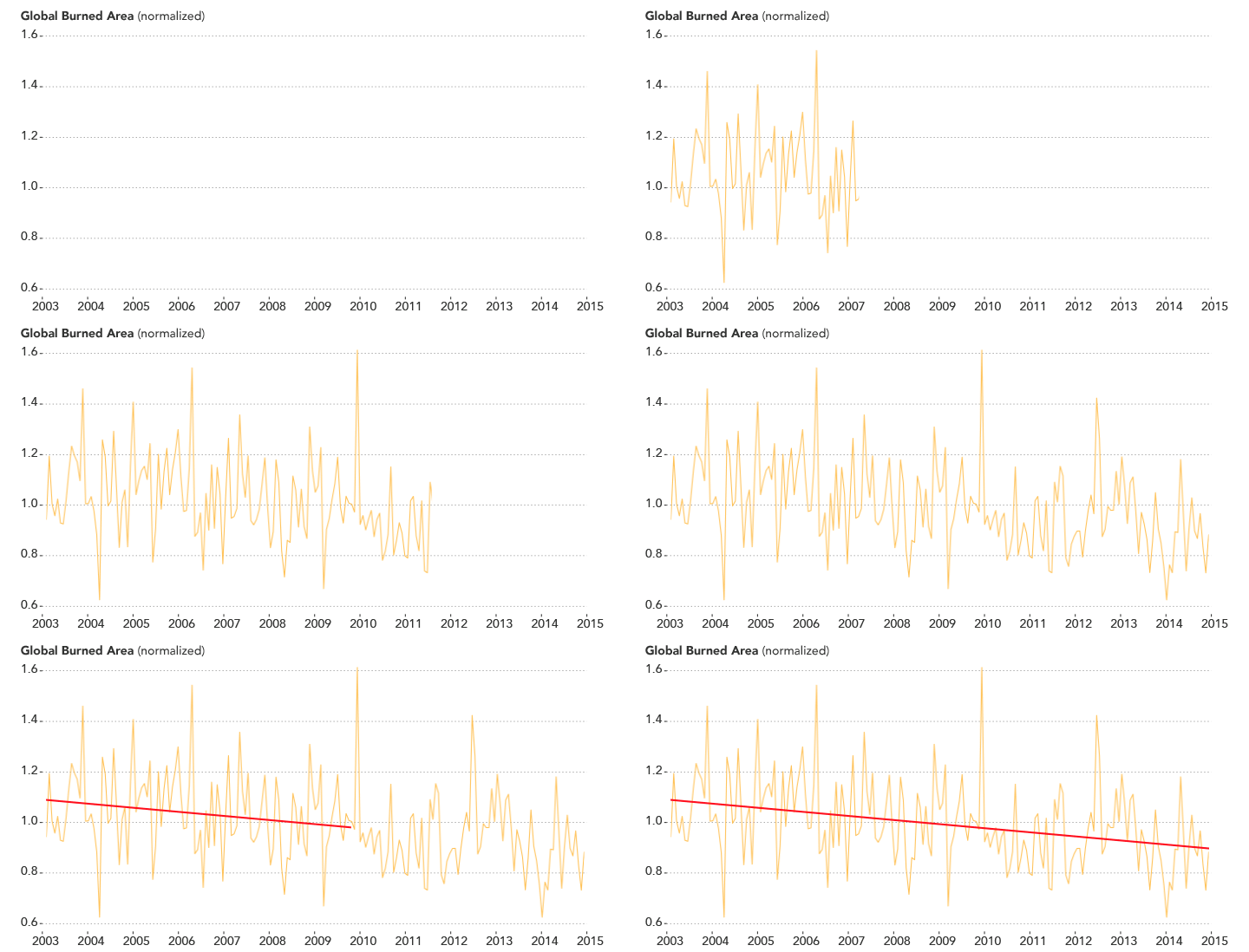
Fires have declined 25% around the world since 2003. True but the data are really patchy and the years you start and stop with hugely impact the conclusion. Here is the NASA data he is referencing. If you pick other start and stop years you get different conclusions. And the data since 2015 are worsening. If you run the data out to 2019 or pick a different start year then that 25% decrease vanishes.
Within the US the opposite trend is happening. 2015 and 2017 were two peak years: https://fas.org/sgp/crs/misc/IF10244.pdf and https://www.carbonbrief.org/factcheck-h ... -wildfires
The amount of land we use for meat — humankind’s biggest use of land — has declined by an area nearly as large as Alaska. Deceptive statistic. The amount of land used for direct grazing in industrial countries is falling because meat production has shifted from rangeland grass grazing to intensive feed-lot production using grains. A lot of the corn produced in the US is used for animal production but isn't counted in these statistics because animals are not directly on the land. Also, a lot of pastoral land in Africa and Asia that was once roamed by migratory herders is now being used for more intensive crop agriculture, or becoming urbanized. So traditional nomadic herders like the Masai in Kenya or herders in Pakistan and China are losing lands to industrial agriculture and urbanization. Very true.
The build-up of wood fuel and more houses near forests, not climate change, explain why there are more, and more dangerous, fires in Australia and California. They are both true. Decades of fire suppression have lead to a big increase in fuel. This is absolutely well known and common dogma. But climate-driven insect infestations have also killed large swaths of forests in the west making them more susceptible to fire as well. The US forest service has concluded that climate-driven bark beetle epidemics that have killed large swaths of forests has increased both the incidence and severity of wildfires. They spark more easily and burn more intensely when forests are filled with dead wood and not green wood: https://www.fs.fed.us/rm/pubs/rmrs_gtr2 ... enkins.pdf
Carbon emissions have been declining in rich nations including Britain, Germany and France since the mid-seventies. Notice he left off the US? Britain, Germany, and France have declined since the 1970s because they all shifted away from coal. It is newly industrialized countries like China and India that are experiencing the fastest growth. But the US has also increased since the mid-1970s. Here is the US graph (it is a dynamic graph so I can't image it here): https://www.statista.com/statistics/183 ... from-1999/
Adapting to life below sea level made the Netherlands rich not poor. The Netherlands lie on granite bedrock which makes it possible to build functional dikes and levies. Florida lies on a porous karst-plane that is essentially a sponge or honeycomb network of porous limestone. It is geologically impossible to use Dutch techniques in Florida and much of the Gulf Coast to hold back rising seas (and most of the warmer coral-based limestone coastlines around much of the world because the sea water will just penetrate underneath. Saltwater intrusion is already happening along much of the gulf coast, destroying coastal aquifers. In any event, the statement is factually wrong. What made the Netherlands rich is four centuries of global trade and empire, not reclaimed wetlands along the coastline. That is like saying that what made Hong Kong rich is that they have reclaimed wetlands along Victoria Harbor. Which is factually true but has nothing to do with Hong Kong's status as an economic power.
We produce 25% more food than we need and food surpluses will continue to rise as the world gets hotter. Famine and hunger are economic and political problems, not science problems. That is not controversial.
Habitat loss and the direct killing of wild animals are bigger threats to species than climate change. True, logging the Amazon and the rain forests in Africa and Asia is killing more species than climate change. Overfishing, pollution, and coastal development (mangrove destruction etc.) is doing the same in the world's oceans. No one would dispute this.
Wood fuel is far worse for people and wildlife than fossil fuels. In terms of particulate matter, yes, wood fuel is far worse than natural gas, but probably about the same as coal, especially coal burned in low-temperature home furnaces and stoves compared to high-temperature modern coal powerplants where it is ground to dust and burned in extreme heat. It is all about the particulate matter resulting from incomplete combustion. Wood stoves have always been a big source of pollution in most western states and have been banned many places, or highly restricted for that reason.
Preventing future pandemics requires more not less “industrial” agriculture. It requires eliminating live wild animal markets in China and other developing countries. Those are a trivial and statistically insignificant source of the world's food supply. I doubt anyone would argue with this.
None of this refutes any of the primary points of the climate change crisis which are that:
1. Global CO2 emissions are rising as are emissions of other greenhouse gasses like methane as a result of human activities.
2. A global rise in greenhouse gases is directly linked to an increase in global temperatures with projections of 2-4 degrees C over this century.
3. That amount of temperature increase will have profound effects on the planet, especially coastal areas and the tropics as well as already warm dry areas like the American southwest. But the effects will be varied and some places may become more productive. Which is one reason I moved my family from Texas to the Pacific Northwest.
Humans are not causing a “sixth mass extinction”: This argument is really a matter of definitions. The mass extinctions typically referenced by geologists were near world-ending events. The Permian extinction wiped out 96% of marine life and over 70% of terrestrial life. It is true, we are nowhere near anything like that. But we are also causing widespread extinctions. Here is a more nuanced article about the subject: https://www.theatlantic.com/science/arc ... ld/529545/
The Amazon is not “the lungs of the world”: True. They produce about 6% of the world's photosynthetic oxygen production but also consume about that same amount so the net effect is close to zero. Oxygen shortage is not the crisis, increased CO2 is. https://www.theatlantic.com/science/arc ... en/596923/
Climate change is not making natural disasters worse: This is a ridiculous statement. Some natural disasters are climate-driven (drought, hurricanes, monsoons) others are not (Tsunamis, earthquakes, volcanoes, etc.). Without a doubt, hurricane intensity has been increasing. Even Trump's science agencies concede this point. Here is a research summary put out by NOAA two weeks ago: https://www.gfdl.noaa.gov/global-warmin ... urricanes/ There is a direct link between sea surface temperatures and hurricane intensity.
Fires have declined 25% around the world since 2003. True but the data are really patchy and the years you start and stop with hugely impact the conclusion. Here is the NASA data he is referencing. If you pick other start and stop years you get different conclusions. And the data since 2015 are worsening. If you run the data out to 2019 or pick a different start year then that 25% decrease vanishes.
Within the US the opposite trend is happening. 2015 and 2017 were two peak years: https://fas.org/sgp/crs/misc/IF10244.pdf and https://www.carbonbrief.org/factcheck-h ... -wildfires
The amount of land we use for meat — humankind’s biggest use of land — has declined by an area nearly as large as Alaska. Deceptive statistic. The amount of land used for direct grazing in industrial countries is falling because meat production has shifted from rangeland grass grazing to intensive feed-lot production using grains. A lot of the corn produced in the US is used for animal production but isn't counted in these statistics because animals are not directly on the land. Also, a lot of pastoral land in Africa and Asia that was once roamed by migratory herders is now being used for more intensive crop agriculture, or becoming urbanized. So traditional nomadic herders like the Masai in Kenya or herders in Pakistan and China are losing lands to industrial agriculture and urbanization. Very true.
The build-up of wood fuel and more houses near forests, not climate change, explain why there are more, and more dangerous, fires in Australia and California. They are both true. Decades of fire suppression have lead to a big increase in fuel. This is absolutely well known and common dogma. But climate-driven insect infestations have also killed large swaths of forests in the west making them more susceptible to fire as well. The US forest service has concluded that climate-driven bark beetle epidemics that have killed large swaths of forests has increased both the incidence and severity of wildfires. They spark more easily and burn more intensely when forests are filled with dead wood and not green wood: https://www.fs.fed.us/rm/pubs/rmrs_gtr2 ... enkins.pdf
Carbon emissions have been declining in rich nations including Britain, Germany and France since the mid-seventies. Notice he left off the US? Britain, Germany, and France have declined since the 1970s because they all shifted away from coal. It is newly industrialized countries like China and India that are experiencing the fastest growth. But the US has also increased since the mid-1970s. Here is the US graph (it is a dynamic graph so I can't image it here): https://www.statista.com/statistics/183 ... from-1999/
Adapting to life below sea level made the Netherlands rich not poor. The Netherlands lie on granite bedrock which makes it possible to build functional dikes and levies. Florida lies on a porous karst-plane that is essentially a sponge or honeycomb network of porous limestone. It is geologically impossible to use Dutch techniques in Florida and much of the Gulf Coast to hold back rising seas (and most of the warmer coral-based limestone coastlines around much of the world because the sea water will just penetrate underneath. Saltwater intrusion is already happening along much of the gulf coast, destroying coastal aquifers. In any event, the statement is factually wrong. What made the Netherlands rich is four centuries of global trade and empire, not reclaimed wetlands along the coastline. That is like saying that what made Hong Kong rich is that they have reclaimed wetlands along Victoria Harbor. Which is factually true but has nothing to do with Hong Kong's status as an economic power.
We produce 25% more food than we need and food surpluses will continue to rise as the world gets hotter. Famine and hunger are economic and political problems, not science problems. That is not controversial.
Habitat loss and the direct killing of wild animals are bigger threats to species than climate change. True, logging the Amazon and the rain forests in Africa and Asia is killing more species than climate change. Overfishing, pollution, and coastal development (mangrove destruction etc.) is doing the same in the world's oceans. No one would dispute this.
Wood fuel is far worse for people and wildlife than fossil fuels. In terms of particulate matter, yes, wood fuel is far worse than natural gas, but probably about the same as coal, especially coal burned in low-temperature home furnaces and stoves compared to high-temperature modern coal powerplants where it is ground to dust and burned in extreme heat. It is all about the particulate matter resulting from incomplete combustion. Wood stoves have always been a big source of pollution in most western states and have been banned many places, or highly restricted for that reason.
Preventing future pandemics requires more not less “industrial” agriculture. It requires eliminating live wild animal markets in China and other developing countries. Those are a trivial and statistically insignificant source of the world's food supply. I doubt anyone would argue with this.
None of this refutes any of the primary points of the climate change crisis which are that:
1. Global CO2 emissions are rising as are emissions of other greenhouse gasses like methane as a result of human activities.
2. A global rise in greenhouse gases is directly linked to an increase in global temperatures with projections of 2-4 degrees C over this century.
3. That amount of temperature increase will have profound effects on the planet, especially coastal areas and the tropics as well as already warm dry areas like the American southwest. But the effects will be varied and some places may become more productive. Which is one reason I moved my family from Texas to the Pacific Northwest.
0 x
A fool can throw out more questions than a wise man can answer. -RZehr

Re: Global Warning/Climate Change
[video][/video]
Experts believe we are about to enter a deep sunshine “recession”, with very low sunspots recorded, and reduced solar activity as part of an 11-year cycle.
Experts believe we are about to enter a deep sunshine “recession”, with very low sunspots recorded, and reduced solar activity as part of an 11-year cycle.
0 x
Try hard not to offend. Try harder not to be offended.
I think I am funnier than I really am.
I think I am funnier than I really am.
-
RZehr
Re: Global Warning/Climate Change
These the same experts who predicted global warming for decades to come, or global cooling 50 years ago?
0 x
-
Josh
Re: Global Warning/Climate Change
I find it interesting that that guy's answer to these problems was more industrialisation, not less. (I personally think more industrialisation, at least on a mass scale, isn't a good thing. Do we really want bigger coal mines, bigger steel mills, and bigger oil refineries?)
0 x
-
Fidelio
- Posts: 620
- Joined: Fri Aug 23, 2019 9:57 pm
- Location: Near Detroit MI
- Affiliation: ACCA Friend
Re: Global Warning/Climate Change
It's a scam, both climate change and Covid.
[video][/video]
[video][/video]
0 x
Convert to Anabaptist truth early 2019; now associated (friend) with the Apostolic Christian Church of America.
