1215 England / The Magna Carta

A place to discuss history and historical events.
temporal1

1215 England / The Magna Carta

Post by temporal1 »

i admit, i haven’t thought much about The Magna Carta since my school days.
but i happened to learn more about it recently, in context of the history of Christianity.

1215 was long before the Reformation days - or the U.S.! :shock:
yet, this document creates a baseline that continues to impact Christianity and secular government.

written in Latin.

Magna Carta / England 1215
https://www.britannica.com/topic/Magna-Carta
Alternative Title: Great Charter

Magna Carta, English Great Charter, charter of English liberties granted by King John on June 15, 1215, under threat of civil war and reissued, with alterations, in 1216, 1217, and 1225. By declaring the sovereign to be subject to the rule of law and documenting the liberties held by “free men,” the Magna Carta provided the foundation for individual rights in Anglo-American jurisprudence. .. ..
Image
“No free man shall be arrested or imprisoned or disseised or outlawed or exiled or in any way victimised, neither will we attack him or send anyone to attack him, except by the lawful judgment of his peers or by the law of the land.”

Indeed, this passage would serve as the foundational expression of the concept of due process in Anglo-American jurisprudence.
In the 17th century, when England’s North American colonies were shaping their own fundamental laws, the words of the Magna Carta were worked into them. The basic rights embodied in the Constitution of the United States of America (1789) and the Bill of Rights (1791) echo the charter, and the Fourteenth Amendment (1868) can trace its ancestry to the Magna Carta as well.

The essential virtue of the Magna Carta, which has made it comparable in historical importance to the Twelve Tables of ancient Rome, lies not in any individual clause or group of clauses but in the solemn circumstances of its first granting and the comprehensive nature of that grant. Thus, the Magna Carta that is commonly remembered is the Magna Carta of King John, and the date that always has been commemorated as its granting is 1215.

That many clauses were omitted from the charter as it finally appeared on the statute rolls and that new ones had been inserted and some original clauses redrafted have made no difference in the collective memory of this venerable document.

Nevertheless, in trying to estimate the influence of the charter on constitutional development in England and elsewhere, it should be borne in mind that, while the drama has never faded from the field of Runnymede, the actual phrases studied by those who fought oppression in 17th-century England or 18th-century America came immediately from the 1217 charter.

There is much evidence that freedom of religion, not freedom from religion, was central.
Prepositions matter.

Conservative and conservative Anabaptist and Christian input is most welcome here.
Please, avoid contemporary political debates.

The British Library
https://www.bl.uk/magna-carta
https://www.bl.uk/magna-carta/articles/ ... troduction

Trailer 5min / The True Christian History of America (in full, 2hr 49min)
0 x
temporal1

Re: 1215 England / The Magna Carta

Post by temporal1 »

Conservative and conservative Anabaptist and Christian input is most welcome here.
Please, avoid contemporary political debates.
0 x
Josh

Re: 1215 England / The Magna Carta

Post by Josh »

temporal1 wrote: ↑Sun May 09, 2021 11:23 am Conservative and conservative Anabaptist and Christian input is most welcome here.
Please, avoid contemporary political debates.
Conservative Anabaptism has precious little to do with either Magna Carta or with English / British political history.
0 x
ohio jones

Re: 1215 England / The Magna Carta

Post by ohio jones »

Josh wrote: ↑Sun May 09, 2021 6:13 pm
temporal1 wrote: ↑Sun May 09, 2021 11:23 am Conservative and conservative Anabaptist and Christian input is most welcome here.
Please, avoid contemporary political debates.
Conservative Anabaptism has precious little to do with either Magna Carta or with English / British political history.
Conservative Anabaptist views on the "True Christian History of America" would be more like this:

0 x
Falco Underhill
Posts: 998
Joined: Sun Mar 28, 2021 12:30 pm
Affiliation: Hermit

Re: 1215 England / The Magna Carta

Post by Falco Underhill »

The rights elaborated by the Magna Charter were not necessarily created by the Magna Charter, they had already been in existence. The king had been abusing them, however, and so the Magna Charter was a way to get the king to stop stepping on them at will.

What's interesting is the unique position of the king in English history and the role that played in helping to create an English commonwealth. In 1066 the French king William the Conqueror became king of England. As a foreign invader taking up residence he didn't want to trust the feudal barons with too much power so he removed the power of justice from the feudal lords. In other words, they couldn't hold court in their local dominions any longer - as they continued to do in France, for example. The English barons were willing to go along with this, and it gave the feudal lords and new rising town and merchant classes a common interest in keeping the king grounded in the rule of law. The committees of barons, which formed a Parliament, would have an interest in representing the lower class interests, too, making them an important player in the body politic. So a like-mindedness developed between the estates, a political friendship developed in unison which gave England its unique character as a commonwealth.

This is also an interesting part of history to me because it's pre-Protestant, way before the Wars of Religion and modern revolutions necessitated separation of Church and State in the modern sense.
0 x
temporal1

Re: 1215 England / The Magna Carta

Post by temporal1 »

ohio jones wrote: ↑Sun May 09, 2021 7:26 pm
Josh wrote: ↑Sun May 09, 2021 6:13 pm
temporal1 wrote: ↑Sun May 09, 2021 11:23 am Conservative and conservative Anabaptist and Christian input is most welcome here.
Please, avoid contemporary political debates.
Conservative Anabaptism has precious little to do with either Magna Carta or with English / British political history.
Conservative Anabaptist views on the "True Christian History of America" would be more like this:
https youtu.be/rmWX

Thank you. i believe i’ve viewed this Bercot video before. A good addition here.

For this topic in History, i’m looking more for the history that led to Protestants and Anabaptists.
There is a lot of background in 1500 years. A lot of thinking, study, translating, questioning, accusations, suffering, violence.

So often history is presented as-if “some defining stand alone moment” happened. When reality is, those memorable moments were more likely culminations of years+years, sometimes hundreds of years, “getting there.”

Another thread delves into this. But the accompanying OP video is lengthy. It would only be viewed by someone with interest.
It covers hundreds of years. Many contributed great effort - before moveable type/the printing press. These accounts amaze me. Men were inspired to seek authentic Truth in the most difficult and dangerous circumstances.

Video: A Lamp in the Dark
viewtopic.php?f=5&t=3138

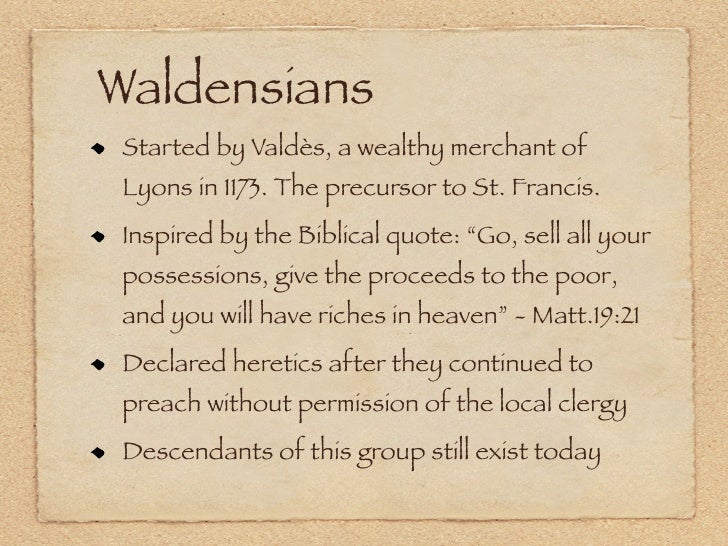
The Waldensians began relatively close to 1215 England. But they were a persecuted fringe group. Did they have any influence on the Magna Carta at all? .. it seems unlikely. but. it’s hard to grasp how information+ideas “get around.” i would not presume zero impact. (evidently, some Waldensians lived in the U.S.? some exist today? i just noticed. this might be another more recent side topic.)
The Waldensians are adherents of a proto-Protestant church tradition that began as an ascetic movement within Western Christianity before the Reformation. Originally known as the "Poor Men of Lyon" in the late twelfth century, the movement spread to the Cottian Alps in what are today France and Italy. Wikipedia

Origin: c. 1173; Lyon, Kingdom of Arles in the Holy Roman Empire (now France)
Founder: Peter Waldo
Region: Italy, France, Germany, Argentina, United States, Uruguay, and elsewhere
Separated from: Catholic Church

Image

Conscientious objector
https://en.wikipedia.org/wiki/Conscientious_objector
.. The first recorded conscientious objector, Maximilianus, was conscripted into the Roman Army in the year 295,
but "told the Proconsul in Numidia that because of his religious convictions he could not serve in the military".
He was executed for this, and was later canonized as Saint Maximilian.[10]


An early recognition of conscientious objection was granted by William the Silent to the Dutch Mennonites in 1575.
They could refuse military service in exchange for a monetary payment.[11]

Formal legislation to exempt objectors from fighting was first granted in mid-18th-century Great Britain following problems with attempting to force Quakers into military service. In 1757, when the first attempt was made to establish a British Militia as a professional national military reserve, a clause in the Militia Ballot Act allowed Quakers exemption from military service.[12]

In the United States, conscientious objection was permitted from the country's founding, although regulation was left to individual states prior to the introduction of conscription.[11] ..
0 x
temporal1

Re: 1215 England / The Magna Carta

Post by temporal1 »

Falco Underhill wrote: ↑Sun May 09, 2021 7:58 pm The rights elaborated by the Magna Charter were not necessarily created by the Magna Charter, they had already been in existence.
The king had been abusing them, however, and so the Magna Charter was a way to get the king to stop stepping on them at will.

What's interesting is the unique position of the king in English history and the role that played in helping to create an English commonwealth.

In 1066 the French king William the Conqueror became king of England.
As a foreign invader taking up residence he didn't want to trust the feudal barons with too much power so he removed the power of justice from the feudal lords. In other words, they couldn't hold court in their local dominions any longer - as they continued to do in France, for example. The English barons were willing to go along with this, and it gave the feudal lords and new rising town and merchant classes a common interest in keeping the king grounded in the rule of law.

The committees of barons, which formed a Parliament, would have an interest in representing the lower class interests, too, making them an important player in the body politic.

So a like-mindedness developed between the estates, a political friendship developed in unison which gave England its unique character as a commonwealth.

This is also an interesting part of history to me because it's pre-Protestant, way before the Wars of Religion and modern revolutions necessitated separation of Church and State in the modern sense.

From what i understand, they were ready to fight, but did not want to, and were successful with the king without violence. (?)
Unlike France. (?)

This history topic is about people and events that eventually led to, or culminated in, Protestants and Anabaptists.
0 x
ohio jones

Re: 1215 England / The Magna Carta

Post by ohio jones »

temporal1 wrote: ↑Wed May 12, 2021 5:05 am The Waldensians began relatively close to 1215 England. But they were a persecuted fringe group. Did they have any influence on the Magna Carta at all? .. it seems unlikely. but. it’s hard to grasp how information+ideas “get around.” i would not presume zero impact. (evidently, some Waldensians lived in the U.S.? some exist today? i just noticed. this might be another more recent side topic.)
For more on the Waldensians, listen to this by John D. Martin.
0 x
Falco Underhill
Posts: 998
Joined: Sun Mar 28, 2021 12:30 pm
Affiliation: Hermit

Re: 1215 England / The Magna Carta

Post by Falco Underhill »

temporal1 wrote: ↑Wed May 12, 2021 5:26 am
From what i understand, they were ready to fight, but did not want to, and were successful with the king without violence. (?)
Unlike France. (?)
Well, France never developed into a commonwealth in the way England did. The feudal lords retained the right to hold trial in their independent domains. The king had no monopoly on legal justice. He was chosen by the barons and his main role was to unite the barrons in case of foreign invasion. Other than that he was rather weak politically and couldn't unite the estates as they were in England. This lack of integration by the three estates proved to be problematic. When the king did become very powerful it was perceived to be at the expense of the third estate. (The people) Since there really was no effective reform mechanism (as in England) when the people finally did assert themselves it had to take the form of a revolution.
This history topic is about people and events that eventually led to, or culminated in, Protestants and Anabaptists.
Not sure what exactly that has to do with Magna Carta. Other than maybe it was indicative of the rise of towns and commerce as a new and formidable power. That brought with it a new ethos of individualism.
0 x
Falco Underhill
Posts: 998
Joined: Sun Mar 28, 2021 12:30 pm
Affiliation: Hermit

Re: 1215 England / The Magna Carta

Post by Falco Underhill »

Addendum: Well, that and the individual rights granted/implied by the Magna Carta. I suppose they were both contributing factors.
0 x
Post Reply